





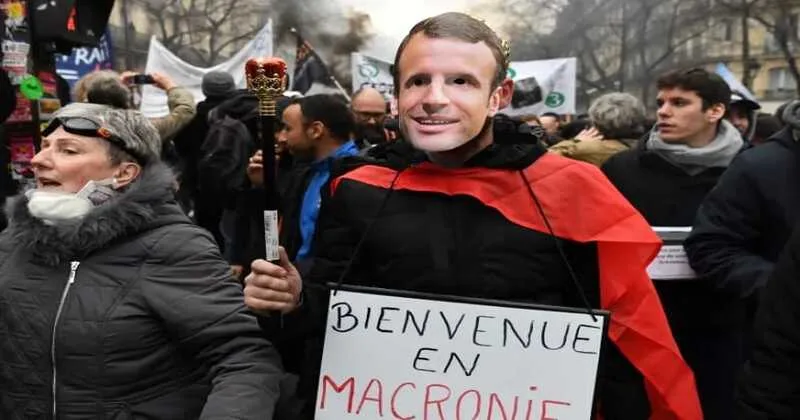
France has been plunged into turmoil after nationwide protests erupted in the wake of Prime Minister Francois Bayrou’s defeat in a parliamentary confidence vote and subsequent resignation. Demonstrators clashed with police, blocked roads, and set fires in Paris and other major cities, as public anger against President Emmanuel Macron and his government intensified.
On Wednesday, thousands of protesters poured onto the streets chanting “Stop everything,” demanding an end to what they describe as unfair austerity measures. In the capital, Paris, barricades were erected, garbage bins were set ablaze, and several vehicles were torched. Police responded with tear gas to disperse the crowds. Authorities confirmed that more than 200 people had been arrested within the first hours of clashes, while 75 people were detained in Paris alone by morning.The number of arrests grew steadily as unrest spread across the country.
The protests, part of the broader “Let’s block everything” movement, were marked by violence and disruption. In Rennes, demonstrators set a bus on fire, while in the southwest, train services were suspended after a power line was damaged. Interior Minister Bruno Rittel accused the protesters of deliberately seeking to destabilise the country, warning that their actions were designed to create “an atmosphere of unrest.” Despite these accusations, protesters vowed to continue until their demands were heard.
In response to the escalating crisis, Macron’s government deployed 80,000 police officers nationwide. Security forces sought to prevent large-scale violence, but their presence failed to stop protesters from setting up barricades, starting fires, and causing traffic chaos. Commuters across France reported severe disruptions, with major roads in Paris gridlocked by burning debris. While the protesters did not fully succeed in their aim of bringing the country to a complete standstill, the impact was nevertheless widespread.
#BREAKING 🚨🔥🇫🇷
Anti Macron protests is getting out of hand in France. There are major Clashes With Police On The Streets Of Paris and Other Major Cities.Protestors are demanding immediate resignation from Macron and general elections.
France must put Le Pen in charge… pic.twitter.com/0iRKxVFvbt
— Frankie™️🦅 (@B7frankH) September 10, 2025
The unrest is rooted in widespread opposition to Bayrou’s austerity programme, unveiled just nine months into his premiership. His economic plan sought to address France’s mounting debt crisis through sweeping cuts. Among the most controversial measures were the elimination of public holidays, a freeze on pensions and welfare payments, and reductions in other social benefits. Unions and citizens’ groups argue that these measures unfairly target low- and middle-income workers while sparing the wealthy.
Bayrou’s resignation, announced shortly after his government’s parliamentary defeat, has done little to calm the anger. Protest organisers and unions insist that the resignation alone does not resolve their grievances. “The government’s failure is good, but it is not enough,” the Sud-Rail union declared in a statement on social media platform Ex.
Macron’s fourth Prime Minister in a year confronts escalating street protests
In a swift move to restore stability, Macron appointed his close ally and loyal defence minister, Sebastien Le Cornouaille, as the new prime minister on Tuesday. Le Cornouaille is the fourth prime minister to take office in just twelve months, underscoring the deep political instability at the heart of the Macron administration. Far from easing tensions, the constant reshuffling has only fuelled criticism that the president is out of touch with the growing frustration in French society.
The “Block Everything” movement, which emerged earlier this year, has rapidly spread through TikTok, Ex, and encrypted messaging channels, drawing support from workers, students, and activists. Its decentralised nature, lacking a formal leadership, makes it unpredictable and difficult for authorities to contain. While some organisers have urged peaceful demonstrations, officials fear that the absence of central coordination could trigger sudden outbreaks of violence.
The movement’s tactics echo those of the “yellow vest” protests that swept France between 2018 and 2019. Then, what began as opposition to a fuel tax hike quickly transformed into a nationwide uprising against Macron’s economic and social policies. Similarly, today’s protests combine traditional street actions with innovative strategies such as bank withdrawals and consumer boycotts of global corporations, including Amazon and Carrefour. These actions are designed to paralyse both the state and private sectors, amplifying pressure on the government.
The protests highlight a growing disconnect between Macron’s economic agenda and public sentiment. The austerity programme disproportionately burdens ordinary citizens while widening existing inequalities. The rapid turnover of prime ministers, combined with the president’s perceived disregard for social discontent, has further eroded confidence in his administration.
For now, the unrest shows no signs of abating. Protesters continue to gather across the country, their anger intensified by the belief that Macron’s government has ignored their concerns for too long. While Bayrou’s resignation has created a political vacuum, the appointment of Le Cornouaille has not reassured demonstrators who see the new leader as merely an extension of Macron’s authority.
As fires burned in Paris and arrests mounted nationwide, the question remains whether Macron’s government can withstand the latest wave of discontent. With the “Block Everything” movement gaining momentum and the political landscape marked by instability, France faces one of its most serious domestic crises since the yellow vest uprising.











Comments