





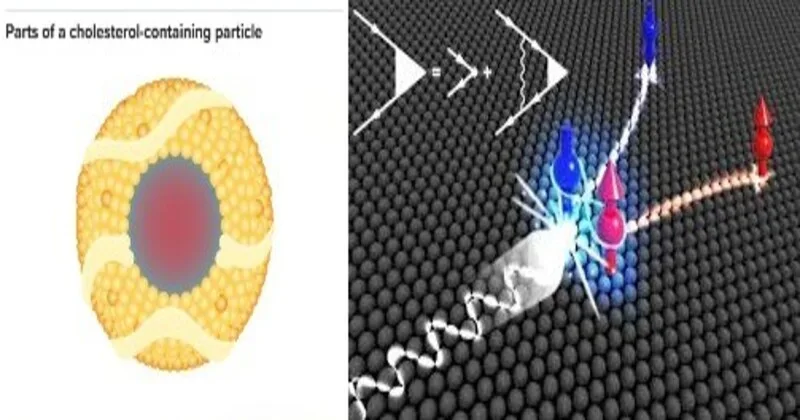
Cholesterol is usually referred as a villain of heart diseases. However, outside of the human system this fat-like molecule has finally made an entry in the field of quantum science. A new development reveals that cholesterol can be utilized to manipulate the spin of electrons, a quantum property that is not seen through eyes. But crucial for the development of next-generation spintronic devices and energy-efficient solutions.
Researchers from the Institute of Nano Science and Technology (INST), Mohali an autonomous institute under the Department of Science and Technology (DST), have presented cholesterol-based nanomaterials as an ideal platform for construction of future quantum technologies based on spintronic materials.
The importance comes from the inherent handedness (chirality) of cholesterol and its molecular flexibility which enable it to be controlled with precision. Based on these characteristics the team of researchers headed by Dr. Amit Kumar Mondal has demonstrated that cholesterol can be mixed with metal ions to produce nanomaterials that can control the spin of electrons a crucial aspect of future electronics.
In their experiments, the researchers showed that the pairing of cholesterol with various metal ions allowed the fabrication of nanomaterials capable of selectively filtering electron spins. Interestingly, both spin directions could be manipulated in the same system. With a minor chemical adjustment or by adding an achiral chemical probe, the transmission of spin information could be adjusted.
The findings of the experiment have been published recently in Chemistry of Materials, will pave the way for a chemical tweak strategy to control spin. It is both powerful and effective technique for enabling spin information to be controlled with great accuracy. It is an important step toward creating biomaterials for advanced quantum and spin technologies.
Spin-based materials can sort molecules with high accuracy, which has direct applications in energy-efficient memory chips, cleaner technology solutions and bioelectronic devices. In an age inclined towards sustainability, such breakthroughs could be instrumental in bringing the energy footprint of computing and data storage down.
Why This Research Matters for India and the World
For India this success signals its rising capability in high-end nanoscience and quantum work. By employing a common biological molecule such as cholesterol, Indian scientists have shown the potential of ordinary chemicals to be used as building blocks for high-technology purposes. This fits into national missions in Aatmanirbhar Bharat, where scientific innovation is regarded as a source of self-reliance in advanced technology.
At a global level this study is in line with the current endeavour of spintronics, a technology that transcends classical electronics. Traditional electronics use electron charge, whereas spintronics employs electrons’ spin orientation, allowing for swifter, compact and less energy-consuming devices. Such innovations could be used in future quantum computers, highly sensitive sensors and environmentally friendly data centers.
What is particularly innovative about this work is its biological nature. Spintronic materials tend to need rare, complex or costly compounds. By demonstrating that cholesterol a ubiquitous natural molecule can be utilized, the INST team opens an environmentally friendly and scalable route for spin-based materials.
The breakthrough of the INST research is in proving dual spin control in a single device a problem that has now constrained spintronics theory. The idea that electron spin orientations can be controlled through simple chemical modification renders the method flexible and versatile.
The innovation may hasten the development of:
· Energy-saving memory chips for lowering digital storage energy requirements.
· Bioelectronic devices that couple natural molecules to electronic devices.
· Greener technologies that lower the dependence on heavy metals and hazardous substances.
Cholesterol unexpected path from a compound having health implications to a quantum material represents the new directions of scientific inquiry. With India going all out in this direction, the research holds hope not just for national development but also for world advancement in green and energy-saving technologies
















Comments