





“All our different sects of Hinduism admit the truth of the celebrated saying of the Shruti, ‘आहारशुद्धौसत्त्वशुद्धिः सत्त्वशुद्धौ ध्रुवा स्मृतिः—When the food is pure, then the inner-sense gets purified; on the purification of the inner-sense, memory (of the soul’s perfection) becomes steady’. Only, according to Shankarâchârya, the word Ahâra means the sense-perceptions, and Râmânuja takes the word to mean food. But what is the solution? All sects agree that both are necessary, and both ought to be taken into account. Without pure food, how can the Indriyas (organs) perform their respective functions properly? Everyone knows by experience that impure food weakens the power of receptivity of the Indriyas or makes them act in opposition to the will”
– Swami Vivekananda, Food and Cooking, Writings: Prose and Poems, The East and The West, The Complete Works of Swami Vivekananda, Volume 5
Ozempic, a drug used for diabetes and weight loss, is facing more than 1800 lawsuits in the US courts. The manufacturer Novo Nordisk also sells brands under the names Wegovy and Rybelsus, initially approved to treat type 2 diabetes, are now facing the costliest drug safety disputes, with over $2 billion in liability. The story related to sleeping pills or child-related products is not very different. Obesity is the other side of the problem that again started in the US society, and now the entire world is grappling with the same. The irony is that, while legal battles have been on, the root cause of the problem – the unhealthy lifestyle and market strategy sold by the American model – is not addressed.
When Prime Minister Narendra Modi addressed the issue of obesity in his Independence Day address, many people were surprised, as they had seen the symptoms but they could not gauge the gravity of the crisis. Overweight and obesity are defined as abnormal or excessive fat accumulation, causing a disastrous impact on health without even realising it. A body mass index (BMI) is a parameter according to which a BMI of 25 is considered overweight, and a BMI of over 30 is considered obese. According to the World Health Organisation (WHO) estimates, from 1990 to 2022, the percentage of children aged 5–19 years living with the disease of obesity increased four-fold from 2 per cent to 8% globally, while the percentage of adults 18 years of age and older has doubled from 7 per cent to 16 per cent. As per the same report, 1 in 8 people in the world is living with obesity, and it is not even considered an illness, unless other side effects are diagnosed.
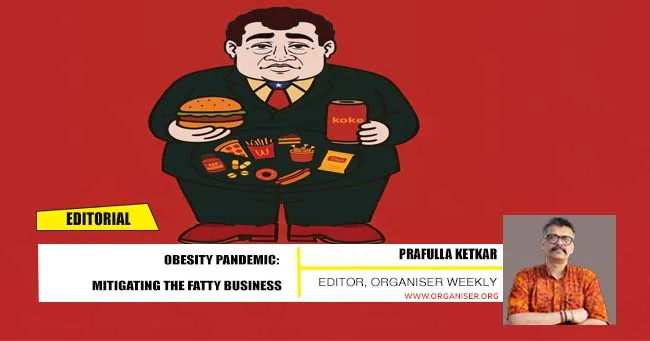
Although numerous factors contribute to this chronic problem, including obesogenic environments, psychological factors, and genetic variants, the core issue is the imbalance between energy intake (diet) and energy expenditure (physical activity). The American lifestyle popularised with the process of market globalisation has normalised unhealthy food habits, such as junk food with unnatural preservatives. The food products that are advertised and sold as cool to the young generation are resulting in multiple health challenges at an early age and unnatural deaths are becoming a new norm. According to a report, deaths from noncommunicable diseases (NCDs) such as cardiovascular diseases, diabetes, cancers, neurological disorders, chronic respiratory diseases, and digestive disorders are higher among obese people. The American giants first sell their food products to amass enormous profits. Then the pharmaceutical giants come up with bio-chemical drugs to earn profits out of health crises and further contribute to an unhealthy society. It is all about profiteering at the cost of human life, which is at the core of the US model of development. The unhealthy sleeping cycle, combined with excessive use of technology, is just a part of it. A society like Bharat with a huge demographic dividend faces more challenges by following the trend mindlessly. Unhealthy food habits and lifestyle not only create a burden on medical services but also hinder the qualitative dimensions of life. Unfortunately, parents themselves promote addiction to soft drinks, burgers, chips, pizzas and consider it as pampering. They realise the mistake only when things go out of hand.
Bharat has a tradition of eating pious and seasonal food grown in the respective geographical surroundings. The body naturally absorbs the required calories from such natural ingredients. Food is not just for taste and filling the stomach, according to the Bharatiya thought, it is also a form of Yajna that has to be performed with utmost sacredness. Shukraneeti 3.220 states, “अति सर्वनाशहेतुर्ह्यतोऽत्यन्तं विवर्जयेत्।” meaning excess is the cause of the ruin. Hence, one should avoid it in any case. Moderation is the key. Therefore, instead of imitating the disastrous and failed model, Bharat can provide an alternative by returning to more scientific and sustainable food practices.















Comments