





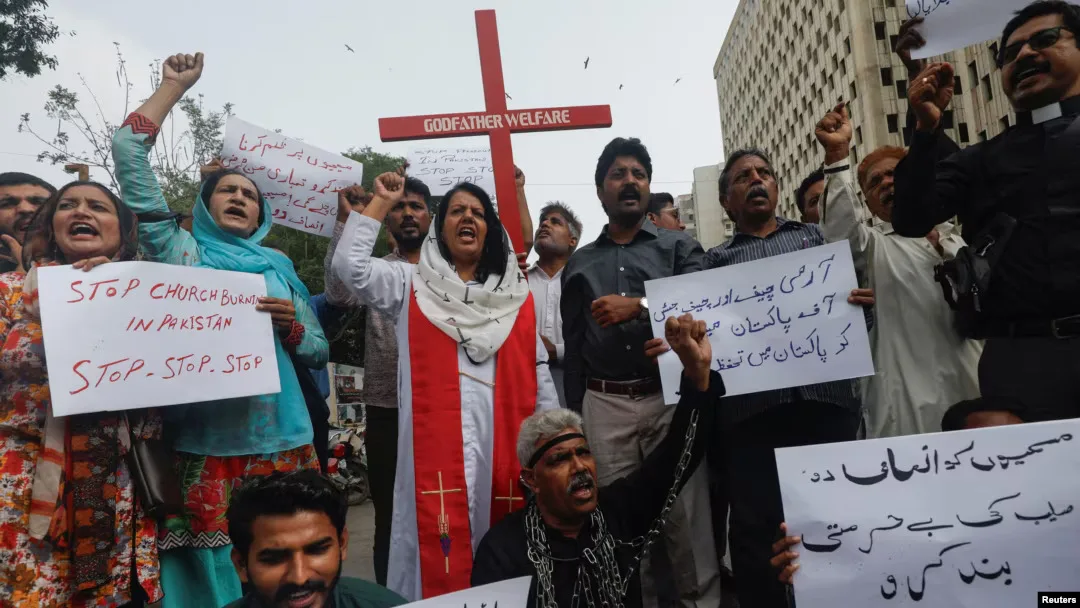
Tensions rose in Lahore district this week after a 21-year-old Christian man, Maan Masih, was taken into police custody under blasphemy allegations. According to the First Information Report (FIR), complainant Shafiq Ahmed accused Maan of tearing down banners inscribed with praises for Prophet Muhammad (PBUH) during street decorations for 12th Rabi-ul-Awwal celebrations.
Eyewitnesses and the victim’s family, however, told the Humanitarian Action for Rights and Development Society (HARDS) that Maan was falsely implicated. They alleged that he was targeted solely because of his Christian identity after a verbal altercation with local residents who were decorating the streets.
“Our son did not desecrate any banner. He is being punished for being Christian in a Muslim-majority neighbourhood,” a relative told HARDS representatives.
The 12th of Rabi-ul-Awwal, also known as Mawlid-un-Nabi or Eid Milad-un-Nabi, is observed as birthday of Prophet Muhammad.
The FIR claims Maan “entered the street and tore down banners,” an act considered deeply offensive by local Muslims. These banners carried inscriptions celebrating the Prophet’s birth. Police arrested him, and he remains in custody as rights groups campaign for his release.
HARDS, which is providing legal assistance, has warned that the case could escalate if authorities do not intervene responsibly.
“Blasphemy allegations in Pakistan often become death sentences outside the court. Even an unproven claim can trigger mob violence,” a HARDS spokesperson said.
Echoes of past violence
The arrest comes just months after one of the most horrific anti-Christian attacks in Pakistan’s recent history. In May 2024, in Sargodha’s Mujahid Colony, a Christian man, Nazir Masih, was lynched by a mob after being accused of desecrating the Quran.
Footage from that incident showed Tehreek-e-Labbaik Pakistan (TLP) extremists storming Nazir’s home, setting his shoe factory ablaze, vandalising a church, and attempting to burn his body after he succumbed to injuries. Several Christian houses were ransacked, and vehicles, including an ambulance and a police van, were torched.
Larger pattern of blasphemy accusations
Blasphemy laws in Pakistan remain a flashpoint for minority persecution. While intended to protect religious sentiments, they are frequently misused to settle personal disputes or target vulnerable communities. Human rights organisations have repeatedly urged Pakistan’s government to introduce safeguards against false accusations.
“Every new case against Christians deepens the climate of fear. The law has become a tool of persecution rather than justice,” said a rights observer.
For now, Maan Masih remains in custody while his legal team prepares to challenge the charges. His family fears retaliation from local extremists, recalling how mobs in past incidents have bypassed the legal system to exact deadly punishments.
Local rights groups have called on the Punjab government to ensure fair investigation, immediate protection for the accused, and safety for his family.
Where are the Indian activists now?
Many so-called rights activists in India frequently project an exaggerated narrative of “minority persecution” at the hands of Hindus, despite the constitutional freedoms and legal safeguards enjoyed by every community in the country, from the right to worship and run institutions, to voicing dissent openly without fear.
Yet, these same activists conveniently fall silent when it comes to the systematic persecution of minorities in Pakistan, where Christians, Hindus, and even minority Muslim sects live under constant threat of mob violence, forced conversions, and blasphemy accusations.
Their selective outrage exposes a glaring hypocrisy, raising their voice against imagined grievances in the world’s largest democracy, while ignoring the brutal reality of neighbouring Islamic republics where minorities are denied even the basic right to live with dignity. This double standard not only undermines genuine human rights advocacy but also emboldens extremist forces that thrive on suppressing vulnerable communities.










Comments