





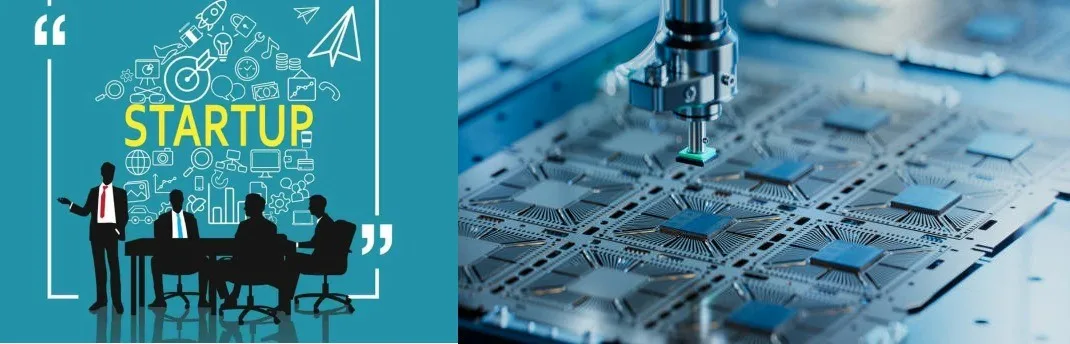
India is at a turning point in its semiconductor tech startups. From relying extensively on imported goods from across the world for the country’s vital electronic components, India is now taking the first steps toward becoming self-reliant or Aatmanirbhar Bharat in semiconductors. This revolution is happening under the Government of India Design Linked Incentive (DLI) Scheme, which is providing thrust to indigenous chip design startups. The Semicon India 2025 conference was a showpiece of this achievement, where Indian startups announced chip design in different fields such as surveillance and networking, energy and motor control. This conference was not only a technology gathering but it’s a confidence show, that India is no longer a consumer of chips made in different countries. This vision is supported by government policy, industry engagement and academic partnerships.
What is DLI Scheme?
The DLI Scheme was initiated in 2021 as a part of the Semicon India Program. While the previous attempts were concentrated on electronics assembly and limited manufacturing. The DLI Scheme focused on the design stage, which is the most value-creating portion of the semiconductor chain. The program offers monetization incentives to indigenous firms working on semiconductor design, exposure to industry-level Electronic Design Automation (EDA) tools, that are too costly for startups. Assistance with the development of Intellectual Property Rights (IPR) that are needed to fuel innovation and competitiveness in the market is also supported. The facilitation of encouraging startups to create System-on-Chip (SoC) solutions for various industries such as telecom, surveillance, power, mobility and networking. 23 chip design projects were approved under the DLI Scheme as of 2025 and 72 companies have been provided with access to state-of-the-art EDA tools. The scheme has opened the doors for the establishment of a robust domestic ecosystem with the ability to compete at a global level.
Building Future on Previous Policy Initiatives
The DLI Scheme did not get approved in a single day. It has been built upon years of policy, initiatives aimed at making India electronics and semiconductor industry stronger. The Electronics Manufacturing Clusters (EMC) scheme offered infrastructure assistance to companies manufacturing electronic items. The Production Linked Incentive (PLI) Scheme promoted mass electronics manufacturing, especially mobile phones and components. The National Policy on Electronics, 2019, had a vision of establishing an electronics manufacturing industry worth USD 400 billion by 2025. Special Manpower Development Programs in chip design and VLSI will establish trained engineers to provide support in semiconductor R&D. The Semiconductor Laboratory (SCL), Mohali has provided indigenous fabrication and packaging facilities to Indian startups. Strategic partnerships with international firms, has facilitated that Indian chip designs moved rapidly from blueprint to factory. Through these combined steps, the foundation was laid for India new path from a low-cost assembly center to one of design strength in the semiconductor sector.
InCore Semiconductors: Reducing Design Time
InCore Semiconductors, founded by the designers of the SHAKTI Processors firm, India first open-source RISC-V processor family. InCore has come up with a System-on-Chip (SoC) Generator Platform that reduces chip design time from months to few minutes, a remarkable advancemnt in chip automation. The company test chip, fabricated on TSMC’s 40nm node, has six heterogeneous RISC-V processor cores, a protocol-bridging Network-on-Chip (NoC) with automatic protocols, several integrated peripherals and a full software stack including a Real Time Operating System (RTOS). InCore’s processor families aim at targeting various segments.
Azurite delivers ultra-low power consumption with rapid interrupt response, suited for motor control, battery-powered devices and real time control.
Calcite balances power and efficiency with performance for mid-tier embedded application use cases such as IoT devices, POS terminals and IP cameras.
Dolomite, currently under development, targets high-performance vector processing and virtualization for edge networking and AI applications. These platform puts India to produce automated chip design, allowing for faster innovation cycles, lower costs and increased global competitiveness.
Advances in Broadband and Networking
Aheesa Digital Innovations, which is set to unveil its Vihaan SoC early in 2026. The chip is developed using the 64-bit C-DAC RISC-V VEGA processor, will be used to drive indigenous broadband and networking hardware. The SoC includes Secure Boot and sophisticated security measures with interfaces such as PCIe 3.0 and USB 3.0 and it will support for general network connectivity specifications. By providing the SoC as well as reference platforms to Original Equipment Manufacturers (OEMs) and Original Design Manufacturers (ODMs), Aheesa will enable Indian manufacturers to create end-to-end broadband solutions with local chips.
Surveillance and Security Systems
The surveillance sector, a field where independence counts significantly. Four Indian start-ups: 3rdiTech, Netrasemi, BigEndian Semiconductors and Mindgrove Technologies are leading the movement. They have tested their chips in 2025 and collectively they have raised ₹300 crore in venture capital, partially under the DLI Scheme. Their total valuation today is over ₹1,000 crore. By 2026, they plan to commercialize production-grade CCTV chips. This transition means India security infrastructure will no longer have to rely on imported chips, which are a strategic vulnerability.
Smart Energy Meters for a Digital Grid
Energy is another area where chips play a crucial role, MosChip Technologies is developing Vidyut which is a completely indigenous smart energy meter chip. The firm has verified IPs like the Power Management Unit, Temperature Sensor, Clock Management Unit and LCD Controller. A prototype was manufactured at 180nm test chip and SCL Mohali packed it. Vidyut will be fully manufactured in India by 2026, fulfilling the dream of self-sufficient power technology.
Motor Control and Space Applications
Vervesemi, a second Indian company looking to achieve indigenous production of motor-control chips by 2026–27. These ICs will find applications in BLDC (Brushless Direct Current) motor control for EVs and UAVs, precision weighing devices and intelligent energy metering. Additionally to the civilian sector, Vervesemi is collaborating with ISRO to develop space-grade data acquisition ASICs (Application-Specific Integrated Circuits). Engineered samples will be delivered by 2025–26, by substituting multiple imported components in Indian space missions. The company interest in both commercial and strategic uses reflects the broad impact of indigenous semiconductor design.
Telecom Sovereignty with MBit Wireless
Telecom autonomy also gained a significant leap with MBit Wireless firm, which has designed a 4G-LTE modem chipset and an entire protocol stack. The chipset has been certified by the Global Certification Forum (GCF) as well as LG Labs. It is in the process of conducting field trials with India top telecom operators. This feat is a big leap towards less foreign dependence on communication technology and providing secure digital infrastructure for India telecom industry.
RISC-V: The Open-Source Advantage
Most of these innovations are (Reduced Instruction Set Computer) RISC-V based, an open-source instruction set architecture designed at UC Berkeley. Its advantages are reduced design costs, innovation freedom in fields such as AI, IoT and supercomputers and a global ecosystem of tools and developers building up around it. Indian businesses by adopting RISC-V are not merely saving money they are becoming part of a worldwide movement towards open hardware innovation.
SoC Generator Platforms: A New Frontier
The System-on-Chip (SoC) Generator Platform is yet another revolutionary technology in chip design. It compresses all of a system’s required components onto one piece of silicon. It accelerates design cycles from years to mere months, achieves better accuracy through verification automation and opens chip design to startups. InCore’s innovation here is of utmost importance, as it provides Indian designers with a powerful competitive advantage in the global semiconductor industry.
Under the visionary leadership of Prime Minister Shri Narendra Modi, India is transforming it image from assembling chips nation to being a full-stack semiconductor country. The firms on display at Semicon India 2025 demonstrates that with adequate support, India can design indigenous chip solutions in various sectors ranging from surveillance and broadband to telecom, energy and even space. This process is more than technology. It is about strategic autonomy, economic development and positions India in a place of global value chain of semiconductors. On the back of the DLI Scheme, India is penning its own chapter in the story of its technological emergence. The message at Semicon India 2025 was loud and clear the world must now see India as a consumer of chips no more, but as a designer and inventor for the world.
















Comments