





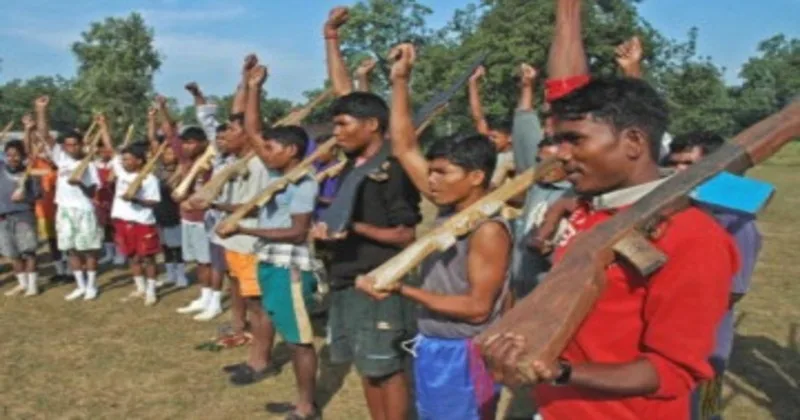
Salwa Judam means ‘Peace March’ in Gondi language of Chhattisgarh. Chhattisgarh became a new state on November 1st, 2000. Chhattisgarh had witnessed very high level of Naxalite violence right from the time it became an independent state in the Union of India. The violence levels were particularly high during the period from year 2001 to 2005. Therefore, the formation of new state brought new challenges related to security as well. Bastar region of Chhattisgarh saw maximum violence. Bastar region comprises of the districts of Bastar, Bijapur, Dantewada, Kanker, Kondagaon, Narayanpur and Sukma.
Dr. Raman Singh became the Chief Minister of Chhattisgarh in December 2003, heralding the first BJP government to power in the state. He remained the CM for the next three consecutive terms till December 2018. During his tenure as the CM, Chhattisgarh witnessed a massive Naxalite violence in the initial period. The state police were ill equipped in the new state and the Naxalites had liberated most of the Bastar region, meaning the writ of the state and district administration did not run here. These areas were governed by the Naxalites.
Under these grave security challenges, Salwa Judam was formed in the state of Chhattisgarh in the year 2005 as the local force to combat the Naxalites. In order to counter the Naxalites who were heavily armed militants, the state police needed local people who knew the area well. Essentially, a ‘Son of Soil’ concept, Salwa Judam was established as a militia force who could supplement police and para military operations against the Naxalites. It was a difficult decision to raise such a militia force but historically these forces have proved to be an asset in India.
The tribal youth from the Bastar region was employed as the Special Police Officers (SPOs). These SPOs formed the core of Salwa Judam. SPOs were given weapon training and they were armed with old vintage rifles. Slowly and steadily, SPOs proved to be useful to the security forces operating in Chhattisgarh. At their peak, the total number of SPOs in Chhattisgarh was above 4000 personnel. Operating under very difficult conditions and putting their lives at risk, these locals provided the security forces much needed fillip in Chhattisgarh.
The concept of SPOs is not new in India. SPOs have been employed in Jammu & Kashmir for a long time and even today are considered backbone of the J&K Police. Besides locals, a large number of local Ex Servicemen have been employed as SPOs in Jammu & Kashmir. During my military career, I also saw the employment of SPOs in Assam and in Manipur. I found that the SPOs were able to augment the local police with better intelligence and their ability to mix with the local population.
While the SPOs proved to be useful for the security forces, critics often raised concerns about the alleged Human Rights Violations by them. Many Human Rights Organisations called them state sponsored mercenaries. During my military career, I saw many armed conflicts where surprisingly, the Human Rights of the terrorists was raised. Very seldom, these Human Rights watchdogs raised their concern about the common public or the security forces. In Chhattisgarh, the security situation was alarming and the security forces had a tough job at hand. Since Naxalites often used the common public as shield during an encounter, the security forces were constrained to use minimum force.
We also saw that the terrorists would kill any person suspected of being informer to the security forces. Even if innocent, many times such kills were attributed to the SPOs. Realistically speaking, some Human Rights violations in such a conflict are inevitable. But the security forces including SPOs are conscious of the Human Rights. In the decade from 2000 to 2015, somehow the Human Rights organisations carried lot of weight with the intelligentsia in India. Most of the times, these organisations were able to subvert the public opinion.
I happened to visit the state of Chhattisgarh in the year 2008 when we got a first-hand account of how SPOs were functioning in the state. The interaction with the local police and para military officials indicated that they were happy with the performance of SPOs. The local administration had also carried out checks and balances to prevent any abuse of power by the SPOs. Surprisingly, both CM Dr. Raman Singh government and the Congress opposition had supported the role of SPOs and Salwa Judam.
To me personally, it was surprising to know that the Hon’ble Supreme Court of India had banned the SPOs in July 2011. The Hon’ble Supreme Court disbanded Salwa Judam and asked the Chhattisgarh government to recover all arms and ammunition issued to the SPOs. Such banning of SPOs was only applicable to the state of Chhattisgarh and did not apply to other states. No doubt that the disbandment of Salwa Judam adversely impacted the fight against Naxalism at that point of time.
In May 2013, the Naxalites ambushed the convoy of the Congress party and killed many prominent leaders. This well coordinated attack took place in the Darbha Valley, 50 km from Jagdalpur. This dastardly attack gave back the moral ascendency to the Naxalites. The security forces suddenly appeared handicapped and they made very slow progress in combating Naxalism at that point of time.
My next visit to the state of Chhattisgarh was in the later part of the year 2015. As part of the National Defence College, New Delhi delegation, I was entrusted to study the state’s fight against Naxalism. Our delegation had two-hour long meeting with Dr. Raman Singh. In my service career, I have not come across a CM who had such a detailed knowledge of the menace of Naxalism. He admitted that the disbandment of Salwa Judam was a setback in the fight against Naxalism. It is to his credit that the BJP government initiated many development initiatives in the Bastar region which eventually weaned away public support to the Naxalites.
Prime Minister Narendra Modi identified Naxalism as the most serious internal security threat right from the year 2014 onwards. A lot of welfare measures were initiated in the state. From the year 2019 onwards, Home Minister Amit Shah has paid special attention to end the menace of Naxalism from India. In the last two years, the fight against Naxalism has now entered a decisive phase, with the aim to end the ongoing violence of the last sixty years by the year 2026.
Under this context, it is not difficult to visualize that India’s fight against Naxalism could have ended this menace much earlier, if all the organs of the state had worked in unison. The fight against Naxalism is similar to Grey Zone Warfare, where there is nothing in black and white. Yes, there has been a delay but now we Indians should be united in support of our warriors’ fight against the Red Terror. Jai Bharat!














Comments