





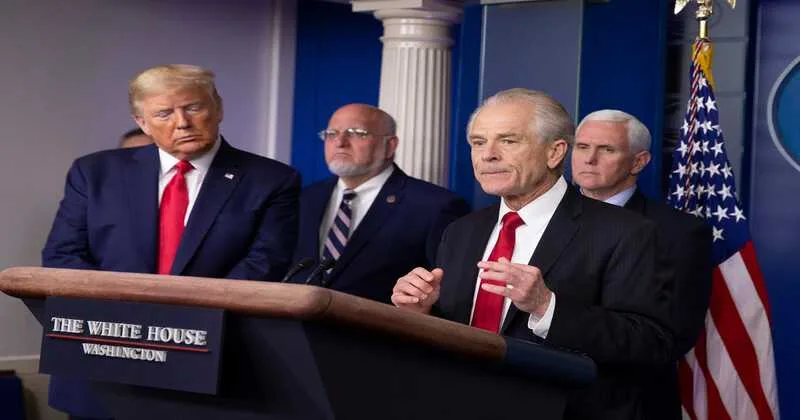
The US administration finds itself in a major dilemma over its policy towards India. Even as President Donald Trump has softened his position and spoken of India as a friend, many of his loyalists continue their attacks. US Commerce Secretary Howard Lutnick recently declared that India should apologize within the next month or two and return to the negotiating table for a trade deal. Trump, however, insists that he views India once again as a partner. This contradiction highlights America’s growing confusion over how to deal with New Delhi.
Lutnick made clear that Washington was always open to dialogue, but he sharply criticized India for its rising purchases of Russian oil. He argued that India made a mistake by deepening its energy ties with Moscow and called upon New Delhi to support the US dollar and withdraw from the BRICS grouping. In other words, despite Trump’s softer tone, pressure on India has not eased. Trump himself has said that he dislikes some of India’s recent actions, especially its Russian oil imports. At the same time, he described Prime Minister Narendra Modi as a ‘great leader’ and stressed that India has not sided with China. According to Trump, the dispute with India would eventually be resolved. His new remarks stand in sharp contrast to his earlier statements, which were far more critical. Importantly, this time he refrained from any direct attack on New Delhi, emphasizing instead his personal friendship with Modi and his determination to smooth over tensions.
In contrast to Trump’s softer tone, Commerce Secretary Howard Lutnick struck a hostile posture, suggesting that India would eventually be compelled to return to negotiations within a month or two, seek reconciliation, and apologize. He indicated that the responsibility for deciding how to handle Prime Minister Narendra Modi ultimately lay with Trump, emphasizing that such authority was vested in the presidency. He pointed out that before the outbreak of the Russia-Ukraine conflict, India bought less than two per cent of its oil from Russia. Today, however, nearly 40 per cent of its oil imports come from Moscow. Lutnick accused India of deliberately shifting its energy dependency and warned that such moves undermine global stability.
The commerce secretary further warned that if India refused to change course, Washington would impose tariffs of up to 50 per cent on its exports to the US. He cited America’s earlier trade disputes with Canada as an example, arguing that retaliatory tariffs hurt smaller economies far more than they hurt the United States. Lutnick warned that India faced the prospect of punitive tariffs of up to 50 per cent unless it aligned more closely with Washington or distanced itself from BRICS. He cautioned that if New Delhi chose to position itself as a bridge between Russia and China, it would have to bear the economic cost of such tariffs, adding that the standoff could persist indefinitely. Underscoring America’s economic clout, Lutnick highlighted that the United States, with its $30 trillion economy and status as the world’s largest consumer, ultimately dictated the terms of global trade, insisting that the consumer always prevails.
Earlier, Trump himself had made immature remarks that seriously affected his relations with New Delhi . He mocked India by wishing a “prosperous future” to India and Russia, whom he claimed had aligned with “the dark side” China. India strongly rejected comments made by one of his advisers against Prime Minister Modi. In the meantime, New Delhi confirmed its participation in the emergency BRICS summit scheduled for Monday.
India Rejects Claims Amid US Policy Confusion
The Ministry of External Affairs (MEA) dismissed as misleading and untrue the claim made by Trump’s adviser Navarro, who had accused Modi of complicity in the Ukraine conflict. Foreign Ministry spokesperson Randhir Jaiswal stressed that India rejects this entirely. Indian officials also opined that no American president in recent memory had issued such disparaging remarks against New Delhi. Trump’s social media posts, which featured a picture of Modi, Chinese President Xi Jinping and Russian President Vladimir Putin together, were viewed in India as a deliberate attempt to portray the three countries as aligned against the West. Trump suggested that all three nations had a long and prosperous future together.
MEA spokesperson Jaiswal declined to escalate the dispute further, saying only that India would not respond in detail to Trump’s latest comments for the time being. New Delhi continues to maintain that its cooperation with the United States should advance on the basis of mutual respect. At the same time, India slammed Navarro’s remarks, calling his claim that the Ukraine war was “Modi’s war” completely unacceptable.
Despite Trump’s conciliatory tone in his most recent remarks, the divide between Washington’s rhetoric and its pressure tactics remains sharp. On one side, Trump stresses his friendship with Modi and his intention to resolve the dispute. On the other, senior officials like Lutnick openly threaten tariffs and demand that India abandon its energy and geopolitical choices. The result is an inconsistent US policy, marked by alternating gestures of goodwill and harsh ultimatums. For New Delhi, the message is clear that while America continues to waver, India is determined not to yield to pressure and will chart its own course in global politics.












Comments