





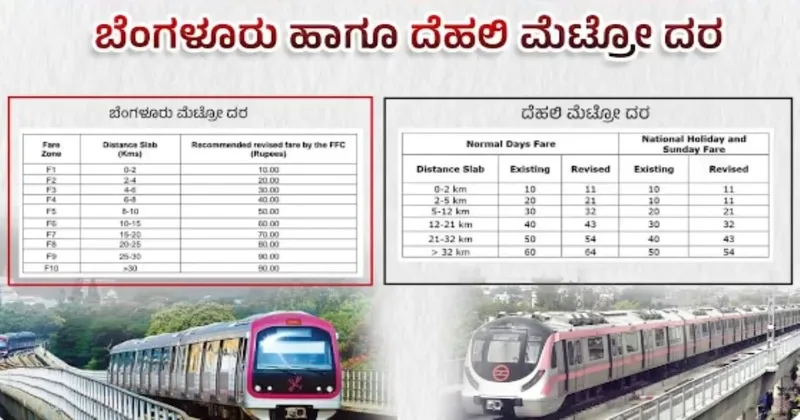
Bengaluru; Once hailed as Bengaluru’s answer to crippling traffic, Namma Metro has now come under sharp criticism for becoming the most expensive metro service in India. With a steep 136 per cent fare hike, public anger is swelling against the Bengaluru Metro Rail Corporation Limited (BMRCL) and the state government, accused of prioritizing revenue over affordability.
Bengaluru South MP Tejasvi Surya has led the charge, demanding an immediate rollback of fares. He pointed out that the Delhi Metro which operates on a far larger scale and carries lakhs more passengers daily raised its fares by a mere Rs 1 to Rs4 in its latest revision. “If fares increase marginally, people accept it, understanding the government’s need for revenue. But in Bengaluru, fares have jumped by Rs 25. Who will tolerate this injustice?” he asked.
The fare hike has dealt a major blow to students, office-goers, and IT-BT sector employees who depend on the metro for their daily commute. A passenger traveling over 25 km from home to work now pays nearly ₹90 for a single trip. For regular commuters, this amounts to a monthly burden running into thousands excluding auto fares, cab rides, or bus charges for first and last-mile connectivity.
“This is not just a fare increase; it is a punishment for choosing public transport,” said Shilpa, a college student from Electronic City who spends over Rs 5,000 a month solely on metro travel.
The irony, critics say, is that while the government publicly encourages citizens to adopt mass transport to reduce congestion and pollution, its fare policy actively discourages it. “Instead of incentivizing the metro, the government has priced it beyond the reach of the common man,” Surya posted on X.
Metro fares vs national benchmarks
A comparison with other cities further highlights the disparity. Delhi Metro’s maximum fare after the hike is still capped at Rs 60, while Namma Metro commuters are forced to shell out Rs 90 for longer routes. In Chennai, Kolkata, and Hyderabad, metro fares remain considerably lower than Bengaluru’s.
“Bengaluru Metro has turned into a rich man’s transport. In no other Indian city does a daily commute cost so much,” noted transport expert Prof. R. Ashwin. “This is not only inequitable but also counterproductive, as people will naturally prefer their two-wheelers or cars instead.”
Adding fuel to the controversy, Tejasvi Surya revealed that he has petitioned the Karnataka High Court against the fare hike. During the hearings, the government submitted an affidavit promising to disclose the Fare Fixing Committee (FFC) report, which is supposed to justify the hike. However, BMRCL has yet to release the report.
The average daily ridership of Bengaluru Metro is 10 lakh, mainly the common public, students and employees from the IT and BT sectors.
When the @OfficialBMRCL increased metro fares, it made Bengaluru Metro the most expensive in the country.
In contrast, @DMRC’s fare hikes have… pic.twitter.com/W9RbIbKyHw
— Tejasvi Surya (@Tejasvi_Surya) September 5, 2025
“The final hearing is scheduled for the 22nd, but the committee’s report remains hidden. What is the government trying to conceal? Public interest must come first,” Surya said.
The lack of transparency has intensified suspicion that the Congress-led government is shielding BMRCL from accountability. Opposition leaders accuse the government of running the metro as a profit-making enterprise rather than as a public service.
The fare hike has quickly snowballed into a political flashpoint. The BJP has accused the Congress government of betraying Bengaluru’s citizens, while civic activists argue that the policy disproportionately hurts middle- and lower-income groups.
“The Congress promised affordable transport for all, but today Namma Metro stands as a symbol of its misplaced priorities. For a government already tainted with corruption allegations, this fare hike has exposed its anti-people character,” charged opposition leader R. Ashok.
Civil society groups have also stepped in, warning that the fare hike could erode public confidence in mass transit altogether. “If Bengaluru Metro becomes unaffordable, it will push lakhs of commuters back to private vehicles, worsening pollution, fuel consumption, and traffic jams,” said urban mobility activist Priya Ramesh.
On the ground, frustration is evident. Commuters at Majestic, Indiranagar, and Yeshwanthpur stations have voiced anger not only at the steep fares but also at overcrowding, delays, and poor first-mile/last-mile connectivity. “We are paying more for less. The government cannot justify this daylight robbery,” complained Rajesh, an IT professional.
Social media, too, has erupted with memes and angry posts comparing Delhi’s affordable metro with Bengaluru’s exorbitant rates. The hashtag













Comments