





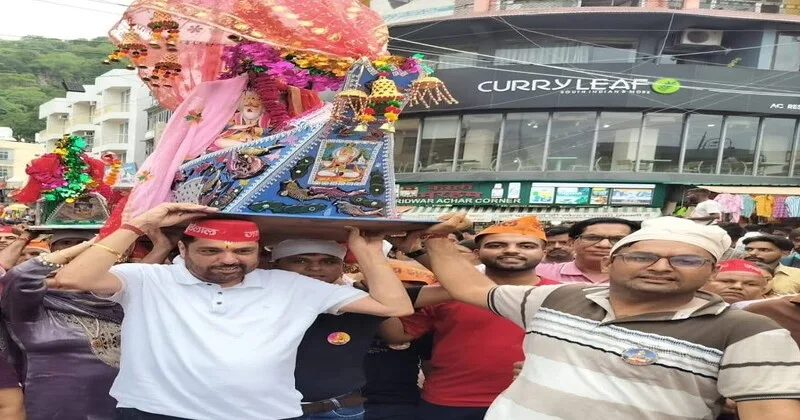
Jhulelal, incarnation of Bhagwan Varuna, revered as the Ishta Dev of Sindhis, emerged as a unifying figure during the medieval period when the community sought protection during the historical crisis such as the attack by foreign invaders and the atrocities by Muslim rulers. Associated with the river deity Varuna – who is prominently mentioned in the Rigveda, he came to symbolize courage, justice, and the safeguarding of dharma. Oral traditions, devotional poetry, and folklore describe him as both saint and savior, appearing in visions to guide his people across turbulent waters. While his worship is most visibly associated with Sindhis, the Siraiki community – especially those hailing from Multan, Bahawalpur, Jhang, and Dera Ghazi Khan – also hold him in deep reverence, therefore, sustaining his worship alongside their own regional traditions. This overlap demonstrates the fluid cultural boundaries of the Sindhu belt, where communities shared not just trade and geography but also devotional practices.
Chaliha Mahotsav
The Chaliha Mahotsav is observed primarily by Sindhis, beginning on the second new moon of the Hindu calendar month of Ashadha and lasting forty days. Devotees undertake vows (mannats) in remembrance of Jhulelal’s protection during historical crises. The period is marked by fasting, abstinence, daily recitation of aarti, and evening gatherings where bhajans recounting the miracles of Jhulelal are sung. The culmination takes place with a grand procession, often carrying the pallav (sacred scarf) and immersing the symbolic representation of Jhulelal in water, signifying his eternal link with the river.
For the Siraiki community, particularly those who migrated from Multan, Bahawalpur, Jhang, and adjoining regions, the rituals of Jhulelal are observed in ways very similar to the Sindhi Chaliha Mahotsav. In places such as Haridwar, Ajmer, and parts of Punjab and Rajasthan, Siraiki families undertake fasting, prayer gatherings, devotional singing, and community feasts, keeping alive the memory of ancestral vows made to the deity. These observances, though marked by regional variations in song and storytelling, carry the same devotional spirit and reinforce Jhulelal as a guardian of faith and identity.
Recently, the Chaliha Mahotsav was celebrated with great fervor across regions where Sindhi and Siraiki communities reside in significant numbers. The Siraiki community, with ancestral roots in the Bahawalpur region, marked the occasion in towns like Rajpura and Patiala in Punjab, where both Sindhis and Siraikis jointly participated. The festivities included shobha yatras, langars, kirtans, and jagrans held in Jhulelal temples and community halls. Each year, a grand shobha yatra gets organized in Haridwar, followed by a langar at Shri Ganesh Bahawalpuri Dharamshala by the Siraikis. The celebrations conclude with the symbolic flowing of the kishti (bedi) into the sacred waters of the Ganga, accompanied by resounding chants of “Aayo Laal, Jhulelal.”
What is remarkable is the convergence, both Sindhi and Siraiki communities come together in their reverence for Jhulelal. Their shared rituals underscore a common devotion, revealing how faith can transcend boundaries and adapt to new geographies while holding on to its essence.
Partition and the Continuity of Worship
The Partition of 1947 was a watershed moment that uprooted millions from their ancestral homes. Sindhis, unlike Punjabis or Bengalis, were not allotted a linguistic homeland within India. Scattered across Bombay, Baroda, Bhopal, Agra, Ayodhya, Lucknow, Raipur, Patna, Ulhasnagar, and beyond it in the regions of South India and Northeast India. They relied heavily on their spiritual and cultural institutions to recreate community bonds. Jhulelal’s worship thus became central to reconstituting Sindhi identity.
Similarly, Siraiki migrants from south Punjab (now in Pakistan) carried the worship of Jhulelal to their new settlements in India. For them – communal prayers, fasting, and devotional singing became vital sources of collective strength. The continuity of these practices allowed displaced families to navigate the trauma of Partition while keeping alive the memory of their roots in Multan, Bahawalpur and adjoining regions.
The Partition context explains why Jhulelal holds not just spiritual but existential significance. For these communities, he is remembered as a guardian of continuity, a deity who traveled with them across borders and anchored them amidst dislocation.
Diaspora and Global Resonance
Falzon in “Cosmopolitan Connections: The Sindhi Diaspora” states that the relevance of Jhulelal worship is not confined to India alone. Across the Sindhi diaspora—in Dubai, Hong Kong, London, and New Jersey—the Cheti Chand (Jhulelal’s birth anniversary) and Chaliha Mahotsav are celebrated with equal fervor. Temples such as the Sindhi Sabha in Singapore and community halls in California have replicated rituals, ensuring that younger generations raised far from the Sindhu river still know of the deity who safeguarded their people.
Siraiki migrants, also sustain the worship of Jhulelal within their community networks in India and abroad. In diaspora hubs, they join Sindhis in celebrating festivals such as Chaliha Mahotsav and Cheti Chand, ensuring that their younger generations remain connected with ancestral traditions. This global resonance shows how devotional practices transform into markers of identity and pride, allowing communities to remain rooted while being mobile.
Why It Matters Now
In contemporary times, festivals such as the Chaliha Mahotsav serve more than devotional purposes. They provide a space for inter-community solidarity, bringing together Sindhi and Siraiki subgroups – Multani, Bahawalpuri, Jhangi, Derewali – under one symbolic canopy. These rituals act as cultural glue, reminding participants of their shared Sindhu heritage even as they negotiate modern identities in urban India.
They also address a crucial generational question: how do younger members of these communities connect with a past that feels remote? By partaking in these festivals, young Sindhis and Siraikis find not only a spiritual anchor but also a historical consciousness. As cultural theorist Homi Bhabha (1994) suggests, identities in diaspora survive through “continuity in hybridity”—they change form, yet retain their essence.
At a time when communities across the globe face cultural dilution under the forces of globalization, the worship of Jhulelal demonstrates how tradition can be a source of strength and resilience. It becomes an act of self-assertion: by celebrating Jhulelal together, Sindhis and Siraikis affirm not only their faith but also their rightful place in the plural fabric of India. The shared faith in Bhagwan Jhulelal among Sindhi and Siraiki communities mirrors Prime Minister Shri Narendra Modi’s call to stay rooted in one’s culture. Celebrated through Chaliha Mahotsav, Jhulelal serves as a spiritual anchor, showing how heritage is a living force that binds people together—just as the PM stresses “Vikas bhi, Virasat bhi”, progress must go hand in hand with cultural continuity.










Comments