





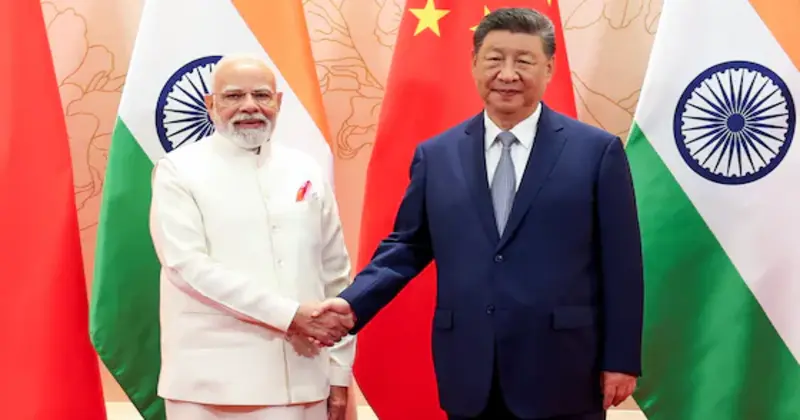
The most significant outcome of the Tianjin SCO Summit held on August 31 and September 1, has to be resetting of Indo-China relationship. Indo-China relationship went through a rough patch after the Galwan clashes in June 2020. It was only in the later part of the last year that the border dispute in Eastern Ladakh witnessed disengagement of troops on both sides in a phased manner.
During the meeting with Prime Minister Modi, Chinese President Xi Jinping said that it is the ‘right choice’ for the two countries to be friends. He further added that India and China are cooperation partners, not rivals and the two countries are each other’s development opportunities rather than threats. Prime Minister Narendra Modi in his statement said that the welfare of 2.8 billion people is linked to the cooperation between India and China.
A number of Confidence Building Measures (CBMs) like resumption of direct flights between India and China and Kailash Mansarovar Yatra was also announced. The border talks also continue between the Special Representatives of the both sides. Prime Minister Modi and President Jinping vowed to work towards a “fair, reasonable and mutually acceptable” resolution of the festering boundary issue and pledged to work towards stabilizing the global trade.
But the most important outcome from Indian perspective came in the form of official declaration from the Tianjin Summit. The SCO Summit strongly condemned the Pahalgam terror attack of April 22, and concurred with India’s position that “double standards” in the fight against terrorism are unacceptable. The declaration mentioned ways to enhance regional security and identified combating terrorism as a major challenge.
The inclusion of Pahalgam terror attack in the official declaration of the SCO Summit is a major diplomatic victory of India. During the SCO Defence Ministers’ Meeting in China from June 25-26, there was no unanimity to include Pahalgam terror attack in the official statement. Thus, no official statement was issued then. Thus, Indian diplomacy and PM Modi worked behind the scenes in the last two months to ensure that the SCO realigns itself to combating terror as its main agenda.
It is not difficult to imagine that making China agree to the Indian viewpoint comes at the cost of Pakistan. For China, it must have been difficult to ignore the protests of Pakistan towards Pahalgam terror attack. In fact, India achieved complete capitulation of Pakistan’s military with less than 50 precision missile attacks.
China has also learnt from its experience in Eastern Ladakh that India is a mighty military power. In the last five years, India has maintained both military and moral ascendency over China in Eastern Ladakh. Indian troops have withstood the extreme cold conditions and have dominated the heights of Eastern Ladakh throughout the year. In the meantime, India has also developed high quality infrastructure on the LAC.
All these developments have made China realize that a military conflict with India is only to their disadvantage. China has helped Pakistan militarily and almost 80% of Pakistan’s military hardware is of Chinese origin. China is also invested heavily into Pakistan through its ‘Belt and Road Initiative’. But China understands it very well that it can no longer use Pakistan as a pawn against India. China would have realized that Pakistan is becoming more of a liability and thus this reset of ties with India. Trump’s tariffs may have acted as catalyst to accelerate the revival of friendship between India and China.
Many analysts have suggested caution while improving India’s relationship with China. Rightly so, based on our past experience with China. But the global geopolitics has undergone so much change that even a bitter past may not show the path to the future. In today’s transactional world, the economics hold the key in maintaining relationships in the long run. But our diplomacy and our planners must decide on short term goals to test the relationship with China.
In this regard, I would suggest goals to improve relationship with China and further the trust factor. Our goals should be time bound and could initially be for one year at a time. For example, we can set the year of 2026 to return to status quo ante to that of 2020 in Eastern Ladakh. In the next one year, we can also look at reducing the trade deficit with China by 10%. Most importantly, we can monitor how China arms Pakistan and how it controls Pakistan as a sponsor of terrorism.
The best way to describe our resetting of ties with China is to think this as an insurance policy against unstable Pakistan. We take insurance policy for one year at a time to compensate for theft, injury, death, damage, accident etc. Our relationship with China should factor similar insurance clause against Pakistan. If Pakistan keeps quiet and does not sponsor terrorism against India for the next one year, then India should renew the insurance policy with China for another year. That is one sure way of controlling Pakistan by strengthening relationship with China in a phased manner.













Comments