





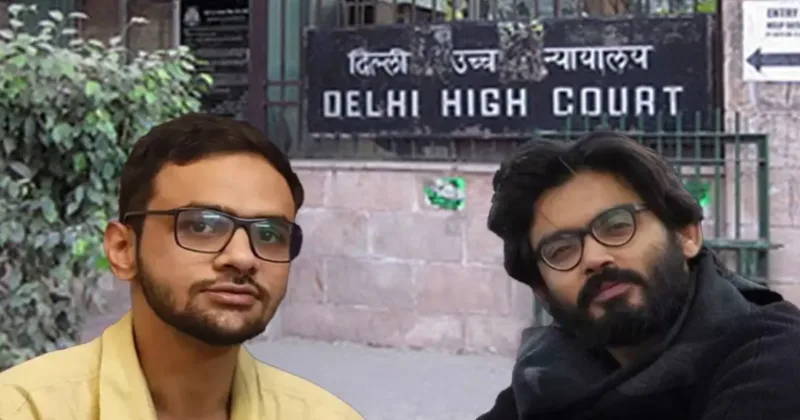
On September 2, the Delhi High Court dismissed the bail applications of nine accused in the Delhi Riots 2020 case. The list includes prominent names such as former JNU students Umar Khalid and Sharjeel Imam, along with Athar Khan, Khalid Saifi, Mohd. Saleem Khan, Shifa-ur-Rehman, Meeran Haider, Gulfisha Fatima, and Shadab Ahmed.
The appellants had primarily relied on the plea of parity, arguing that since co-accused Devangana Kalita, Natasha Narwal, and Asif Iqbal Tanha had already been granted bail, they too should be enlarged on the same grounds.
However, the Court held that this argument was untenable, both legally and factually.
The plea of parity in bail jurisprudence is based on fairness and consistency, if co-accused similarly placed are released on bail, others in the same footing should be treated alike.
But the High Court observed that parity is not automatic. It requires a detailed comparison of the specific role attributed to each accused. In this case, the Bench made it clear that the appellant’s roles were distinct and “graver,” involving speeches, mobilisation, fundraising, and organisational responsibilities that set them apart from Kalita, Narwal, and Tanha.
Crucially, the Court also relied on the Supreme Court’s restraint order dated June 18, 2021 (later made final on May 2, 2023), which directed that the earlier Delhi High Court bail orders in favour of Kalita, Narwal and Tanha “shall not be treated as precedent and may not be relied upon by any party.”
Counsel for Umar Khalid argued three grounds:
Bail precedents of Kalita, Narwal, and Tanha.
Supreme Court’s Vernon ruling.
His prolonged incarceration of more than five years.
The Court dismissed all three. It observed that unlike Narwal or Kalita, Khalid was accused of delivering inflammatory speeches on communal lines, prima facie instigating mass mobilisation. His role, therefore, was not comparable but “distinct and graver.”
On the Vernon ruling, the Court said it did not alter the balance of allegations. On delay, the Bench noted that the voluminous chargesheet, over 30,000 pages of evidence and multiple supplementary chargesheets justified the slow pace of trial, adding that a “hurried trial would also be detrimental to both the appellants and the State.”
Sharjeel Imam too placed heavy reliance on parity, stressing that his name was not in the FIR linked to the riots. But the Court found that Imam, like Khalid, had delivered speeches that were communal and provocative, amounting to a grave role in the conspiracy.
On the issue of prolonged arresting, the Court reiterated its earlier reasoning, the magnitude of the conspiracy justified the time taken.
For the remaining accused, similar parity claims were advanced. However, the prosecution detailed how each appellant’s role was qualitatively different from those already bailed.
For instance, Gulfisha Fatima was accused of creating WhatsApp groups to mobilise women and collecting money from co-accused Tahir Hussain to sustain protest sites. The Court noted that such active mobilisation and fundraising placed her role beyond that of Narwal or Kalita, despite all being part of Pinjra Tod.
Athar Khan, Khalid Saifi, Shifa-ur-Rehman, Meeran Haider, Mohd. Saleem Khan, and Shadab Ahmed were also said to have engaged in organising funds, meetings, or networks, elements the Bench described as “graver participation in the alleged conspiracy.”
The Delhi High Court ultimately rejected all nine bail pleas. It emphasised two decisive reasons:
Supreme Court’s Orders: Earlier bail orders of Kalita, Narwal, and Tanha cannot serve as precedent in any case.
Distinct and Graver Roles: The appellants were alleged to have played larger roles in conspiracy through speeches, mobilisation, or fundraising, going beyond those already granted bail.
In its categorical ruling, the Court said: “Merely because co-accused persons have been granted bail would not, by itself, entitle the other accused to bail. The role of each appellant must be tested individually, and in the present case, the plea of parity is not made out.”
For now, the nine accused, including Khalid, Imam, and Fatima, will continue to remain in custody as the trial moves forward in one of the most closely watched conspiracy cases linked to the Delhi Riots of 2020.














Comments