





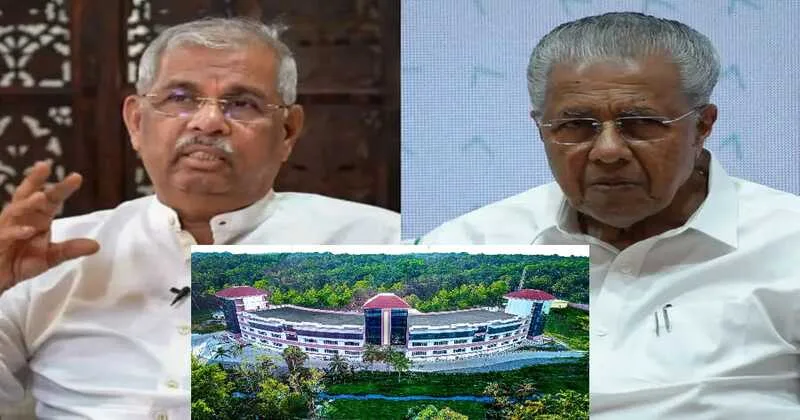
Kerala Governor Rajendra Arlekar has recommended a CBI investigation and a Comptroller and Auditor General (CAG) audit following the discovery of large-scale financial fraud in research projects at the Digital University. The allegations surfaced in a report submitted by former Vice Chancellor Sisa Thomas, which reveals that officials of the Digital University, where Chief Minister Pinarayi Vijayan serves as Pro Chancellor, executed multi-crore research projects through shell companies formed after receiving project funds.
According to the report, these companies were established only after the funds were sanctioned. Investigators found that some companies did not exist at their registered addresses. Notably, one such company was led by the chairman of the inquiry commission that cleared Chief Minister Vijayan in the controversial Sprinklr deal.
The Rs 94.85 crore fund for the graphene research and development project, jointly provided by the Union Electronics Ministry and the state government, was initially allocated to a company called India Graphene Engineering and Innovation Centre (IGEIC). Later, a rectification order appointed Kerala Digital University as the implementing agency. However, the investigation revealed that IGEIC was registered only after the central funds were allocated. Moreover, the company had no presence at its registered address on Ambuja Vilasam Road near the Ayurveda College in Thiruvananthapuram. Shortly after this finding, the address was removed from the company’s website.
The report highlights that the structure of IGEIC lacked transparency and that it operated within the Digital University building without obtaining permission or paying rent. Further, there was no proper auditing of the financial utilization of multiple projects. The bills worth Rs 3.94 crore submitted for financial utilization included expenses on food, air travel across Indian cities, and trips to Singapore and the United States, along with accommodation costs.
Although Sisa Thomas had formally requested a CAG audit citing these irregularities, the proposal was never forwarded to the CAG. Following this inaction, the report was submitted directly to the Governor. While serving as interim Vice Chancellor, Thomas conducted a detailed inquiry into the university’s operations and documented widespread misuse of government funds. The report noted that crores of rupees were being handled without the presence of a finance officer. It also exposed ambiguity surrounding the registration of the company tasked with implementing the graphene project.
Key concerns flagged in the report include a lack of transparency in company formation, inconsistencies in the company’s registered address, unclear project implementation processes, and irregular financial practices.
Further scrutiny revealed that two of IGEIC’s founders had direct links to the Digital University. The company was established by M. Madhavan Nambiar and Professor Alex James, both of whom serve as board members of IITMK, the university’s sponsoring agency. Nambiar, a former Union Civil Aviation Secretary, also chaired the inquiry commission that cleared the Chief Minister in the Sprinklr corruption allegations. Alex James, another founder, is a faculty member at the university. The company lists four directors, including these two individuals.
This overlap raises serious conflict-of-interest concerns, as those holding influential roles within the university were simultaneously associated with a private company engaged in implementing a state-funded project. The lack of disclosure of these dual roles adds to the gravity of the allegations.
Governor Arlekar’s recommendation for a CBI probe and a CAG audit signals a significant escalation in the controversy, which involves questions of governance, transparency, and financial accountability in state-funded research projects.














Comments