Fostering India-Japan Strategic Partnership
December 5, 2025
  • Read Ecopy
  • Circulation
  • Advertise
  • Careers
  • About Us
  • Contact Us
Android AppiPhone AppArattai
Organiser
  • ‌
  • Bharat
    • Assam
    • Bihar
    • Chhattisgarh
    • Jharkhand
    • Maharashtra
    • View All States
  • World
    • Asia
    • Europe
    • North America
    • South America
    • Africa
    • Australia
  • Editorial
  • International
  • Opinion
  • RSS @ 100
  • More
    • Op Sindoor
    • Analysis
    • Sports
    • Defence
    • Politics
    • Business
    • Economy
    • Culture
    • Special Report
    • Sci & Tech
    • Entertainment
    • G20
    • Azadi Ka Amrit Mahotsav
    • Vocal4Local
    • Web Stories
    • Education
    • Employment
    • Books
    • Interviews
    • Travel
    • Law
    • Health
    • Obituary
  • Subscribe
    • Subscribe Print Edition
    • Subscribe Ecopy
    • Read Ecopy
  • ‌
  • Bharat
    • Assam
    • Bihar
    • Chhattisgarh
    • Jharkhand
    • Maharashtra
    • View All States
  • World
    • Asia
    • Europe
    • North America
    • South America
    • Africa
    • Australia
  • Editorial
  • International
  • Opinion
  • RSS @ 100
  • More
    • Op Sindoor
    • Analysis
    • Sports
    • Defence
    • Politics
    • Business
    • Economy
    • Culture
    • Special Report
    • Sci & Tech
    • Entertainment
    • G20
    • Azadi Ka Amrit Mahotsav
    • Vocal4Local
    • Web Stories
    • Education
    • Employment
    • Books
    • Interviews
    • Travel
    • Law
    • Health
    • Obituary
  • Subscribe
    • Subscribe Print Edition
    • Subscribe Ecopy
    • Read Ecopy
Organiser
  • Home
  • Bharat
  • World
  • Operation Sindoor
  • Editorial
  • Analysis
  • Opinion
  • Culture
  • Defence
  • International Edition
  • RSS @ 100
  • Magazine
  • Read Ecopy
Home World

Can India and Japan lead a new Indo-Pacific order?

There is widespread enthusiasm among business leaders in Japan for deeper cooperation with India in the coming years. In this context, Prime Minister Ishiba, while inaugurating the ninth Tokyo International Conference on African Development (TICAD 9), announced Japan’s intent to work with the Indian Ocean-Africa region to promote economic development and maintain a free and open Indo-Pacific — where India would play a pivotal role. The trilateral cooperation between India, Japan and Africa, an idea championed since 2016, is now evolving into a concrete government policy.

Ameya KulkarniAmeya Kulkarni
Sep 3, 2025, 06:00 pm IST
in World, India, Opinion, Asia, Business
Follow on Google News
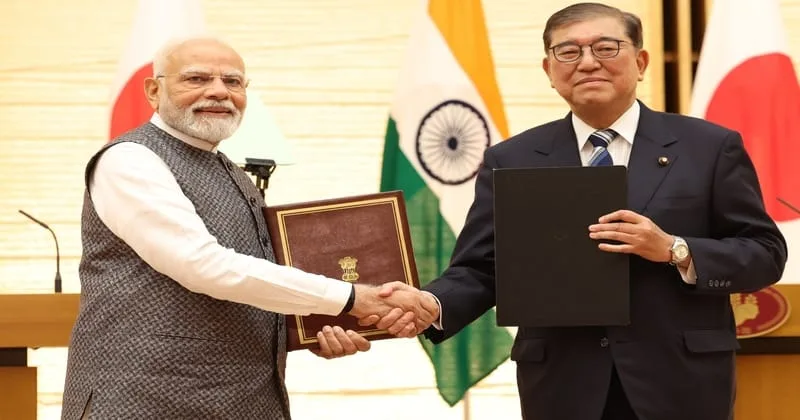
Prime Minister Narendra Modi and Japan's Prime Minister Shigeru Ishiba

Prime Minister Narendra Modi and Japan's Prime Minister Shigeru Ishiba

FacebookTwitterWhatsAppTelegramEmail

Prime Minister Narendra Modi’s eighth visit to Japan for the annual summit is significant. This is his first such summit with Prime Minister Ishiba Shigeru, though the two have met on the sidelines of the East Asia Summit (EAS) and the G7. Ishiba currently faces a political deficit, having lost the majority in both the lower and, more recently, the upper houses of the Japanese parliament. Yet, efforts to oust him from the leadership of the ruling Liberal Democratic Party (LDP) remain muted, perhaps because few wish to shoulder the burden of managing a turbulent relationship with a rampaging US administration.

For India and Japan, both Quad partners, this summit provides an opportunity to assess the regional situation and the future of the Quad, as well as their respective engagement with the US, which is discomfiting for both. They reiterated their commitment to continue the Quad arrangement, but in the absence of a clear signal from the US, the next Quad summit remains uncertain. It may, therefore, be timely for India, Japan, and Australia to convene their own summit, perhaps on the sidelines of the upcoming EAS in Malaysia this October, to reaffirm their shared commitments.

Economically, both India and Japan remain targeted by US tariffs and related measures. Despite having reached certain agreements, Japan continues to tread cautiously, while India is showing greater resolve in the face of tariffs, sanctions, and the absence of a comprehensive trade deal. In this context, the need for closer India-Japan cooperation has never been more urgent, and this was clearly reflected in the visit.

Economic collaboration, traditionally in the critical minerals as well as in new and emerging technologies. They also issued an Economic Security Fact Sheet as an illustrative list of suggested cooperation. Main pillar of the India-Japan partnership, is reinforced with efforts to boost bilateral trade beyond the current level of $23 billion to offset potential losses in the US market. Indian imports are about $18 billion and exports $5 billion. Japan announced a decision to double its investment in India: The earlier target of JPY 5 trillion set in 2022 will now rise to JPY 10 trillion by 2035. This major boost instills confidence and ensures continuity in Japanese investment decisions. This will likely augment trade. India and Japan launched the Economic Security Initiative to promote supply chain resilience in strategic sectors such as semiconductors, critical minerals as well as new and emerging technologies.

Of particular significance is the growing depth and diversity of Japanese investment in India, spanning these sectors. For instance, while Japan remains cautious about EV adoption domestically, Maruti Suzuki recently inaugurated an EV plant in India in the presence of Modi. These new investment plans are expected to bring more Japanese businesses and visitors to India.

Amid global economic uncertainty, India offers Japanese companies a rare flicker of hope.  There is widespread enthusiasm among business leaders for deeper cooperation with India in the coming years. In this context, Ishiba, while inaugurating the ninth Tokyo International Conference on African Development (TICAD 9) in Yokohama on August 20, announced Japan’s intent to work with the Indian Ocean-Africa region to promote economic development and maintain a free and open Indo-Pacific — where India would play a pivotal role. The trilateral cooperation between India, Japan, and Africa, an idea championed since 2016, is now evolving into a concrete government policy.

Japan’s approach toward Africa is not to increase ODA but to support Japanese companies in expanding trade, investment, and supply chains for critical minerals, possibly working in partnership with Indian companies. Under this emerging framework, African countries could supply critical minerals for beneficiation and initial investment, after which they would be sent to India for processing. The processed materials could then support Japanese industries in semiconductors, climate-friendly technologies, defence electronics, and space. This would help build resilient supply chains, reducing dependence on China. While this concept has received government endorsement and was included in the India-Japan communiqué, the responsibility now lies with the business communities to operationalise it. A supportive MoU to advance cooperation in supply chain resilience for critical minerals, including through the development of processing technologies, joint investments for exploration and mining and efforts for stockpiling critical minerals, was agreed upon.

Also Read: Obama’s white house dinner jibe set Trump on path to power and an obsession with the Nobel peace prize

The long-pending bullet train project is also showing signs of renewed coherence between Indian and Japanese stakeholders. Instead of supplying technology from the date of the original agreement, Japan is now prepared to provide the latest E10 Shinkansen coaches as they are introduced domestically. Should the bullet train commence operations earlier, it will initially use the E5 or Indian-made coaches, a move that could pave the way for an expanded network of fast trains in India based on Japanese models, though not necessarily as full Shinkansen lines. These are envisaged in the mobility partnership.

Defence and strategic cooperation have yielded tangible results during this visit. The Unicorn antennas earlier agreed upon are reportedly ready and will soon be provided to India. Negotiations are also underway for joint R&D and production in India, particularly in defence electronics. Naval cooperation is likely to deepen as Japanese companies gain confidence in supplying armaments, potentially including warship collaboration, as Japan recently initiated with Australia for six vessels.

While Japan is prepared to collaborate with India across the Indian Ocean and in Africa, its willingness to work jointly in ASEAN remains limited. Extending similar efforts to ASEAN, through partnerships with Indian companies, could unlock new supply chains, expand India’s economic footprint and elevate regional trade relations.

Topics: India-Japan strategic PartnershipEconomic CollaborationJapan Prime Minister Shigeru IshibaIndiaIndo-PacificPrime Minister Narendra ModiJapan
ShareTweetSendShareSend
✮ Subscribe Organiser YouTube Channel. ✮
✮ Join Organiser's WhatsApp channel for Nationalist views beyond the news. ✮
Previous News

Election Officer issues notice to Pawan Khera for dual registration as voter in 2 Delhi; Wife holds 2 EPIC cards

Next News

Chhattisgarh: Police arrests five for allegedly luring people into ‘conversion’ in Surajpur

Related News

Chhattisgarh CM Vishnu Deo Sai at Panchjanya Conclave, Nava Raipur, Image Courtesy - Chhattisgarh govt

Panchjanya Conclave: Chhattisgarh CM Sai shares views on development projects in Maoist hotbed, women empowerment

Prime Minister Narendra Modi and Russian President Vladimir Putin

India on the side of “peace” in Russia-Ukraine conflict, PM Modi asserts for swift peaceful solution

Russian Economic Development Minister Maxim Reshetnikov and Commerce and Industry Minister Piyush Goyal

Piyush Goyal holds talks with Russian counterpart, discusses cooperation in textiles, automobiles and agriculture

Prime Minister Narendra Modi and Russian President Vladimir Putin(File Photo)

President Putin hails leadership of PM Modi, says, India has right to buy Russian oil just like the US

Official residence of Chhattisgarh's Governor, Image Courtesy - Patrika

Chhattisgarh Governor house renamed from ‘Raj Bhavan’ to ‘Lok Bhavan’, breaking away from colonial shackles

Prime Minister Narendra Modi

PM Modi pays tribute to Dr Rajendra Prasad on his birth anniversary

Load More

Comments

The comments posted here/below/in the given space are not on behalf of Organiser. The person posting the comment will be in sole ownership of its responsibility. According to the central government's IT rules, obscene or offensive statement made against a person, religion, community or nation is a punishable offense, and legal action would be taken against people who indulge in such activities.

Latest News

Petitioner S Vignesh Shishir speaking to the reporters about the Rahul Gandhi UK citizenship case outside the Raebareli court

Rahul Gandhi UK Citizenship Case: Congress supporters create ruckus in court; Foreign visit details shared with judge

(L) Kerala High Court (R) Bouncers in Trippoonithura temple

Kerala: HC slams CPM-controlled Kochi Devaswom Board for deploying bouncers for crowd management during festival

Fact Check: Rahul Gandhi false claim about govt blocking his meet with Russian President Putin exposed; MEA clears air

Union Minister for Road Transport and Highways Nitin Gadkari (Right)

India set for highway overhaul as Union Minister Nitin Gadkari unveils nationwide shift to MLFF electronic tolling

RSS Akhil Bharatiya Prachar Pramukh Shri Sunil Ambekar

When Narrative Wars result in bloodshed, countering them becomes imperative: Sunil Ambekar

Ministry of Civil Aviation mandates emergency action: IndiGo ordered to stabilise flight operations by midnight

Chhattisgarh CM Vishnu Deo Sai at Panchjanya Conclave, Nava Raipur, Image Courtesy - Chhattisgarh govt

Panchjanya Conclave: Chhattisgarh CM Sai shares views on development projects in Maoist hotbed, women empowerment

Union Finance Minister Nirmala Sitharaman

‘TMC is holding Bengal back’: Sitharaman slams Mamata govt over industrial & healthcare setbacks

Karnataka: Muslim youth Mohammed Usman accused of sexual assault, blackmail & forced conversion in Bengaluru

Social Justice Is a cover; Anti-Sanatana dharma is the DMK’s real face at Thirupparankundram

Load More
  • Privacy
  • Terms
  • Cookie Policy
  • Refund and Cancellation
  • Delivery and Shipping

© Bharat Prakashan (Delhi) Limited.
Tech-enabled by Ananthapuri Technologies

  • Home
  • Search Organiser
  • Bharat
    • Assam
    • Bihar
    • Chhattisgarh
    • Jharkhand
    • Maharashtra
    • View All States
  • World
    • Asia
    • Africa
    • North America
    • South America
    • Europe
    • Australia
  • Editorial
  • Operation Sindoor
  • Opinion
  • Analysis
  • Defence
  • Culture
  • Sports
  • Business
  • RSS @ 100
  • Entertainment
  • More ..
    • Sci & Tech
    • Vocal4Local
    • Special Report
    • Education
    • Employment
    • Books
    • Interviews
    • Travel
    • Health
    • Politics
    • Law
    • Economy
    • Obituary
  • Subscribe Magazine
  • Read Ecopy
  • Advertise
  • Circulation
  • Careers
  • About Us
  • Contact Us
  • Policies & Terms
    • Privacy Policy
    • Cookie Policy
    • Refund and Cancellation
    • Terms of Use

© Bharat Prakashan (Delhi) Limited.
Tech-enabled by Ananthapuri Technologies