






In a twist to the widely debated issue of forced conversions, the Uttar Pradesh Police on September 1, exposed what it described as “Love Jihad 2.0,” an interstate religious conversion network targeting not women, but Hindu men. The Bareilly Police confirmed the arrest of four men linked to the gang, which trapped youths through marriages, emotional manipulation, and drugs, and operated across 14 states and more than 20 cities.
Bareilly SP (South) Anshika Verma, who is leading the investigation, described the case as “a systematic and dangerous attempt to weaken young men by drugging, brainwashing, and trapping them into conversions.”
Complaints from families lead to crackdown
The racket came to light after multiple families in Bareilly complained of their sons either going missing or suddenly embracing Islam under suspicious circumstances. FIRs revealed a recurring pattern: young Hindu men lured with promises of marriage, financial aid, or acceptance.
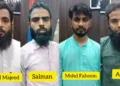
Following surveillance of phone records and money transfers, police tracked the network’s kingpin to Abdul Majeed of Faiznagar. Raids led to the arrest of Majeed, along with Salman Raza (30), Mohammad Arif (29) of Kareli, and Mohd Faheem (24) of Saidpur Chunnilal village. Another suspect, Mahmood Beg, remains absconding, while investigators are probing links to Changur Baba alias Jamaluddin, who was earlier arrested in Lucknow in a similar case.
The gang’s modus operandi
Investigators revealed that the gang followed a layered process of entrapment:
1. Initial Contact: Victims were approached in person or via social media, often under the guise of friendship or marriage prospects.
2. Emotional Manipulation: Once trust was gained, victims were persuaded that Islam offered them acceptance, stability, and equality.
3. Drug Dependence: In several cases, those resisting were introduced to addictive substances, ensuring control and isolation from families.
4. Final Conversion: Victims were then pushed into circumcision, Islamic rituals, and arranged marriages with Muslim women.
Officials believe the racket’s purpose was not only religious conversion but also to sever family bonds and create long-term dependence on the gang.
Chilling human stories behind the racket
The police investigation has uncovered deeply troubling stories of vulnerable men exploited by the racket:
1. Prabhat Upadhyay became ‘Hameed’: A visually impaired government teacher from Bulandshahr, abandoned by his wife, was promised remarriage by gang members. He was indoctrinated and given a new identity as “Hameed,” but police raids stopped his formal conversion just in time.
2. Brijpal Singh became ‘Abdullah’: A 40-year-old coaching teacher from Kareli, devastated by personal losses, was convinced Islam offered solace. He converted, married Tabassum, the sister of a gang member, and even influenced his mother and sister to convert.
3. 17-year-old student targeted: A B.Com student working part-time at a salon was introduced to drugs by a co-worker linked to the gang. As addiction deepened, he was gradually indoctrinated and made to perform namaz. Police say circumcision was already planned when the racket was exposed. The boy is now under medical treatment for drug-induced mental trauma.
Raids reveal fake IDs, drugs, and 100 photos of women
During raids, police seized:
Fake identity documents and SIM cards
Marriage and conversion certificates
Large quantities of sedatives and tablets
Laptops and encrypted chats showing targeted men across states
Over 100 photographs of Muslim women, allegedly shown to Hindu men as potential brides to ensure conversion through marriage
“We are verifying the identities of these women. The pattern clearly suggests they were being projected as marriage prospects for vulnerable men,” SP Verma said.
Legal action underway
Police have registered a case against five accused under: Bharatiya Nyaya Sanhita (BNS) Sections 140(3) & 351(3) and Sections 3 & 5(1) of the Uttar Pradesh Prohibition of Unlawful Conversion of Religion Act, 2021.
Officials also confirmed that provisions of the NDPS Act may be invoked if the drug angle is conclusively established.
“This is just the beginning. More arrests are likely as the investigation expands,” an officer told News18, adding that the primary focus remains to safeguard Hindu youth from falling prey to such networks.
A dangerous new trend
While earlier cases of forced conversions largely targeted women, the Bareilly case marks a disturbing shift towards trapping men. Officials warn that this reflects a “new and dangerous trend” in religious conversion tactics, combining emotional vulnerability, drug abuse, and marriage traps to lure young Hindu men into Islam.
With the network’s footprint stretching across states, the case is expected to widen further in the coming weeks, raising fresh concerns about religious conversion rackets operating under new disguises in India.














Comments