





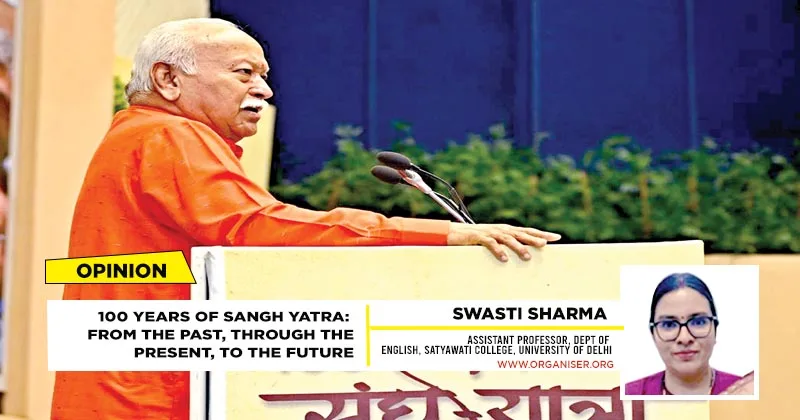
Reiterating the importance and vitality of nation-building through individual development—Vyakti-Nirman se Rashtra-Nirman—a three-day lecture series upon the completion of hundred years of illustrious journey by Rashtriya Swayamsevak Sangh commenced in Vigyan Bhawan, Delhi. It was a confluence of divergent ideas and convergent goals. The primary purpose was collective brainstorming, orienting discourse, and designing a roadmap for the future.
Vision and Mission in Context
In the aforementioned three-day Vyakhyanmala, the aims and objectives of the RSS were revisited. Founded in 1925 by Dr Keshav Baliram Hedgewar, RSS has played a crucial role in eliminating discriminatory practices, educating the marginalised, participating in disaster management efforts, providing social services, promoting environmental equilibrium, etc. These humanitarian and philanthropic initiatives have ensured greater inclusivity over the years. There’s a growing need to keep up the efforts and reject complacency.
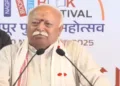
In his comprehensive address, Revered Sarsanghchalak Dr Mohan Bhagwat quoted several verses from the Vedic canon to describe the significance of Dharma (Dhaarayati Iti Dharmah) for youth. It comes at an opportune moment when the world is grappling with uncertainty. His speech underscored striking a delicate balance between Pravritti dharma (outward path) and Nivritti dharma (inner path). Emphasising the importance of self-discipline, Dr Bhagwat cautioned against the repercussions of Eurocentric wokeism, unbridled global market forces and other -isms on Bharatiya society. The cultural fabric of the rashtra (not the nation-state) must be protected and preserved by future generations. For this, Sangh shakha has an indispensable function to perform – transmission of the Bharatiya ethos. While self-reliance is appreciable, extreme individualism can be fatal for humanity.
Integrating Traditional Values and Modern Practices
In the contemporary scenario, Bharatiya Jnana Parampara has acquired a unique place due to the implementation of the National Education Policy 2020, which places a premium on integrating traditional values with modern requirements. Creating an ideal citizen begins in the classroom. Connecting mainstream education with the Gurukul system will elevate personality development. Swadeshi, atmanirbharta and antyodaya are integral values of our society. Everyone should have access to places of worship and basic amenities. Sarsanghchalak Ji, in his address, focused on adopting and inculcating best practices from everywhere without forgetting the roots of one’s native culture. This frequent cultural amnesia often leads to self-deprecation and an identity crisis. In order to become Vishwaguru, we need to reclaim Bharat’s glorious past, foster oneness and acknowledge heterogeneity of ideas. A positive approach is central to positive outcomes. Therefore, giving a human touch to knowledge and recognising the strength of Hinduness, as per Sarsanghchalak Ji’s speech, can change the world’s perspective towards our country. Man-to-man contact, heart-to-heart talk should be the key.
Breaking free from left-liberal Cultural Hegemony
The dominance of leftist ideology over the years is clearly reflected in the erstwhile policymaking and education model. Wokeism is an offshoot of the leftist propaganda machinery. Due to the hegemonic framework of the communist-capitalist binary, the society has become extremely individualistic, whereas the focus should be on selfless leadership and service. Co-ordination (Samanvaya) and not conflict (Sangharsh) is the cornerstone of Bharatiya values. As Dr Hedgewar said and Sarsanghchalak Ji quoted, “This life of mine is dedicated to the nation; concern for personal happiness shall be reserved for the next birth.” Focus on regional principles, samskaras and imbibing virtues will produce a free individual in the true sense. Only through seamless dialogue and deliberation can we negotiate solutions.
A New Horizon of Expectations
After one hundred years of indefatigable journey, the way forward is Charaiveti-Charaiveti. Presumably, there is a need to expand the dimensions of work through constant reflection and introspection. The media has a bigger responsibility in this endeavour. Unbiased coverage will motivate others to join the cause of nation-building. As the event concluded, one of the key takeaways was the engagement with the Bharatiya diaspora and the anticipated exchange with the neighbouring countries. A broad spectrum of vimarsh is being executed to evaluate social progress and identify problem areas. This, indeed, lays the groundwork for the next hundred years.











Comments