





Prime Minister Narendra Modi on August 31, highlighted the ever-expanding global footprint of Indian culture, spirituality, and traditions, pointing out how the world is embracing India’s civilisational heritage in ways never witnessed before.
Speaking in the 125th edition of his monthly radio programme Mann Ki Baat, the Prime Minister drew attention to examples from Italy, Canada, and Russia, where reverence for Indian icons and epics has taken a new cultural shape.
“Wherever you go in the world, you will definitely find the influence of Indian culture, and this influence is not limited to the big cities alone, but is visible even in small towns,” Modi said, striking a tone of pride in India’s soft power that transcends geographical and political boundaries.
Statue of Maharishi Valmiki in Italy
PM Modi began by recalling an emotional and historic event from Italy, where the town of Camp-Rotondo witnessed the unveiling of a statue of Maharishi Valmiki, revered as the Adi Kavi (first poet) of Sanskrit literature and the composer of the Ramayana.
“Something similar was witnessed in a small town of Italy, Camp-Rotondo. There, a statue of Maharishi Valmiki was unveiled. Many important personalities of the area, including the local mayor, also attended the programme,” Modi said.
The Prime Minister added that the Indian diaspora in the region was filled with pride. “People of Indian origin living in Camp-Rotondo are very happy with the installation of the statue of Maharishi Valmiki. The messages of Maharishi Valmiki inspire all of us,” he remarked.
For the Indian community in Italy, this installation goes beyond symbolism, it represents a bridge of values and teachings that connects India’s ancient wisdom to a modern European setting. The presence of the mayor and other dignitaries underscored how India’s cultural heritage is increasingly finding acceptance in international civic spaces.
Canada welcomes a grand 51-foot statue of Shri Ram
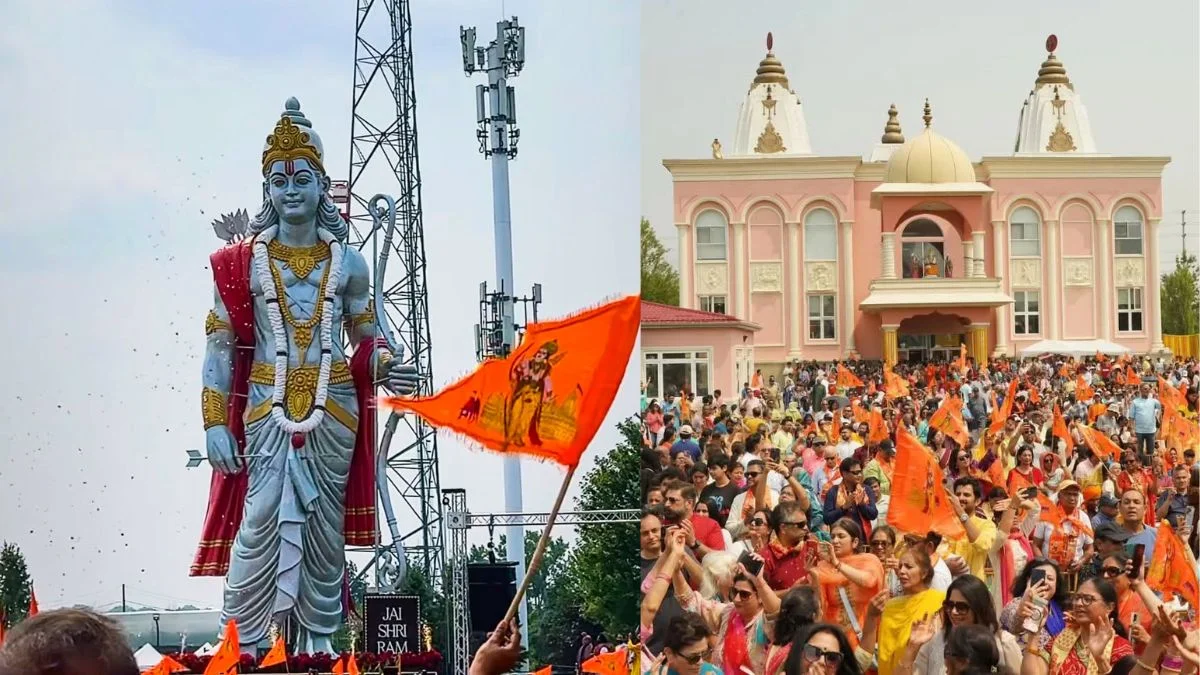
The Prime Minister next referred to an equally significant cultural milestone that took place earlier this month in Mississauga, Canada, where a 51-foot-tall statue of Shri Ram was inaugurated.
“People were very excited about this event. Videos of the grand statue of Bhagwan Shri Ram were widely shared on social media,” Modi said, highlighting how such developments create a buzz beyond physical boundaries.
The massive idol, believed to be among the tallest representations of Shri Ram outside India, has already become a rallying point for not just Indian-origin devotees but also for Canadians curious about Hindu philosophy. The inauguration, accompanied by traditional rituals, bhajans, and devotional gatherings, reflected how faith and cultural expressions from India continue to travel seamlessly across continents.
The diaspora’s emotional connect was evident in the widespread celebrations, with many saying that such a landmark gives their children in Canada a way to remain attached to their roots.
Russia’s growing fascination with the Ramayana
Turning eastwards, the Prime Minister lauded the increasing interest in the Ramayana and other aspects of Indian culture in Russia. He specifically mentioned the far-eastern city of Vladivostok, a place known more for its freezing winters than cultural events, but which recently hosted a unique celebration of India’s epic.
“This love for the Ramayana and Indian culture is now reaching every corner of the world. There is a famous place in Russia, Vladivostok. Many people know it as a city where the temperature falls to -20 to -30 degrees Celsius in winter,” Modi said.
Earlier this month, Vladivostok witnessed a Ramayana exhibition where Russian children painted scenes and characters from the epic. The artwork depicted not just artistic skill but also a heartfelt curiosity for Indian mythology. A competition was also organised, showcasing the enthusiasm among young Russians to engage with Indian traditions.
“This month, a unique exhibition was held in Vladivostok, where paintings made by Russian children on different themes from the ‘Ramayana’ were displayed. A competition was also organised. It is indeed heartening to see the growing awareness of Indian culture in different parts of the world,” Modi noted.
India’s culture as soft power
The examples cited by the Prime Minister underline India’s growing stature as a cultural powerhouse. What makes these developments significant is their location not just metropolitan hubs like Toronto or Rome, but smaller towns and lesser-known cities. From the hills of Italy to the streets of Canada and the snow-laden regions of Russia, India’s civilisational ethos is finding resonance.
This rise in cultural acceptance also reflects India’s diplomatic success. Cultural diplomacy, often seen through yoga, Ayurveda, festivals like Diwali, and now iconic statues and exhibitions, is becoming a cornerstone of India’s foreign engagement.
For the diaspora, these events serve as anchors of identity. For foreigners, they open windows into a civilisation that has thrived for thousands of years. And for India, they are a testimony to what PM Modi has often described as Vasudhaiva Kutumbakam, the idea that the world is one family.
Through his Mann Ki Baat address, Prime Minister Modi did more than list events; he wove a narrative of how India’s cultural heritage is no longer confined to the subcontinent. From Maharishi Valmiki’s teachings in Italy, to Shri Ram’s towering presence in Canada, to Russian children painting scenes of the Ramayana, the stories reveal how India’s legacy is being embraced globally.
As Modi put it, the “messages of Maharishi Valmiki inspire all of us.” In an era where soft power often determines global influence, India’s culture is emerging as one of its strongest ambassadors.















Comments