





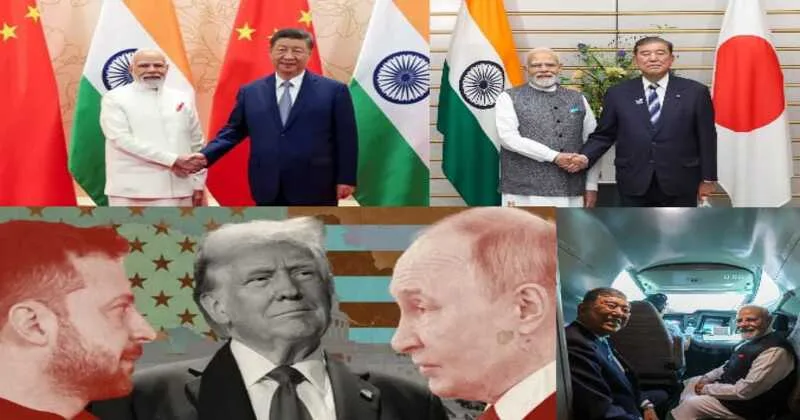
Prime Minister Narendra Modi’s recent diplomatic outreach underscores New Delhi’s steadfast commitment to strategic autonomy, as India strengthens ties with key global powers while standing firm against unilateral trade measures imposed by the United States.
Modi’s high-profile visits to Japan and China, along with sustained engagement with Russia and significant energy cooperation with Ukraine, reflect a pragmatic and confident foreign policy approach aimed at securing national interests, economic resilience, and regional stability.
India strengthens Asian partnerships from Japan’s bullet trains to China’s diplomatic table
Arriving in China’s Tianjin for the Shanghai Cooperation Organization (SCO) Summit, Modi held crucial bilateral talks with Chinese President Xi Jinping. This meeting, the first since the Galwan clash and Modi’s first visit to China in over seven years, comes at a time when the global order faces new fault lines. The two leaders are expected to review economic ties and explore avenues for normalizing relations further. The timing is significant as the Western nations are closely watching the SCO, emerging as a platform for Asia’s collective response to shifting global dynamics.
Upon landing in Tianjin, Modi received a warm welcome from the Indian community, who greeted him with chants of “Bharat Mata ki Jai” and “Vande Mataram,” reflecting popular support for India’s proactive global engagement. Earlier, he attended a cultural event featuring Chinese artists performing on Indian classical instruments such as sitar, santoor, and tabla, a gesture symbolizing cultural diplomacy at its finest.
Landed in Tianjin, China. Looking forward to deliberations at the SCO Summit and meeting various world leaders. pic.twitter.com/gBcEYYNMFO
— Narendra Modi (@narendramodi) August 30, 2025
This visit builds on the momentum generated by Modi’s two-day trip to Japan for the 15th India-Japan Annual Summit. Accompanied by Japanese Prime Minister Shigeru Ishiba, Modi travelled on the iconic Shinkansen bullet train from Tokyo to Sendai, a journey described by the External Affairs Ministry as a symbol of development and friendship. Modi’s engagement in Japan was not merely ceremonial, it involved strategic discussions aimed at bolstering economic cooperation, defence collaboration, and technology partnerships. Agreements were signed to enhance collaboration in infrastructure and advanced technology, including technical support for India’s Chandrayaan mission.
The Prime Minister’s interactions with Japanese officials and local leaders also showcased India’s focus on leveraging partnerships to modernize infrastructure, including plans for high-speed rail. The experience of travelling in the Shinkansen and meeting Indian trainees in Japan’s rail sector underlined Modi’s vision of adopting cutting-edge technology to transform India’s transportation landscape.
India balances energy diplomacy by standing firm on Russian oil while fueling Ukraine’s needs
From Japan, Modi flew to Tianjin to join world leaders for the SCO Summit, which also brings him face-to-face with Russian President Vladimir Putin. The meeting between Modi and Putin will carry immense strategic importance as both countries seek to deepen their partnership amid global economic uncertainties and shifting alliances.
Russia remains a critical energy partner for India, a fact underscored by New Delhi’s unwavering stance on continuing oil imports from Moscow despite heavy US tariffs. President Donald Trump’s administration has imposed a punitive 50% duty on Indian products, including a 25% ‘penalty’ for purchasing Russian oil. The move, effective from August 27, is aimed at pressuring India to halt energy trade with Russia. However, India has stood its ground, rejecting attempts to undermine its sovereign decision-making.
Thank President Zelenskyy for his phone call today. We exchanged views on the ongoing conflict, its humanitarian aspect, and efforts to restore peace and stability. India extends full support to all efforts in this direction. @ZelenskyyUa
— Narendra Modi (@narendramodi) August 30, 2025
Trump’s trade adviser Peter Navarro described India’s energy imports as “blood oil” and accused New Delhi of funding Russia’s war effort. These remarks were accompanied by warnings that India must end Russian oil purchases to avoid the steep tariffs. Yet, India’s position remains clear that energy security and economic stability are non-negotiable. By maintaining oil imports from Russia, India demonstrates a pragmatic approach that prioritizes national interest over external pressure.
Meanwhile, India has emerged as a key supplier of refined petroleum products to Ukraine, a development that highlights New Delhi’s growing role in stabilizing energy markets amid the ongoing Russia-Ukraine conflict. According to data from Ukrainian market watchdog NaftoRynok, India’s share in Ukraine’s diesel imports soared from just 1.9% in July 2024 to 15.5% in July 2025, making India the largest supplier of diesel to Kyiv. On average, India supplied 2,700 tonnes of diesel per day to Ukraine during July, primarily via Turkey and Romania.
Between January and July this year, India accounted for 10.2% of Ukraine’s diesel imports, a significant jump from the previous year’s 1.9%. This surge reflects India’s ability to navigate complex geopolitical realities while contributing to global energy security. The rise in India’s share surpasses that of several European suppliers, placing it ahead of countries like Greece and Turkey. Slovakia currently follows India with a 15% share, while Greece and Turkey stand at 13.5% and 12.4% respectively.
By continuing to import oil from Russia and simultaneously supplying refined products to Ukraine, India has positioned itself as a pivotal player in the global energy matrix. These moves underline New Delhi’s commitment to independent decision-making and its determination to uphold strategic autonomy, even in the face of punitive measures from Washington.
Trump backs out as Putin plans high-profile India visit
The US administration’s reported decision to cancel President Donald Trump’s planned visit to India for the Quad summit later this year signals a widening rift in bilateral ties. According to The New York Times, the deterioration began after Trump’s repeated claims of having “resolved” the India-Pakistan conflict, assertions strongly refuted by New Delhi. Tensions escalated following a phone conversation between Modi and Trump on June 17, during which Modi reiterated that India would not accept third-party mediation in its disputes with Pakistan.
The Quad summit, scheduled for November in New Delhi, was intended to bring together leaders from India, Japan, Australia, and the US to discuss pressing Indo-Pacific challenges. While Trump’s absence marks a setback for Washington’s strategic positioning, India’s dynamic engagement with other major powers reflects its readiness to pursue a balanced and autonomous foreign policy.
🇷🇺🤝🇮🇳 On September 12, #Russia's President Vladimir Putin had a meeting with Ajit Doval, National Security Advisor to the Prime Minister of #India, at the Konstantinovsky Palace in #StPetersburg.
👉🏻 https://t.co/vFQ64S4vMq#RussiaIndia #DruzhbaDosti pic.twitter.com/KxcD9aciDG
— Russia in India 🇷🇺 (@RusEmbIndia) September 12, 2024
In sharp contrast to the reportedly cancelled visit Trump, Russian President Vladimir Putin will visit India in December, marking his first trip since the outbreak of the Russia-Ukraine war. Kremlin Foreign Minister Yuri Ushakov confirmed the visit, underlining the strength of India-Russia ties. Ahead of that, Modi and Putin are holding talks during the Shanghai Cooperation Organization (SCO) Summit in Tianjin, China, where preparations for Putin’s visit to New Delhi will be finalized. This diplomatic convergence comes as Trump’s tariff war against India intensifies, with a punitive 50% duty, including a 25% penalty on Russian oil imports, coming into effect recently.
Yet, India remains firm. Despite the tariff shock and Washington’s demands to halt energy imports from Moscow, New Delhi continues to prioritize energy security, strategic autonomy and national interest. At the same time, India has emerged as a key supplier of refined diesel to Ukraine, reinforcing its growing role in global energy stability.
Amid escalating global crises, from conflicts in Ukraine and Gaza to disruptive trade wars, India’s diplomatic stance is unmistakable that build constructive partnerships, protect economic sovereignty, and resist coercion. By deepening ties with Japan, reaffirming engagement with China, sustaining vital energy links with Russia, and aiding Ukraine through fuel supplies, India demonstrates both pragmatism and principle.











Comments