





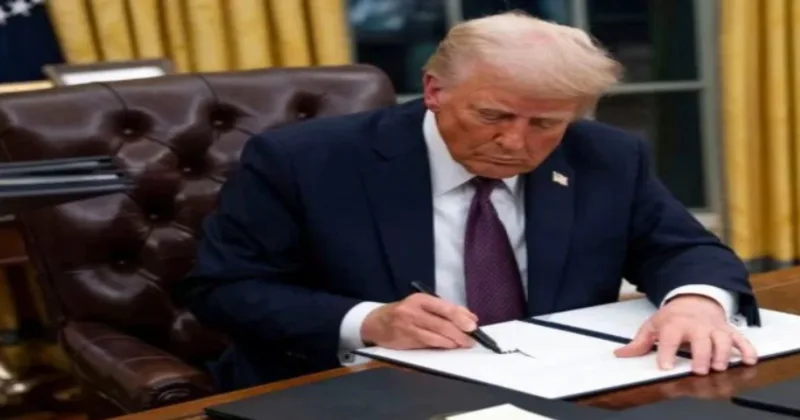
US President Donald Trump has been facing a series of criticism and backlash from various experts and economists, the seven-four verdict from the Federal Court ruled that most of the tariffs imposed by the Trump administration are illegal. The verdict coming from the judicial wing of US, marks a significant counterblast to the Trump’s tariff policies. The verdict is coming from a legal channel and is backed by the constitutional provisions of the United States, unlike the previous criticisms for Trump’s tariffs that were emerging from the camp of US economists, government officials and subject experts.
The verdict is based on the two lawsuits filed by the small business of US and by the coalition of US states. Business firms such as VOS Selections Inc.(wine and spirits importer), Plastic Services and Products had appealed to the court questioning the authority of Trump to invoke IEEPA and claimed that President had ‘no authority to issue across-the-board worldwide tariffs without congressional approval”. The appeal was filed in the aftermath of Trump signing an executive order to impose 10% baseline tariffs on all the countries in April, as a part of America’s ‘Liberation Day’.
Trump ‘overstepped’ his authority by invoking IEEPA
The court also exclaimed that the imposition of International Emergency Economic Powers Act(IEEPA) of 1977 by Donald Trump, in order to secure the trade interests of US is totally unacceptable, as the act has to be exclusively operated during national emergency scenario and while facing ‘unusual or extraordinary threats’, but not for rectifying trade imbalances. The court has asserted that by invoking IEEPA Trump has evidently ‘overstepped’ his authority. Donald Trump had earlier declared ‘national emergency’, citing that huge trade imbalance faced by the US is a threat to US national security. Apparently, no US President had previously invoked IEEPA on the ground of trade imbalance and to impose tariff on other countries.
“The statute(IEEPA) bestows significant authority on the president to undertake a number of actions in response to a declared national emergency, but none of these actions explicitly include the power to impose tariffs, duties, or the like, or the power to tax,”, the Federal Court verdict asserted while taking a jibe at the US President’s draconian policies and said that IEEPA don’t explicitly render the power to impose tariffs.
It is the core power of the Congress to regulate trade and commerce
The US Federal Court further noted that, as per the US Constitution, the US Congress holds the exclusive power to regulate trade and commerce activities with other nations. This power of the Congress cannot be superseded by the President’s powers and concern to secure the economic interests of the country. “It is the core Congressional power to impose taxes such as tariffs and is vested exclusively in the legislative branch by the Constitution,” said the ruling.
What is the move of the Trump Administration?
US President Donald Trump has out lashed at the court’s ruling with a series of posts on his social media platform. “Today a highly partisan appeals court incorrectly said that our tariffs should be removed, but they know the United States of America will win in the end. If these tariffs ever went away, it would be a total disaster for the country. It would make us financially weak, and we have to be strong”, wrote Trump on his Truth Social platform.
“If allowed to stand, this decision would literally destroy the United States of America”, further added Trump and asserted that his administration would fight back the court’s ruling with the help of the Supreme Court of America. Attorney General Pam Bondi, Commerce Secretary Howard Lutnick and Treasury Secretary Scott Bessent have also severely criticized the verdict of the Federal Court, claiming that it undermines the strategic interests of US and accused the court for interfering with the constitutional powers of the President with respect to foreign policy. They also resolved to fight back at the doors of apex court and secure the economic interests of the country.
Meanwhile, the ruling by the Federal Court does not completely curtail the powers of the Trump administration to impose tariffs. As per the Federal Court, tariffs cannot be imposed under the provisions of IEEPA act. However, there are numerous other channels to impose tariffs such as various trade legislations inscribed in the US. Also, the Trump administration has a window of opportunity to appeal the Supreme Court. The court’s ruling will not come into effect immediately and the Trump administration has time till October 14th. In this time, they can appeal the Supreme Court of the US, questioning the verdict of the Federal Court.
Beyond the legal discourses, what does the Federal Court’s verdict reflect is the increasing criticism towards the aggressive tariff policies of Trump arising not from other nations, but emanating within the US economic and judicial landscape. Such criticisms reverberate the fact that Trump’s irrational tariffs will indeed adversely hit the US economy in the long-run. Such increasing criticisms evoking within the US and hitting the global headlines everyday, also reduces the negotiation potential and credibility of the Trump administration to strike trade deals. However, will Donald Trump realizes this fact and indulges in fair, reasonable and mutually beneficial trade practices, is a geopolitical riddle.











Comments