





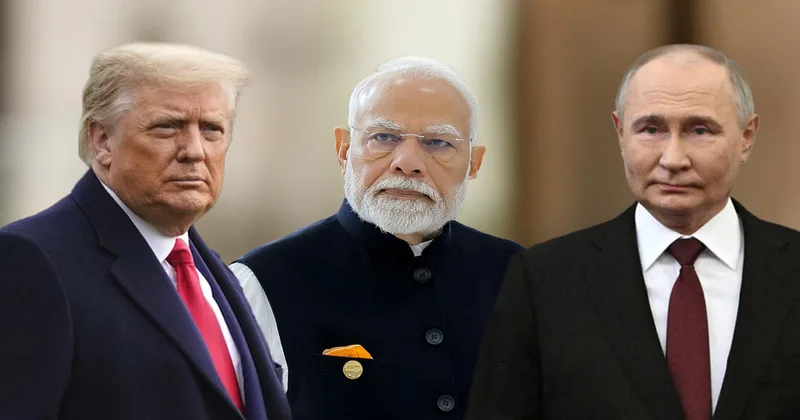
The second term of the US President Donald Trump has created a semi cold-war situation between the US and the other influential nations of the world including India and Russia. It is completely contrary to the perception that was prevalent during the election campaigning of Donald Trump last year. It was generally perceived that he would take the legacy of his first term forward as the President of the United States. However, that didn’t happen though quite surprisingly.
Immediately after assuming his office in Washington DC on January 20th this year, Trump invited certain prominent leaders and the heads of governments to the White House one by one. The invited leaders included PM Narendra Modi as well. A perfect bonhomie between Trump and Modi was seen through the entire programme at the White House. A joint statement and the press conference in this regard are a witness of the geniality exhibited by the Trump administration on the occasion. But there was a pointed statement of Donald Trump during the entire event that said, ‘Yes, PM Modi is a hard negotiator’.
J.D.Vance, the Vice President of US in the first week of May 2025 said, ‘Modi drives a hard bargain…..that is why we respect him….trade deal with India soon’. This was the time when behind the door negotiations were going on between India and US in regard to various types of trade deals. Just before that when President of Ukraine Volodymyr Zelensky was invited to the White House, his public ‘reprimand’ in the open press conference by Trump & Vance exhibited a very ugly picture about the public relations of the new regime in the US. It also did cast shadows about the events to come ahead.
The limited war between India and Pakistan in the month of May 2025 in connection with the Pahalgam Islamic terror incident changed the whole scenario affecting the relations between India and the US. Operation Sindoor created new permutations and combinations in the field of defence, diplomacy, dialogue and derivatives in political parlance. The US President announced in public through his one after the other tweets that he negotiated a ‘truce’ between India and Pakistan which was never confirmed by any of the two countries.
India went some steps ahead and said that there was no communication between Prime Minister Modi and President Trump between April 22nd, 2025 and June 17th, 2025. With this it closed the chapter and made things straight. The same statement was delivered by PM Modi in the Monsoon session of the Parliament held recently. The Ministry of External Affairs also made it known emphatically that the ‘ceasefire’ during the Operation Sindoor was the outcome of the talks between the DGMOs of India and Pakistan, consequent upon the persistent phone calls of the Pakistan DGMO in this regard.
It is believed that all these developments and the impact of Operation Sindoor made the Trump administration alert about India. It also irked Donald Trump to a large extent who didn’t expect India to respond in such an independent fashion in the capacity of a sovereign nation and how PM Modi led the whole operation with complete command and control.
Donald Trump was under an illusion that he would be able to summon, invite and enter into a treaty with any leader of the world at his discretion, time and place and would force them to toe his line and follow him as per his dictates. He didn’t succeed in the case of India despite his tariff-tornado.
When Trump invited Modi while he was in Canada in connection with the G7 meetings to visit the US, Modi attended his fixed priorities in Croatia and declined the invitation of the US administration. That ‘Modi didn’t attend four telephonic calls of Trump’ is also in circulation and hasn’t been refuted either by US or India. Trump was of the notion that the new tariff regime would compel PM Modi to toe his line despite being the leader of an independent and sovereign nation, which didn’t happen. Then he tried to do the same in a different context with the Russian President Vladimir Putin but failed flatly.
Trump invited Putin to the US and organized the summit meeting in Alaska which was earlier a part of Russia. This part of its territory was sold by Russia to the US in 1867 and consequently the US made this territory its 49th state in 1959. A high voltage three-hour meeting took place between Putin and Trump on August 15, 2025 in this very state under a psychological trap laid by the US administration. President Trump declared, unceremoniously, one night before this meeting that if Putin didn’t agree to the ceasefire between Russia and Ukraine, the US would apply additional penalties on India. It was completely an absurd condition which didn’t find favour at any level and had no direct business with the agenda of the meeting.
Trump’s argument that since India is purchasing oil from Russia and the money is being spent by Russia on the Ukraine war is beyond any logic worth any value. The purchases are being done by China and European nations as well and then the US is also importing a lot of materials and minerals from Russia directly. This argument fell flat in the discussion held between the two leaders. Trump was unable to take any assurance from President Putin in the meeting about any sort of ceasefire between Ukraine and Russia. In fact, Putin made it clear that Russia was not going to return the territory of Ukraine that it captured during the war and he kept this as the most important condition for any ceasefire between the two nations.
In addition to this, President Putin made it known to President Trump that there would be no guarantee to allow American companies to work for reconstruction in Ukraine once the war is stopped. Trump seems very eager for a ceasefire in the Ukraine and Israel-Hamas scenario so that the American companies, particularly Trump’s family business units, start doing business there in the name of reconstruction work. Putin didn’t assure Trump in this regard in any way and rather put conditions of his choice before him, surely to the displeasure of Trump.
Two days after his meeting with the US President Donald Trump in Alaska, Russian President Vladimir Putin called Prime Minister Narendra Modi on August 18, 2025 and informed him about the discussions he had with the US leadership. The EAM said in a statement that Modi presented India’s ‘consistent position’ about finding a peaceful solution to the conflict in Ukraine, while Putin presented his ‘assessment’ of his conversation with Trump. Russia also announced an additional 5 per cent discount to India on oil purchases.
Then the visit of the Minister of Foreign Affairs of the People’s Republic of China to India on the invitation of the National Security Advisor, Ajit Doval added a new dimension to the existing scenario. Bilateral meetings were held between the two sides in a cordial atmosphere on several important issues concerning various strategic areas with a resolve to take the dialogue to the next level in near future. PM Modi is currently also on a visit to Japan and China in connection with the Bilateral Summit between Japan & India and Shanghai Cooperation Organisation Summit in China.
Brazil also flatly refused to toe the line of the US and instead announced that it would like to go along with India instead. The President of Brazil, Luiz Inacio Lula da Silva said that he will confront Donald Trump’s 50% tariffs head-on. He affirmed Brazil’s global standing by announcing plans to personally contact world leaders including the Prime Minister of India Narendra Modi. He said, “I will call him and I will call Xi Jinping, I will call Prime Minister Modi”.
The EAM said on August 7th, 2025 that ‘Prime Minister Shri Narendra Modi received a telephone call today from the President of Brazil. Prime Minister recalled his visit to Brazil last month during which the two leaders agreed on a framework to strengthen cooperation in trade, technology, energy, defence, agriculture, health and people-to-people ties. Building on these discussions, they reiterated their commitment to take India-Brazil Strategic Partnership to new heights. The two leaders exchanged views on various regional and global issues of mutual interest and agreed to remain in touch’.
All these developments make it clear that the one-upmanship of Donald Trump is not going to make any kind of headway towards peace, brotherhood and cordial relations between the US and the other nations. The context in which it is observed that PM Modi and President Putin have taken the gas out of Trump’s chambers’ this might pave the way for a bigger cooperation between India, China and Russia. This will also act as a catalyst to strengthen the future role of BRICS which is surely to the distaste of Donald Trump. Thus, it is now time to watch the geopolitical developments very closely in regard to the emerging trends.











Comments