





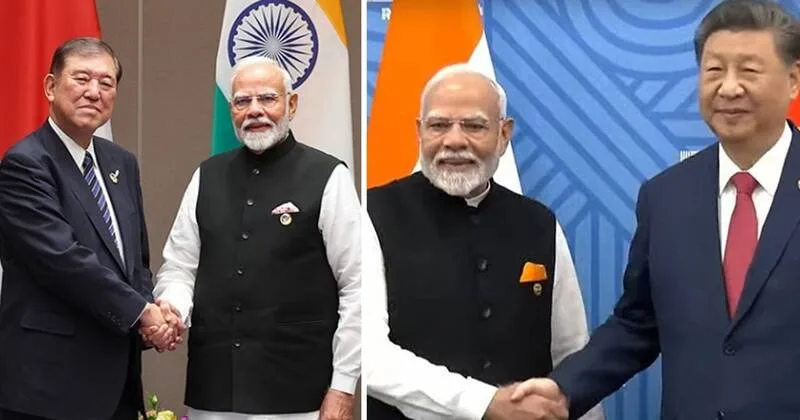
Prime Minister Narendra Modi is set to embark on an official visit to Japan and China from August 29th to September 1st. PM Modi will be in Japan on August 29 and 30 as a part of the bilateral visit and will chair the 15th India-Japan Annual Summit along with his Japanese counterpart Prime Minister Shigeru Ishiba. Later, PM Modi will emplane to China for the Shanghai Cooperation Organisation(SCO) Summit.
Both the visits come at an extremely crucial geopolitical juncture, as the world is reeling under the heat of Trump’s tariffs and is charting an reliant economic path to tackle the tariff tussle instigated by the Trump administration. Especially, New Delhi has been facing the brunt of a massive 50% tariff, which includes 25% additional tariffs for importing the Russian oil. As India navigates these geopolitical & geo-economic challenges to secure its national interests and seeks to debunk the hypocrisy of the US administration, strengthening bilateral and multilateral partnerships is a strategic indispensability. New Delhi is indeed in this path of striking strategic superiority against unreasonable geopolitical compulsions.
Prime Minister’s visit to China is further witnessed with a great geopolitical curiosity, as it will be the maiden visit in the aftermath of the Galwan clash of 2020, when the bilateral relations had plunged to an all-time low. The series of swift bilateral exchanges witnessed between New Delhi and Beijing in the last few months has culminated in the Prime Minister’s visit to China. This visit is thus will be a strategic milestone in Sino-India relations. The SCO summit also will be looked with keen strategic interests in order to know how Asian economies react to tariff tensions emanating from the US.
Quad, Bullet Train, AI and what’s more on the India-Japan list
As Prime Minister Modi is set to hold the 15th India-Japan Annual Summit with his Japanese counterpart Prime Minister Shigeru Ishiba, the bilateral priorities include strengthening the defence and security cooperation between New Delhi and Tokyo, boosting Japan’s participation in India’s bullet train project, ensuring high-stake Japanese investment in India’s semiconductor industries and boosting cooperation in the domain of Artificial Intelligence(AI ecosystem) etc.
- Defence Cooperation
Foreign Secretary Vikram Misri during the press briefing reiterated, “Defence ties with Japan have emerged as an important pillar of cooperation between the two countries in recent years. There was a meeting between the defence ministers that was held just recently in May, where the two sides were able to review a whole host of issues, operational engagements between the two sides, but more importantly, defence equipment and technology collaboration, which is an important part of the overall defence and security engagement.”
In this regard, Japanese Navy and the Japanese Maritime Self-Defence Force are exploring opportunities to cooperate in the domain of ship maintenance in India. Discussions are also going on to foster cooperation between DRDO and Japan’s ATLA to calibrate partnership in defence research.
During Prime Minister’s visit it is also anticipated that the both nations will upgrade the ‘Declaration on Security Cooperation’ that was initially inked in the year 2008.
- Collaboration on Bullet trains
Prime Minister Modi will be touring the Tokyo Electron Factory, a leading chip manufacturing unit and Tohoku Shinkansen plant in Sendai, the outlet where bullet train coaches are designed and built. It is also expected that PM Modi will discuss the participation of Tokyo in India’s Bullet train project with his Japanese counterpart.
India is planning to purchase the E10 bullet trains for the 508 km Mumbai-Ahmedabad High-Speed Rail Corridor. The E10 state-of the-art bullet trains have the operational speed of 320km per hour and are inbuilt with cutting-edge safety mechanisms that have the potential to prevent derailment even during earthquakes and other natural calamities.
It is also said that Japan International Cooperation Agency(JICA) will fund Rs. 88,000 crore for the Mumbai-Ahmedabad high-speed rail project that amounts to 81% of the total expenditure.
- Boosting Business and Investment Relations
As per the reports, Japanese Prime Minister will announce plans to invest US $68 billion in India over the next decade to boost bilateral businesses. The core sectors of focus will be the semiconductor industry, Artificial Intelligence ecosystem, medicine, mobility etc. These Japanese investments in India also intend to boost highly-skilled employment prospects for the Indian youth and will help to strengthen the Indian start-ups in cutting-edge technologies.
- Echoing for the sustainability of Quad
India and Japan being the epicentre of Asia and specifically of the Indo-Pacific, have always been vocal about the free, open, inclusive and rule-based Indo-Pacific architecture. However, with US President Donald Trump’s tilt towards economic ambitions and with the latest tariff tussle the current Quad Summit that has Indo-Pacific at its core that India is supposed to host is under doldrums. However, India and Japan is committed for the objectives of Quad and Prime Minister Modi and Prime Minister Shigeru Ishiba will discuss about the future of Quad and will seek to keep its geopolitical relevance high.
Foreign Secretary Vikram Misri asserted that Quad is an important platform and it is on the agenda during PM Modi’s visit to Japan. “The Quad is indeed an important platform for working on and promoting peace, stability, prosperity and development in the Indo-Pacific region. I’m sure when the two prime ministers meet, the Quad will be a subject that will be discussed between the two of them,” Mr. Misri affirmed.
PM Modi visit to China: A crucial geopolitical move
Prime Minister Narendra Modi will visit Tianjin, China for the 25th SCO Summit on August 31st and September 1st, as per the invitation of the Chinese President Xi Jinping. SCO has the core principles of countering terrorism, extremism and seperatism. In this backdrop, Prime Minister attending the SCO summit gains strategic importance in the aftermath of the Pahalgam terror incident. New Delhi’s firm stance against terrorism was also witnessed when Defence Minister Rajnath Singh and EAM Dr. S. Jaishankar visited China for the SCO meet. Thus, How does the SCO leaders’ react to cross-border terrorism is been closely watched from India.
This will also be PM Modi’s maiden visit to China in the aftermath of Galwan Clash of 2020 when the Sino-Indian relations hit an all-time low. From the past year, New Delhi and Beijing has had a swift bilateral exchanges and efforts for the restoration of normalcy and resetting of bilateral relations have been witnessed both at the borders and at the diplomatic level including the resumption of direct flights connectivity, restart of the Kailash Mansarovar Yatra etc. In this direction, the meeting between Prime Minister Modi and President Xi Jinping is anticipated with high curiosity and expectations.
Moreover, PM Modi’s visit to China comes at a critical geopolitical juncture when the world economies are embroiling under Trump’s tariff tantrums, especially when India is facing a massive 50% tariffs. The outcomes of the SCO summit in this direction is also much awaited as the forum predominantly encompass Asian economies who have been the victim of Trump’s tariff tantrums.
There are also probability of Prime Minister Modi meeting Russian President Vladimir Putin and Chinese President Xi Jinping on the same platform for the first time since the Alaska Summit between Putin and US President Donald Trump. With this background, the leaders’ statements from the floors of the SCO summit are anticipated with keen strategic curiosity not just in India but across the globe. However, the bilateral discussions that PM Modi is set to hold on the sidelines of the SCO summit is not yet officially known.
The SCO summit is especially vital for New Delhi as a part of its ‘multi-alignment’ policy in order to sail through all the geopolitical challenges and ultimately champion India’s national security priorities and strategic autonomy.












Comments