





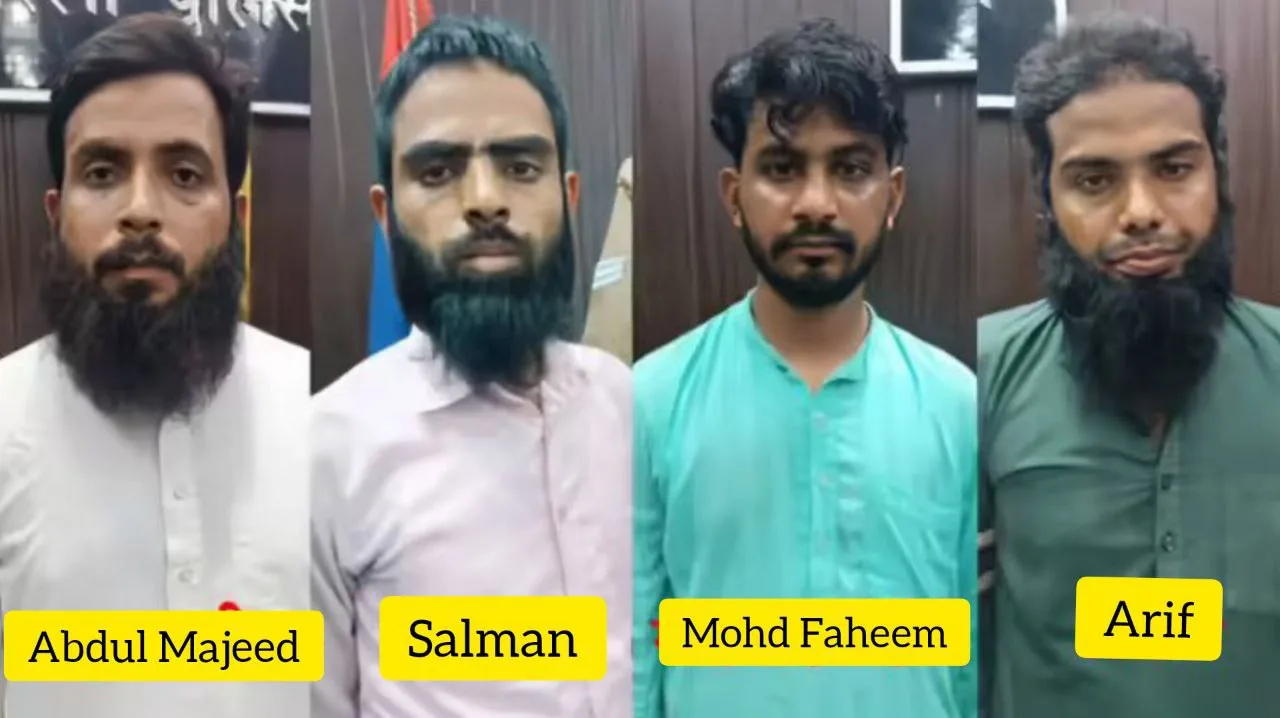
A massive illegal religious conversion racket operating from Bareilly, Uttar Pradesh, has been exposed by police in what officials are calling one of the most organised networks of its kind in recent years. The gang, led by 35-year-old madrasa operator Abdul Majeed, has been active for at least a decade and had built a sprawling network across 13 states and more than 20 Indian cities.
The breakthrough came after a woman’s complaint triggered police action, unravelling chilling details of how vulnerable individuals, including a blind government school teacher, were targeted, manipulated, and converted.
Police say the gang was not just operating locally but was backed by a coordinated fundraising mechanism involving multiple bank accounts, regular interstate travel, and propaganda material.
With four arrests made so far, investigators are now mapping the group’s nationwide operations, its financial channels, and its local collaborators. The First Information Report (FIR No. 377/2025) registered at Bhuta Police Station under the Bharatiya Nyaya Sanhita (BNS) and the Uttar Pradesh Freedom of Religion Act forms the legal foundation of the probe.
The mastermind and his gang
The mastermind of the gang is Abdul Majeed, a 35-year-old madrasa operator from Faiznagar, Bhuta, Bareilly. Despite presenting himself publicly as a street vendor selling coats and garments, Majeed ran a sophisticated operation of religious conversion. Five bank accounts linked to him have been identified.
Alongside him, three other key associates were arrested:
Salman (30): A tailor from Kareli village in Subhashnagar, Bareilly. Salman acted as the gang’s ideological propagandist. He distributed religious books, CDs, and other literature, playing a central role in “brainwashing” people. Police have identified six bank accounts in his name.
थाना भुता बरेली पुलिस द्वारा थाना भुता पर पंजीकृत मु0अ0सं0 377/2025 धारा 140(3)/351(3) बीएनएस व 3/5(1) उ0प्र0 विधि विरुद्ध धर्म संपरिवर्तन प्रतिषेध अधिनियम, 2021 से संबंधित 04 अभियुक्तों की गिरफ्तारी एवं बरामदगी के संबंध में सुश्री अंशिका वर्मा #SP South बरेली की बाइट।#UPPolice https://t.co/hOveW3QedX pic.twitter.com/YSnPOiNzS3
— Bareilly Police (@bareillypolice) August 26, 2025
Mohammad Faheem (23): A barber from Saidpur Chunnilal, Bhojipura. Faheem reportedly scouted potential victims, identified vulnerable targets, and also performed circumcision rituals during conversions. Two bank accounts have been traced to him.
Arif (29): Another tailor from Kareli village and Salman’s close associate. He is accused of luring new recruits into the conversion trap. Police have found two bank accounts in his name as well.
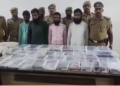
All four were arrested and sent to jail, with police confirming that large quantities of conversion-related literature and material were seized from their possession. They all have been booked under sections 140(3)/351(3) of the BNS and 3/5(1) of the Uttar Pradesh Freedom of Religion Act.
How the racket operated
Abdul Majeed used his madrasa as a cover, but the real work was carried out through constant travel and discreet networking. Investigators discovered that Majeed maintained contact with “prominent persons and religious centres” across the country, many of whom provided him with regular financial donations.
Within Uttar Pradesh, Majeed’s travel footprint included Sambhal, Amroha, Ghaziabad, Gorakhpur, Moradabad, Lakhimpur Kheri, Bulandshahr, Raebareli, Bareilly, Prayagraj, and Jhansi.
Outside the state, he was found to have visited Vadodara and Surat (Gujarat); Bhopal (Madhya Pradesh); Mumbai and Palghar (Maharashtra); Rohtak and Faridabad (Haryana); Jaipur (Rajasthan); Delhi NCR; Chennai (Tamil Nadu); Bengaluru and Mysuru (Karnataka); Thiruvananthapuram (Kerala); Vijayawada (Andhra Pradesh); Puducherry; and several cities in West Bengal.
Police confirmed that the gang had raised funds from more than 20 cities in 13 states, making it one of the largest interstate conversion networks uncovered in recent years.
Ten-year trail of conversions
Evidence of the gang’s decade-long operation surfaced in Kareli village of Subhashnagar, where the family of Brajpal Singh, also known as Brajpal Sahu, was converted.
Brajpal, once a mathematics tutor struggling financially, was befriended by Salman and Arif about ten years ago. They persuaded him to convert, renaming him “Abdullah.” He was subsequently married to a woman named Tabassum.
The web spread further:
His sister Rajkumari was converted and renamed Ayesha, and later married off within the community.
Eventually, his mother, Rajkumari, facing pressure, also converted and was renamed Amina.
This case alone demonstrates how the gang targeted vulnerable families, offering support, marriages, and a sense of belonging while systematically erasing their earlier identity.
The teacher’s ordeal
The most disturbing testimony in this case comes from Akhilesh Kumari, a widow from Aligarh, who lodged the FIR that blew the lid off the racket. In her detailed written complaint, accessed by Organiser, she narrated how her son Prabhat Upadhyay, blind since birth, fell into the gang’s trap.
Prabhat, an academically accomplished man, studied at Aligarh Muslim University from nursery to M.Phil, later completing a PhD at Hyderabad Central University. In 2019, he secured a teaching position at Government Inter College, Aligarh, and married a woman named Anjali Sharma. However, his marriage collapsed amid domestic violence and dowry-related disputes, leaving him emotionally vulnerable.
According to Akhilesh Kumari’s FIR:
“When Prabhat was transferred to Bareilly, I noticed a change in his behaviour. He secretly spoke on WhatsApp, often taking Muslim names like Abdul Majeed, Mahmood Beg, Salman, and Arif. On August 3, I overheard him asking Abdul Majeed about a man called Piyush who had been renamed Ali after conversion. He questioned why that man went to jail for marrying Ayesha and whether he, too, would face jail if he converted and married a Muslim girl. This made me realise my son was being lured into conversion.”
Kumari alleged that when she and her brother confronted Abdul Majeed in Faiznagar, they were threatened.
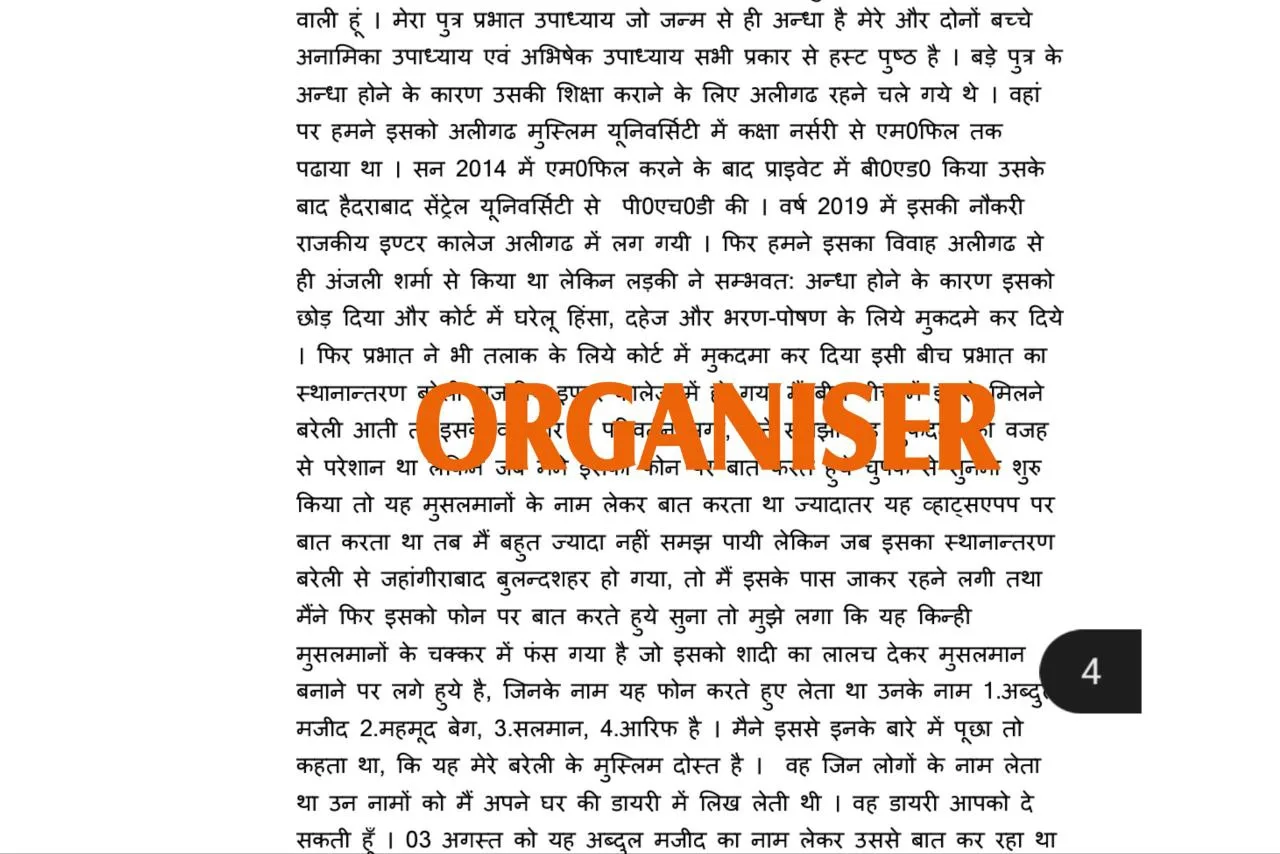
“Majeed and four others told us they had already converted my son into Hamid and warned they would kill us if we persisted. I fear they exploited my son’s blindness to forcefully convert him,” she wrote.
Her statement further reveals that Majeed’s gang promised her son marriage with a Muslim woman as bait for conversion.
Police action and recoveries
Following the FIR, SP South Anshika Verma confirmed the arrests of the four accused and detailed the seizures.
From Abdul Majeed’s madrasa and associates, police recovered:
12 religious books
2 seals
3 blank conversion certificates with official stamps
13 CDs (titles including “Mahaguru Shankaracharya Alami Bhaichara,” and speeches by Dr. Zakir Naik)
3 green bead necklaces
10 Islamic lockets with printed pictures
1 conversion certificate with an affidavit under the name Abdullah
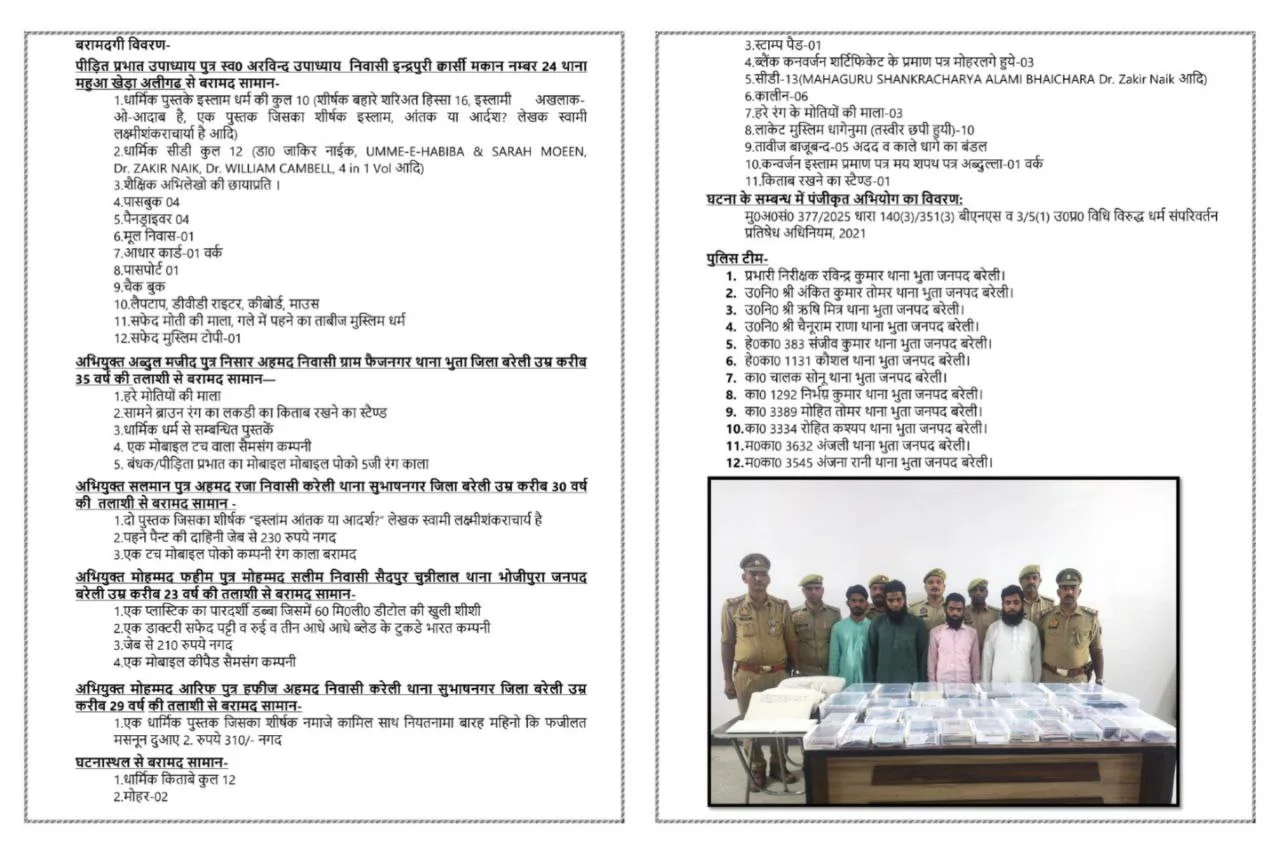
From the accused individuals, additional controversial material was seized:
From Arif: Namaaz Kamil Saath Niyatnama Barah Mahino Ki Faazilat Masnoon Duaaye
From others: Bahar-e-Shariat Part 16, Islami o-Adab, Islam: Terror or Ideal? (by Swami Lakshmi Shankaracharya)
12 CDs including works of Dr. Zakir Naik, Umme-e-Habiba, Sarah Moeen, and Dr. William Campbell.
Police believe these materials were central in “indoctrination” and grooming.
Rising cases of illegal conversions
The Bareilly case is not isolated. Uttar Pradesh has witnessed a spurt in cases of mass conversions, forced marriages, and grooming rackets in recent years. From the Chhangur Baba case to the recent exposure of a sex racket linked to conversion in Rampur, where a woman named Hameeda became Yashoda after returning to Sanatan Dharma, a pattern of targeting vulnerable individuals is evident.
The police and intelligence agencies are increasingly focusing on the financial and organisational aspects of such networks, especially the alleged flow of foreign funding.
For now, Abdul Majeed and his associates remain in custody, while police continue to track their wider network. Officials are combing through bank account details, travel logs, and digital communication records to build a watertight case.
As SP Anshika Verma put it: “The gang’s network spans 13 states. We have seized large amounts of conversion-related literature. The arrested accused have been sent to jail. A deep investigation is ongoing.”













Comments