





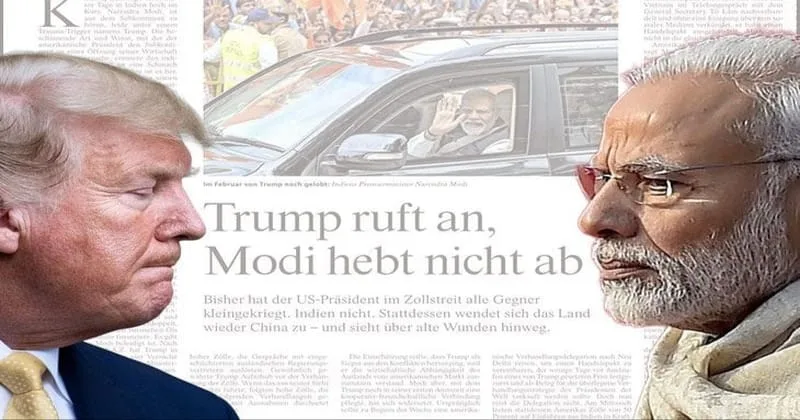
The bravery of Indian Prime Minister Narendra Modi, who reportedly ignored four calls from the hot-tempered US President Donald Trump, was not highlighted by the American media or India’s news channels. Instead, it was brought to light by a 75-year-old German newspaper, Frankfurter Allgemeine Zeitung (FAZ).
Known widely by its abbreviation FAZ, this newspaper has become the talk of both India and the United States with this single revelation. FAZ reported that Modi stood firm against Trump’s pressure, even after the US hiked tariffs on India by 50 percent in retaliation for India’s continued oil imports from Russia. The newspaper observed that Modi refused to yield to Trump’s tactics of exploiting other nations’ dependence on the American market. Despite Trump’s repeated calls urging India to give in, Modi maintained a cooperative relationship during Trump’s first term without compromising India’s economic interests. Neither New Delhi nor Washington has denied the report, adding weight to its credibility. FAZ’s reputation lends further legitimacy, this is one of the most respected newspapers in the world, celebrated for its political depth and social analysis.
FAZ has a long and influential identity
To Germans, Frankfurter Allgemeine Zeitung is what The New York Times is to Americans, a newspaper seen as the nation’s public conscience, upholding editorial independence and neutrality. FAZ has a long and influential history.
It was first published on November 1, 1949, by founding editors Hans Baumgarten, Erich Dombrowski, Karl Kohn, Paul Sethe, and Erich Welter. The paper was considered a successor to Frankfurter Zeitung, which was banned by the Nazis in 1943. Some former editors of the original newspaper joined FAZ, but the very first issue rejected the notion that it continued the old paper’s tradition. Instead, it embraced freedom, democracy, and anti-racism, values once reviled by the Nazi regime.
The editorial structure is unique. FAZ has four editors with equal powers. Its format, too, stood apart from sensationalist trends. For decades, it featured conservative blackletter headlines, minimal photos on the front page, and a restrained layout. Yet when it did use images, they became iconic that the celebrations in front of the German Parliament on October 4, 1990 and the dramatic photo of the collapsing World Trade Center beside President George Bush on September 12, 2001, are notable examples.
In an era when rival papers filled front pages with sensational headlines and half-clad celebrities, FAZ’s sober tone sparked discussion. There was even a saying in Germany: “To get your picture in the Frankfurter Allgemeine, you must die in an unusual way.” The newspaper modernised on October 5, 2007, adopting colour photographs on the front page and updating its nameplate, but these changes unsettled traditional readers and even inspired a 2009 comedy film. Such was FAZ’s cultural influence.
FAZ warnings from post-war Germany to the age of Islamic terrorism
The newspaper’s distinction lies in its serious, prophetic analyses and in-depth reporting. After World War II, FAZ played a pivotal role in shaping Germany’s democratic identity. It consistently exposed links between German political figures and former Nazis and documented atrocities committed by the Soviet Red Army.
In the 1950s, FAZ championed post-war reconstruction. Its Cold War coverage captured major developments, including the space race. In the lead-up to German unification in 1990, FAZ helped awaken national consciousness. Later, when the European Union and the common euro currency emerged, the paper produced exhaustive analyses of their potential and pitfalls, shaping public opinion.
FAZ’s reportage extended to global events from the September 11 attacks and their geopolitical aftermath to Germany’s role in Afghanistan. It warned about the looming refugee crisis before 2015 and became a major critic of Chancellor Angela Merkel’s immigration policy, triggering national debate. Its foresight was evident again months before Russia’s invasion of Ukraine, when FAZ analysed internal government disputes over the Nord Stream pipeline and warned of Germany’s dependence on Russian gas. Today, as Germany grapples with Islamic terrorism and energy challenges, the prescience of FAZ’s editorials stands confirmed.
Bans in Egypt, Blocks in China and the FAZ’s uncompromising fight for editorial freedom
Unlike newspapers that thrived on sensationalism, FAZ grew on the strength of its serious journalism. Its circulation peaked at 4,09,000 in 2001, up from 3,91,013 in 1993. Even as print declined worldwide during the rise of Google and YouTube, FAZ held steady, 3,82,499 copies in 2007, and 2,56,188 in 2016, a remarkable survival when many newspapers either closed or went digital-only. The paper experienced a surge in 2011, expanding its staff to over 800, including 40 foreign correspondents. Today, FAZ maintains a strong digital presence while preserving its traditional editorial ethos.
Another hallmark of FAZ is its refusal to bow to threats or compromise editorial independence. The paper has faced hundreds of threats and numerous lawsuits without wavering. In 2006, Egypt banned FAZ for allegedly publishing material offensive to Islam. Two years later, it faced another Egyptian ban over cartoons depicting the Prophet. In November 2012, FAZ sparked controversy in Spain over its criticism of Spanish immigration to Germany. In July 2019, China blocked FAZ’s online site following its coverage of the Hong Kong protests.
Despite such challenges, FAZ continued reporting fearlessly, relying on its global network built over decades. Its credibility enables it to publish reports like the recent one on Modi and Trump, news that many outlets, bound by political allegiance, would hesitate to run.
Modi’s steadfastness, highlighted by FAZ, is just the latest chapter in the newspaper’s legacy of fearless journalism. Even if other media organisations had access to the story, their dependence on American goodwill might have stopped them from publishing it. This is what makes FAZ’s free editorial voice so relevant today.














Comments