





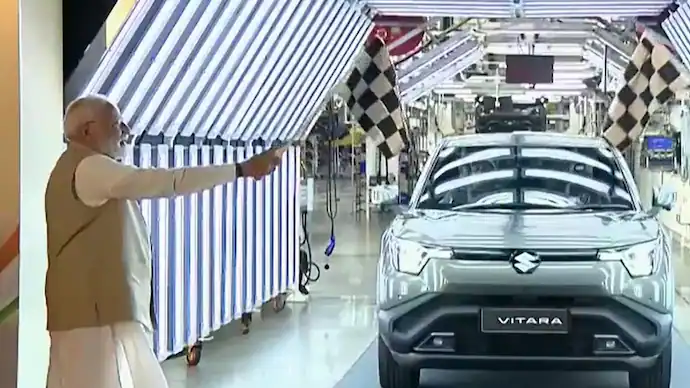
With global trade tensions resurfacing and protectionist policies such as Trump’s tariffs casting uncertainty over exporters, Prime Minister Narendra Modi struck a note of resilience and confidence in India’s manufacturing strength, declaring that the Make in India initiative has created a favourable environment for both global and domestic manufacturers.
He made the remarks while inaugurating a series of green mobility projects at Suzuki Motor Corporation’s Hansalpur plant, marking a major step in India’s clean energy and Swadeshi manufacturing journey.
India’s first global EV flag-off
In a symbolic moment, PM Modi flagged off Suzuki’s first global strategic Battery Electric Vehicle (BEV), the e-VITARA, manufactured entirely in India and set to be exported to over 100 countries, including advanced markets like Europe and Japan.
“India is taking large strides towards becoming Aatmanirbhar in green energy. Starting today, electric vehicles made in India will reach 100 countries,” the Prime Minister said, underlining how the project will also deepen India-Japan economic ties.
Ahead of the launch, he wrote on X (formerly Twitter): “Today is a special day in India’s quest for self-reliance and being a hub for green mobility… This Battery Electric Vehicle (BEV) is made in India and will be exported to over a hundred nations. In a big boost to our battery ecosystem, production of hybrid battery electrodes will also commence at a plant in Gujarat.”
Boost to EV ecosystem: Batteries go swadeshi
Alongside the EV launch, Modi inaugurated the local production of hybrid battery electrodes at the TDS Lithium-Ion Battery plant in Gujarat, a joint venture between Toshiba, Denso and Suzuki.
With this development, over 80 percent of battery value will now be produced domestically, cutting India’s reliance on imports. “This localisation will reduce costs and strengthen India’s global competitiveness in clean mobility,” PM Modi said.
India as a global manufacturing hub
Striking a confident note, the Prime Minister said: “India possesses the strength of democracy, the advantage of demography, and a vast skilled workforce – creating a win-win situation for every partner. Companies like Maruti Suzuki have become brand ambassadors of Make in India.”
Recalling his days as Gujarat’s Chief Minister, Modi noted how land was allotted to Suzuki in Hansalpur in 2012. He paid tribute to the late Osamu Suzuki, crediting his vision for Maruti’s expansion in India, which has now evolved into a global success story.
The Prime Minister also announced plans for six new semiconductor manufacturing plants and launched the National Critical Mineral Mission, which will conduct over 1,200 exploratory campaigns to secure rare minerals crucial for the EV and auto sectors.
Rs 11,000 crore E-mobility push
In a bid to scale up clean transport, Modi highlighted the PM E-DRIVE scheme, with an allocation of ₹11,000 crore for e-ambulances and hybrid EVs. He praised Maruti Suzuki for producing a hybrid ambulance prototype in just six months, underscoring India’s growing innovation speed.
Swadeshi during festive season
Striking a chord with households, PM Modi urged Indians to celebrate upcoming festivals with a Swadeshi spirit.
“This is the season of festivals. Now Navratri, Vijayadashami, Dhanteras, Diwali… all these festivals are coming. These are celebrations of our culture, but they should also be celebrations of self-reliance. Therefore, I want to reiterate my request: whatever we buy will be Made in India, it will be indigenous,” he appealed.
India-Japan: Beyond diplomacy
Modi said India’s partnership with Japan is rooted not just in diplomacy but in “culture and mutual trust.” He reminded the audience of Japan’s active participation in Gujarat’s Vibrant Summit since its inception and praised the deepening education and skill partnerships between the two nations.
“India will not stop here. In sectors where we are performing well, the goal is to achieve even greater excellence,” he said, expressing confidence that today’s initiatives will help lay the foundation for a developed India by 2047.
The Suzuki e-VITARA: India’s global EV
Suzuki’s e-VITARA, positioned as a global electric SUV, boasts two battery options, 49kWh and 61kWh, with ranges up to 500 km per charge. The AWD variant will deliver a combined output of 184hp and 300Nm torque.
To back the EV, Maruti Suzuki will roll out 1,500 EV-ready workshops across 1,000 cities, install home chargers with support, and establish public fast-charging stations every 5–10 km in the top 100 cities over the next three years.
At a time when Trump’s tariffs and Western protectionism threaten exporters, PM Modi’s call for Swadeshi reflects his resilient faith in Indian manufacturers. The Hansalpur launch not only cements India’s role in the global EV supply chain but also showcases the country’s determination to move from being a manufacturing destination to a global leader in clean mobility.










Comments