





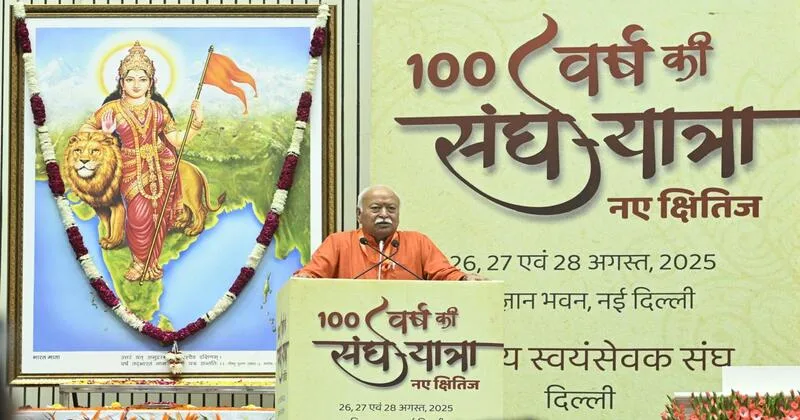
NEW DELHI: In a comprehensive and wide-ranging address on the second day of the three-day lecture series, “100 Years of Sangh Yatra – New Horizons,” Rashtriya Swayamsevak Sangh (RSS) Sarsanghchalak Dr Mohan Bhagwat articulated a vision for a renewed India and a more balanced world, defining ‘dharma’ as the central principle for both. Speaking at Vigyan Bhavan on August 27, his remarks offered a philosophical framework for addressing contemporary challenges, from global unrest and economic imbalances to societal fragmentation.
The lecture, held in the lead-up to the Sangh’s centenary year, saw Dr. Bhagwat present a multi-faceted vision for national and global well-being, emphasizing self-reliance, moral conduct, and a return to fundamental ethical principles. The event was attended by senior RSS functionaries, including Sarkaryavah Dattatreya Hosabale, and was a key moment for the organization to project its core philosophy to a broader audience.
‘Dharma’ as the Path to Balance
At the core of Dr. Bhagwat’s address was a profound definition of ‘dharma,’ which he distinguished from the Western concept of ‘religion.’ He explained that dharma is not about rituals or specific worship practices but is a universal principle of balance in life and society. “Dharma is what prevents any kind of extremism,” he stated. “India’s tradition calls this the middle path, and this is the greatest need of the world today.”
He contended that the modern world, dominated by a consumerist and materialistic worldview for the last three and a half centuries, has seen a decline in human decency. The solution, he proposed, is a global paradigm shift, a return to a “dharma-based” perspective that values harmony not just between people but also with nature. “Beyond all forms of religion, there is dharma,” he said. “Dharma teaches us balance—that we must live, society must live, and nature must live.” This perspective, he argued, is the only way to achieve true global peace and stability.
Championing ‘Swadeshi’ and Ethical Trade
In a timely comment amid escalating global trade tensions, Dr. Bhagwat called for India’s international trade to be based solely on voluntary participation, not on pressure. This statement comes as a crucial reinforcement of the ‘Atmanirbhar Bharat’ (Self-Reliant India) policy and a strong endorsement of ‘Swadeshi’ (economic self-reliance). He stressed that for India to achieve true self-reliance, it must prioritize indigenous products and economic models that are sustainable and environmentally friendly.
“We must present a development model that incorporates self-reliance, ‘Swadeshi,’ and ecological balance,” he said, suggesting that such a model would serve as a global example. He also touched upon India’s foreign policy, noting the nation’s historical tendency to exercise restraint and offer help to adversaries in times of crisis. He said that while the lines drawn on a map may create different countries, the people, rivers, and mountains remain the same, and the shared values of the subcontinent should be leveraged for mutual progress.
The Crisis of a Disenfranchised World
Dr. Bhagwat expressed deep concern about the current state of the world, which he sees moving towards fanaticism, conflict, and unrest. He highlighted the failures of international bodies and the lack of genuine solutions despite ongoing discussions on peace, the environment, and economic inequality.
To illustrate the source of this imbalance, he invoked Mahatma Gandhi’s seven social sins: “wealth without work, pleasure without conscience, knowledge without character, commerce without morality, science without humanity, religion without sacrifice, and politics without principles.” These “sins,” he said, have created deep-seated societal imbalances that must be rectified by adopting a more balanced and ethical approach.
The Sangh’s Role: Selfless Service and Social Transformation
Addressing the workings of the RSS, Dr. Bhagwat emphasized that the organization’s work is based on “pure, sattvic love and dedication to society.” He clarified that RSS volunteers do not seek personal gain; rather, they find joy and a sense of purpose in selfless service. “There are no incentives here; in fact, there are more disincentives,” he remarked, underscoring the volunteer-driven nature of the work.
He defined the Sangh’s life values as befriending the virtuous, ignoring the wicked, feeling joy when others do good, and showing compassion even to the malevolent. This philosophy, he argued, is what has earned the RSS the trust and credibility it holds in society today. “Society listens to what the Sangh says,” he affirmed, attributing this trust to the organization’s unwavering commitment to service and social dedication.
The ‘Hindutva’ Ethos and A Call for Unity
Defining ‘Hindutva,’ Dr. Bhagwat said its core essence is “truth, love, and a sense of belonging.” He reiterated that India’s sages taught that life is not for oneself alone and that India, as a “big brother,” has a role to guide the world towards its well-being.
He also addressed the historical rifts within Indian society, specifically those resulting from foreign ideologies. He stressed the need to bridge the distances created by these influences, acknowledging that individuals who adopted these beliefs are still part of the same nation. He called for understanding and empathy, stating, “We are all part of one country, one society, and one nation. Despite our diversities, we share common ancestors and a shared cultural heritage.” He urged a “positive and harmonious” approach to move forward, suggesting a gradual, step-by-step process of reconciliation.
‘Panch Parivartan’: A Five-Point Plan for Social Change
Dr. Bhagwat presented a practical blueprint for societal transformation, urging individuals to start the change at home. He outlined the “Panch Parivartan” or five transformations as the key to building a stronger society:
Family Awakening (Kutumb Prabodhan): Encouraging families to spend quality time together and uphold traditional values.
Social Harmony (Samajik Samarasata): Working to eliminate social divisions and promoting equality.
Environmental Protection (Paryavaran Sanrakshan): Fostering respect for nature and sustainable practices.
Self-Awareness (Swabodh – Swadeshi): Promoting a sense of national identity and prioritizing indigenous products. He gave examples such as wearing traditional attire during festivals, signing in one’s native language, and respectfully purchasing local goods.
Citizenship Duties (Nagrik Kartavyon ka Palan): Emphasizing adherence to the Constitution, laws, and rules of the land.
He particularly cautioned against destructive behavior during times of discontent, advising citizens not to be provoked by “anarchist elements” who seek to create chaos. “If there is any situation of provocation, do not burn tires or throw stones,” he said. “We should never engage in illegal conduct when provoked.”
A Vision for the Future
Concluding his address, Dr. Bhagwat outlined the future direction of the RSS. He stated that the Sangh’s goal is to reach every corner, class, and level of society. By connecting with and uniting well-intentioned people, the organization aims to empower society to take on the responsibility of character building and patriotism itself.
He stressed that the RSS does not seek credit for its work but envisions a transformative leap for India that not only revitalises the nation but also establishes peace and happiness throughout the world.














Comments