





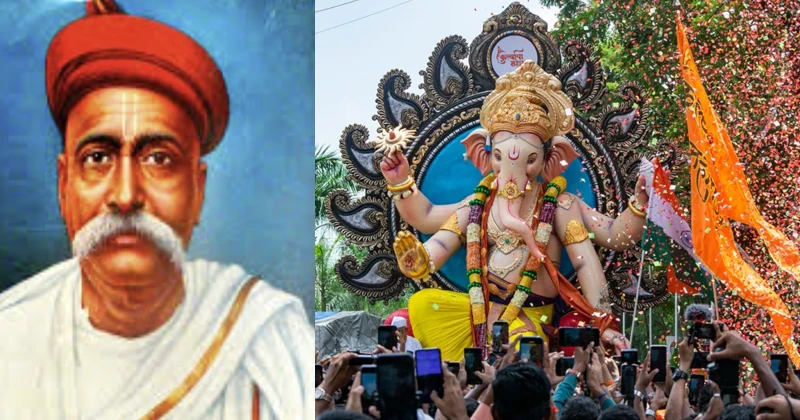
In the bustling lanes of Pune in 1893, the beats of the dhol reverberated louder than ever before. Towering murtis of Bhagwan Ganesha, housed in elaborately decorated pandals, began drawing massive crowds of Hindus who sang bhajans, recited patriotic verses, and whispered words of freedom. What had for centuries been a quiet, one-day household puja was suddenly reborn as a ten-day public celebration charged with the spirit of Hindutva, cultural pride, and political awakening.
The man behind this transformation was Lokmanya Bal Gangadhar Tilak teacher, journalist, orator, patriot, and above all, a visionary who understood that Utsavs could achieve what fiery speeches or political petitions could not: unite a divided people and inspire them to fight for Swaraj.
Until Tilak’s intervention, Ganesh Chaturthi was a modest Utsav celebrated within Brahmin households, largely confined to rituals, with little significance beyond religious devotion. The colonial British, meanwhile, had perfected their divide-and-rule policies, portraying Indians as “uncivilised” and imposing strict bans on large public gatherings.
Tilak saw an opportunity where others saw limitation. By taking Ganesh Chaturthi out of private homes and into the streets, he not only revived an ancient tradition but also created a public sphere where Hindus from all castes and classes could stand shoulder to shoulder. For the first time, carpenters, farmers, traders, and scholars alike came together under the gaze of Bhagwan Ganesha united by faith, bound by culture, and stirred by nationalism.
“Ganapati, the remover of obstacles, shall also remove the chains of slavery,” Tilak would thunder in his speeches. The deity of wisdom became the deity of freedom.
Tilak’s transformation of Ganesh Chaturthi was more than religious innovation—it was cultural resistance. He understood that the British were attempting to delegitimise Hindu civilisation by branding it backward and fragmented. To counter this narrative, he invoked Hindu symbols that were already deeply embedded in society and gave them a modern political meaning.
The Ganesha Utsav thus became a Hindutva platform—a celebration of Hindu unity, resilience, and pride. Pandals turned into nationalist classrooms where hymns blended seamlessly with patriotic songs, where mythological stories carried messages of freedom, and where cultural identity was reimagined as political identity.
By making Ganesh Chaturthi a public event, Tilak dismantled caste barriers. Every Hindu, regardless of background, had a place in the festivities. This unity—achieved through culture, not mere politics was precisely what unnerved the British Raj.
Tilak was no moderate content with crumbs from the colonial table. He belonged to the extremist school of nationalism, demanding complete self-rule rather than piecemeal concessions. Alongside thinkers like Aurobindo Ghosh, he championed aggressive political methods at a time when many leaders still sought compromise with the British.
His declaration, “Swaraj is my birthright, and I shall have it,” electrified the masses. Through his fiery newspapers Kesari (Marathi) and Mahratta (English), Tilak relentlessly attacked British exploitation and rallied public opinion against colonial injustice.
But it was his cultural strategy the Ganesh Utsav and later the Shivaji Utsav (initiated in 1896) that gave nationalism its heartbeat. If Kesari was his sword, Ganesh Chaturthi was his shield, protecting Bharat’s cultural soul while mobilising resistance against foreign domination.
Ganesh and Shivaji: Twin symbols of Hindu pride
For Tilak, Ganesh was not the only icon of Hindutva mobilisation. In 1896, he also began celebrating the birth anniversary of Chhatrapati Shivaji—the great Maratha king who had resisted Mughal domination. Shivaji represented political courage and Hindu sovereignty; Ganesh symbolised cultural unity and divine blessing. Together, they formed a twin pillar of resistance against British colonial rule.
Tilak encouraged young Maharashtrians to look to Shivaji as their role model and see in Ganesh their cultural guardian. He also initiated campaigns such as the boycott of foreign cloth to link daily life with nationalist duty. For millions of Hindus, freedom was no longer a distant ideal but an everyday responsibility.
Though firmly rooted in Hindutva, Tilak’s genius lay in broadening the scope of Ganesh Chaturthi beyond narrow religious boundaries. He infused the Utsav with debates on education, political rights, and social reform. In pandals, lectures on history, discussions on Swaraj, and recitals of patriotic poetry took centre stage.
Tilak was aware that Utsavs were not merely rituals they were opportunities for community dialogue and mass education. By reimagining Ganesh Chaturthi, he turned faith into a weapon of empowerment.
Tilak’s Hindutva was not exclusionary it was assertive. It sought to give Hindus confidence in their civilisation, unity against colonial policies, and pride in their culture. Far from dividing, his vision built bridges across caste lines and awakened a sense of collective destiny.
Today, Ganesh Chaturthi is one of Bharat’s grandest Utsav celebrated with enormous idols, booming processions, and nationwide devotion. Yet, behind the colour and splendour lies Tilak’s revolutionary idea: that culture could be weaponised against oppression.
In every Ganapati Bappa Morya chant, in every immersion procession, echoes the vision of a man who dared to dream that Utsavs could spark freedom. Tilak’s transformation of Ganesh Chaturthi proved that Hindutva, when harnessed as cultural nationalism, could shake even the mightiest empire.














Comments