





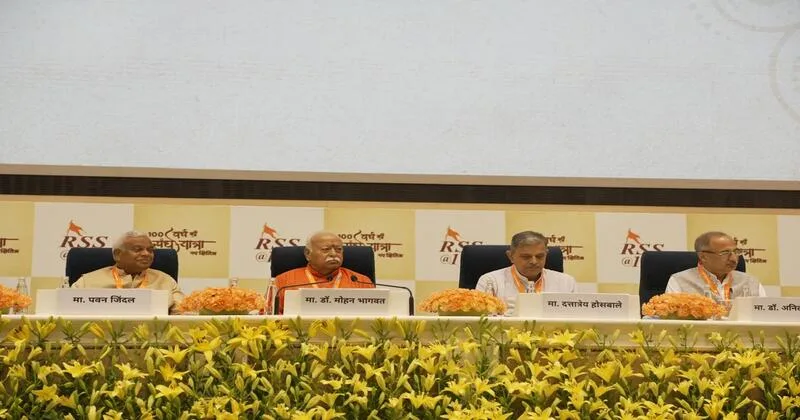
NEW DELHI – In a bid to counter the lack of authentic information about the Rashtriya Swayamsevak Sangh (RSS), Sarsanghchalak Dr Mohan Bhagwat delivered a candid and fact-based address in New Delhi on August 26, 2025. The event, held at the same venue as a similar interaction in 2018 ie Vijnan Bhavan, was designed to clarify the Sangh’s purpose, history, and foundational principles, moving the discussion from perception to verifiable facts.
Dr Bhagwat began by asserting the RSS’s core mission: serving Bharat. He emphasised the unique purpose of every nation, stating that each contributes to the world’s diversity and beauty. He then delved into the life of the RSS founder, Dr Keshav Baliram Hedgewar, whom he hailed as a “born patriot.” Dr Hedgewar’s journey, Bhagwat explained, was rooted in a deep-seated commitment to the nation, evident from his early years.
He shared details of Dr Hedgewar’s formative years, noting that he pursued medical education in Kolkata with community support and became an active member of the revolutionary Anushilan Samiti, where his code name was “Koken.” Dr Bhagwat highlighted that revolutionaries like Rash Behari Bose mentioned Dr Hedgewar in their documents, underscoring his early involvement in the freedom struggle.
Upon completing his education, Dr Hedgewar was offered a lucrative job in Burma with a salary of Rs 3000, secured through a recommendation from his professor. However, he declined the offer and instead chose to dedicate himself to revolutionary work in Nagpur. When asked about marriage by his uncle, Dr Hedgewar famously replied, “This life of mine is dedicated to the nation; concern for personal happiness shall be reserved for the next birth,” a quote Bhagwat shared to illustrate the founder’s unwavering dedication.
Dr Bhagwat then outlined the Sangh’s vision for leadership, citing Rabindranath Tagore’s writings on the need for “Nayaks,” or leaders, at every corner of Bharat. He described these ideal leaders as individuals of impeccable character, consistently connected with society, trusted by their communities, and willing to live and die for them. These are the individuals, he said, who form the social fabric.
The Sarsanghchalak acknowledged that while the RSS was formally established in 1925, its ideological seeds were planted in Dr Hedgewar’s mind much earlier. He declared that the Sangh’s purpose is to organise the entire society. Addressing a common question about the exclusion of other faiths, Dr Bhagwat clarified the RSS’s perspective: “For us, Hindu is the one who is responsible for this nation.” This statement encapsulates the Sangh’s belief that the responsibility for the nation’s well-being rests with those who identify with its civilisational and cultural ethos.













Comments