





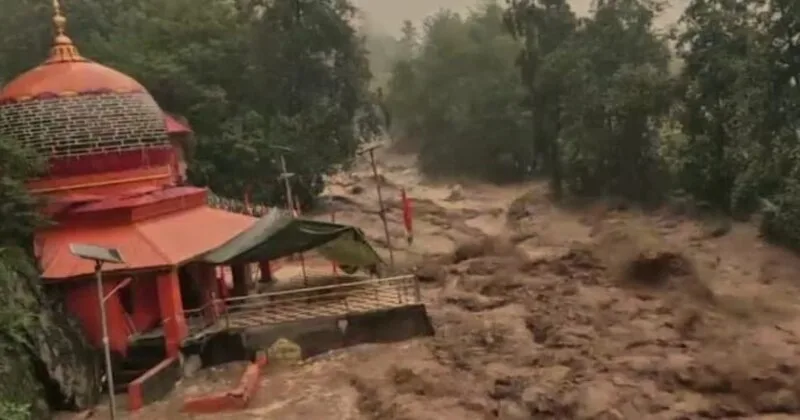
Four people lost their lives following a cloudburst in J&K’s Doda district on August 26, following similar disasters in Kathua and Kishtwar. The sudden, intense rainfall caused flash floods that damaged over 10 houses, officials reported.
#WATCH | Doda, Jammu and Kashmir | Continuous heavy rainfall across Doda district has triggered landslides, mudslides, and shooting stones, leading to the closure of several link roads as well as stretches of the national highway. pic.twitter.com/0EuHmW5XNu
— ANI (@ANI) August 26, 2025
The incident occurred amid weather department warnings of heavy to very heavy rainfall across several areas in the J&K region, including Kathua, Samba, Doda, Jammu, Ramban, and Kishtwar districts. As a precaution, all government and private schools in the Jammu division were closed due to the severe weather conditions.
Traffic on the Jammu-Srinagar national highway was halted as a precaution due to landslides and falling rocks. Additionally, a crucial road in Doda was washed away after a nearby stream overflowed its banks.
The River Tawi was in spate, with water levels already above danger marks in many rivers and streams. Officials warned of a further significant rise expected throughout the night.
“A flood alert has been issued for the Jammu region, and people are urged to avoid water bodies and landslide-prone areas,” a senior official stated.
Kathua district recorded the highest rainfall in the region with 155.6 mm over the 24 hours ending at 8:30 a.m. Monday, followed by Bhaderwah in Doda at 99.8 mm, Jammu at 81.5 mm, and Katra at 68.8 mm, according to the meteorological department.
Authorities have issued warnings for possible cloudbursts, flash floods, and landslides in high-altitude areas until at least August 27. Rescue and relief teams have been placed on high alert in vulnerable zones, officials said.
Jammu experienced record rainfall over the weekend, receiving 190.4 mm in 24 hours, the second-highest August downpour in a century. The highest recorded rainfall for the month was 228.6 mm on August 5, 1926, while the previous second-highest was 189.6 mm on August 11, 2022.
In Kashmir, moderate to heavy rains drenched the southern districts, with heavy downpours in the higher elevations. Although no flood alert was issued for the Jhelum river, water levels are expected to rise. Central Kashmir saw light to moderate showers, while north Kashmir experienced light rain or dry conditions.
















Comments