





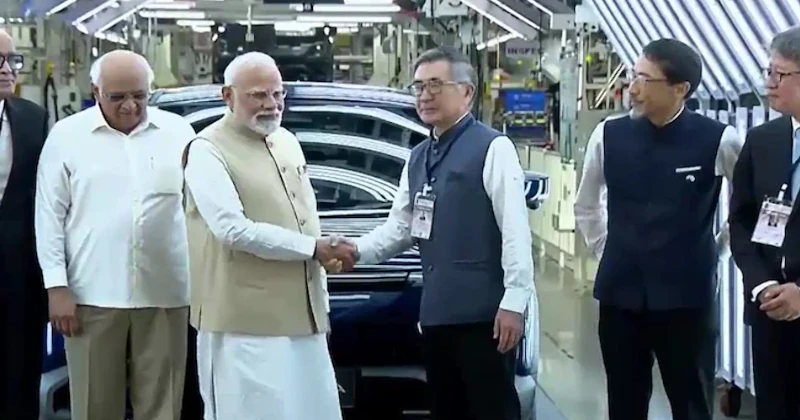
Prime Minister Narendra Modi on August 26 flagged off the export of Maruti Suzuki’s first global Battery Electric Vehicle (BEV), the e-Vitara, from Suzuki Motor Gujarat’s Hansalpur plant. The vehicle, made entirely in India, will be exported to over 100 countries including advanced markets like Europe and Japan, firmly placing India on the global electric vehicle map.
The launch came alongside the inauguration of localised hybrid battery electrode production at the TDS Lithium-Ion Battery plant—a joint venture between Toshiba, Denso, and Suzuki—also situated in Gujarat. With this move, India is set to manufacture more than 80 percent of the battery value domestically, drastically reducing import dependence and reinforcing the Aatmanirbhar Bharat vision.
From his Red Fort address to an event in Ahmedabad, PM Modi stressed that the upcoming festive season should celebrate self-reliance and urged people to opt for swadeshi goods.
“This is the season of festivals. Now Navratri, Vijayadashami, Dhanteras, Deepawali… all these festivals are coming. These are celebrations of our culture, but they should also be celebrations of self-reliance. Therefore, I want to reiterate my request to you once again that we must adopt a mantra in our lives: whatever we buy will be ‘Made in India’, it will be indigenous,” PM Modi said, as quoted by news agency media.
#WATCH | Gujarat: Prime Minister Narendra Modi flags off the 'e-VITARA', Suzuki’s first global strategic Battery Electric Vehicle (BEV), at the Suzuki Motor plant in Hansalpur, Ahmedabad.
(Source: DD News) pic.twitter.com/CLKE9nvnKG
— ANI (@ANI) August 26, 2025
PM Modi’s ‘Green Swadeshi’ push
Calling the day “special in India’s quest for self-reliance and becoming a hub for green mobility,” Prime Minister Modi emphasised how the dual milestone local production of hybrid battery electrodes and the flagging off of Suzuki’s e-Vitara represents a new phase in India’s Make in India journey.
“Today is a special day in India’s quest for self-reliance and being a hub for green mobility. At the programme in Hansalpur, e-VITARA will be flagged off. This Battery Electric Vehicle (BEV) is made in India and will be exported to over a hundred nations. In a big boost to our battery ecosystem, production of hybrid battery electrodes will also commence at a plant in Gujarat,” PM Modi wrote on X.
The launch of hybrid battery electrode production at the TDS Lithium-Ion Battery plant is equally significant. With India now producing key components of EV batteries locally, the country is reducing its dependency on expensive imports, especially from East Asian nations.
“This development ensures that more than eighty percent of the battery value will now be manufactured within India,” a government release stated, highlighting how this would create jobs, reduce costs, and secure supply chains for the growing domestic and international EV market.
E-Vitara is positioned as a global electric SUV and measures 4,275mm in length, 1,800mm in width, 1,640mm in height, and has a 2,700mm wheelbase. It uses a 3-in-1 electric system that integrates the motor, inverter, and transmission. Customers will have a choice between two battery packs: a 49kWh unit paired with a front-mounted motor producing 144hp and 189Nm, and a larger 61kWh unit paired with a front motor generating 174hp and 189Nm.
Maruti Suzuki will back the e Vitara with a robust charging and service network. Owners will receive smart home chargers with installation assistance, while public fast-charging points will be rolled out in the top 100 cities within 2–3 years, at intervals of every 5–10km. To further strengthen after-sales support, the company will establish 1,500 EV-ready workshops across more than 1,000 cities.















Comments