





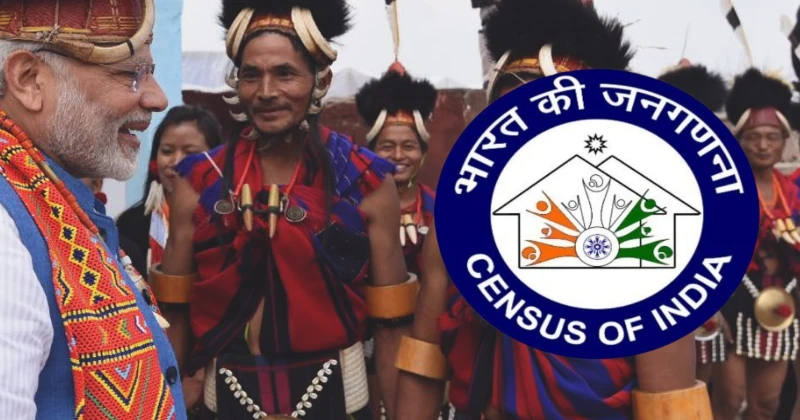
The Ministry of Tribal Affairs (MoTA) has formally urged the Registrar General and Census Commissioner of India (RGI) to separately enumerate Particularly Vulnerable Tribal Groups (PVTGs) in the upcoming 2027 Census. If finalised, this will be the first time in India’s Census history that these groups, considered the most marginalised among Scheduled Tribes (STs), will be distinctly counted.
For decades, PVTGs though officially recognised as the country’s most disadvantaged tribal communities remained lost in the broader Scheduled Tribe category, their true numbers obscured, and their extreme deprivation statistically invisible. With this initiative, the Modi government is set to change that.
India is home to more than 700 tribal communities, of which 75 have been identified as PVTGs spread across 18 states and the Union Territory of Andaman & Nicobar Islands. They were classified on the basis of:
- Stagnant or declining populations,
- Pre-agricultural levels of subsistence,
- Extremely low literacy,
- Geographical isolation,
- Economic backwardness.
The Dhebar Commission of the early 1960s had first marked out these groups—then termed Primitive Tribal Groups—as communities facing the severest disadvantage even within STs. Yet, despite the recognition, Census after Census failed to record them separately.
The result: in the 2011 Census, PVTGs were swallowed within larger ST categories. While some 40 groups were reflected as part of broader notified STs, others simply disappeared from records. This invisibility prevented the government from accurately mapping their population, living conditions, or cultural distinctiveness.
As Professor A. B. Ota, former director of Odisha’s Tribal Research Institute, observed, “Many PVTGs are actually sub-groups within bigger ST communities. Since they are not separately recorded, the government does not get accurate numbers on their population or living standards.”
Correcting this gap has become a priority under Prime Minister Narendra Modi, who has repeatedly stressed that no community should be left behind in India’s growth journey.
In November 2023, the Prime Minister launched the PM-JANMAN (Pradhan Mantri Janjati Adivasi Nyaya Maha Abhiyan) in Jharkhand—a massive programme designed to saturate PVTG habitations with basic facilities within three years. The scheme covers 200 districts across the country and spans 11 critical interventions implemented by nine ministries, including:
- Road and telecom connectivity,
- Housing, drinking water, electricity,
- Schools and health centres,
- Nutrition and livelihood opportunities.
The ambition was clear: to close the development gap that has persisted for decades.
But a deeper problem quickly became apparent the data itself was faulty. At the time of PM-JANMAN’s launch, the Centre estimated PVTG population at 28 lakh. A special habitation-level survey using the PM Gati Shakti mobile app revealed the real number to be far higher. MoTA informed Parliament earlier this year that the PVTG population is now estimated at 45.56 lakh.
State-wise, Madhya Pradesh leads with 12.28 lakh, followed by Maharashtra (6.2 lakh) and Andhra Pradesh (4.9 lakh). The massive discrepancy underscores why precise enumeration is urgently required. In a strongly worded letter dated July 17, Ajeet Kumar Srivastava, Joint Secretary in MoTA, wrote to the RGI emphasising that separate enumeration was essential for targeted schemes like PM-JANMAN.
Describing PVTGs as the “most marginalised and socio-economically backward vulnerable section of our population,” the letter argued that “precise enumeration will certainly be of great support towards the formulation and implementation of targeted schemes for PVTGs.”
The Ministry called for not just population counts but also detailed recording of PVTG households’ demographic, cultural and socio-economic features, and suggested a high-level meeting between Census authorities and MoTA to finalise survey design.
Experts in tribal affairs have welcomed the step as long overdue. Professor Kamal K. Misra, former director of the Anthropological Survey of India, noted that the current list of 75 PVTGs itself may need updating, “There are overlaps across states due to nomenclature, and in some cases, omission of certain groups. Thus, only a revision of the criteria can help update the information.”
He added that once Census data is available, the government must build a PVTG Development Index to pinpoint which communities face the most acute challenges—since deprivation levels vary across groups.
Research paints a stark picture. A peer-reviewed review of 13 PVTGs in Odisha, covering studies from 2000–2023, found disproportionately high health burdens, extremely low literacy, poor maternal and child health outcomes, and inadequate access to even basic services.
Sociological studies further show:
- PVTGs largely inhabit remote and inaccessible regions,
- Many depend on subsistence economies with little or no exposure to modern livelihoods,
- Populations in some groups are stagnant or declining,
- Literacy remains shockingly low compared to other STs.
These conditions highlight why decades of clubbing them under broad ST data proved disastrous welfare could never be properly targeted.
Some communities, like the Jarawas of Andaman Islands, live in voluntary isolation and are often portrayed as unreachable. But experts argue that with culturally sensitive approaches, even such groups can be documented respectfully for Census purposes ensuring their inclusion without violating their autonomy.
The 2027 Census, to be conducted in two phases house listing and housing Census in April 2026, followed by main population enumeration will also include a caste-based survey. If PVTGs are separately enumerated, it will mark a watershed moment in India’s statistical history.
For the first time, the most vulnerable tribal groups who have remained invisible in official records for decades will gain recognition, visibility, and the possibility of targeted, data-driven interventions.
The Modi government’s push signals more than administrative reform; it represents a civilisational commitment to justice for those who have lived for centuries on the margins of India’s development story.











Comments