





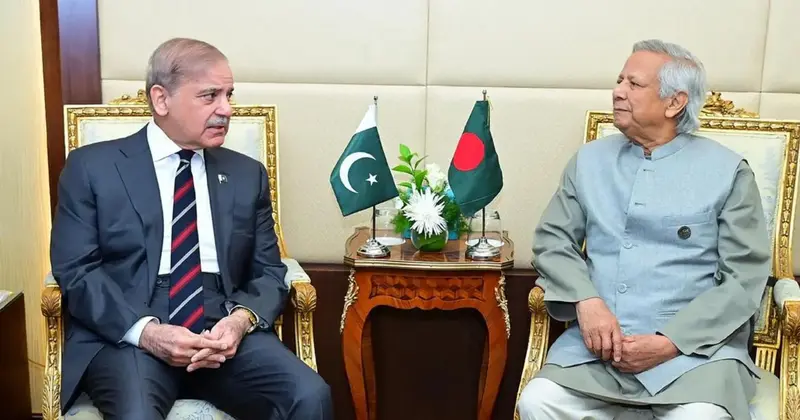
The Chief Advisor of the Bangladesh interim government Muhammad Yunus has demanded an ‘apology’ from Pakistan for the atrocities committed by Islamabad during the 1971 Bangladesh Liberation War. However, Pakistan has refuted these allegations and has denied to seek the pardon. The latest row aroused during the visit of Pakistan’s Deputy Prime Minister and Foreign Minister Ishaq Dar to Dhaka. This is the highest level visit to Dhaka till date from Islamabad, since the Interim government took charge and the process of normalization of ties between Pakistan and Bangladesh unleashed.
The Bangladesh Ministry of Foreign Affairs issued a statement and demanded a formal apology from the Pakistan for the genocide committed by the West Pakistan in East Pakistan in 1971. The statement has also asserted that other issues between Islamabad and Dhaka should be resolved including division of assets amounting to US $ 4.52 billion, transfer of foreign aid meant for cyclone victims etc. Resolving these bottlenecks is crucial to take forward the bilateral relations in a stable and peaceful way, the statement further added.
What led to the latest row?
During the visit of Pakistan Foreign Minister to Bangladesh the initial meetings were cordial. However, rift emerged when Pakistan Foreign Minister Ishaq Dar met the former Prime Minister of Bangladesh Khaleda Zia who belong to Bangladesh Nationalist Party(BNP), which has tensions with the interim government. He also met the leaders from Jamaat-e-Islami, a party that had historically opposed the independence of Bangladesh from Pakistan in 1971, thus further adding to the strain.
Irked by the political developments between Pakistan Foreign Minister and the political rivals of the interim government, Chief Advisor Muhammad Yunus demanded an apology from Pakistan for the historical atrocities. Reports also claim that the demand by Yunus came in response to the political pressures faced by him within the domestic camps. Many analysts thus assert that the demand for apology from Pakistan is an outgrowth of local political dynamics unraveling in Bangladesh. Whether this leads to any major diplomatic breakthrough between Islamabad and Dhaka in terms of resolving the historical wounds, is doubtful.
Pakistan refuses to seek pardon
The Foreign Minister of Pakistan Ishaq Dar after flying back to Islamabad from Dhaka, refused to apologize and conceal for the demands of Bangladesh. He also exclaimed that the issues pertaining to the 1971 Bangladesh Liberation War has been resolved twice in 1974 and then again in July 2000 when General Pervez Musharraf visited Bangladesh.
Meanwhile, the Foreign Minister of Bangladesh Md. Touhid Hossain has refuted the claims of his Pakistani counterpart regarding the historical issues being solved. He said that both nations are not on the same page regarding the ‘unsettled issues’ from 1971. “Definitely, I don’t agree (with Dar). Had it been so, the problems would have been solved. It would be wrong to expect problems of 54 years to be solved in a single day”, said the Foreign Minister of Bangladesh.
This is not the first time that Dhaka has sought for an apology from Islamabad for the 1971 genocide. During the foreign secretary level talks held few days ago between both the nations, Bangladesh had asked Pakistan to resolve the unsettled historical issues and settle the pre-independence asset sharing and demanded for an apology as well for the atrocities committed during the Liberation War.
The latest row testifies the fact that deep scars and historical wounds still prevail between Pakistan and Bangladesh despite the recent reconciliation efforts under the interim government of Dhaka. It also raises doubts on whether the latest bilateral bonhomie witnessed between the two countries is just superficially etched to fulfil short-term political goals in both the nations, without resolving the deeper wounds. Moreover, Pakistan acceding to the demands of Bangladesh on either seeking an apology or dividing the assets is indeed a mirage and will be a geopolitical marvel!













Comments