





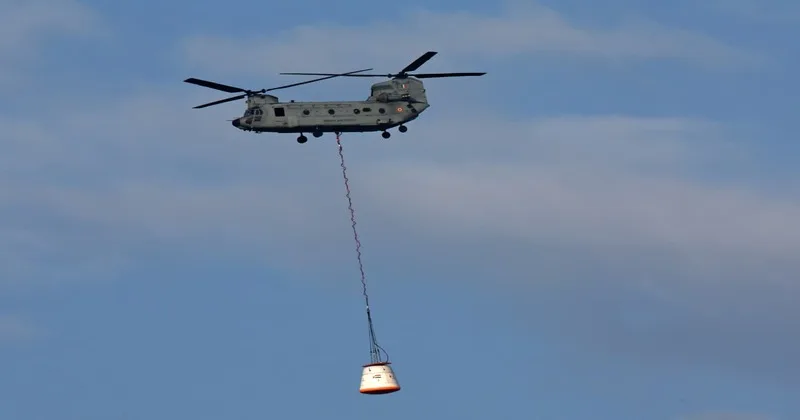
The Indian Space Research Organisation (ISRO) has successfully accomplished the Integrated Air Drop Test(IADT-01) as a part of the ambitious Gaganyaan mission, country’s first human spaceflight programme. The Air Drop Test marks a major leap in the Gaganyaan mission and brings the nation an inch closer to the most awaited space programme.
As per the statements from ISRO, the successful demonstration is an impact of the combined effort from various government agencies and research institutions such as DRDO, Indian Air Force, Indian Navy and the Indian Coast Guard.
ISRO successfully accomplishes first Integrated Air Drop Test (IADT-01) for end to end demonstration of parachute based deceleration system for Gaganyaan missions. This test is a joint effort of ISRO, Indian Air Force, DRDO,Indian Navy and Indian Coast Guard pic.twitter.com/FGaAa1Ql6o
— ISRO (@isro) August 24, 2025
Gaganyaan is the most anticipated and ambitious space programme of the country. India’s maiden human spaceflight programme intends to send the selected and trained astronauts to the Low Earth Orbit(LEO) i.e. approximately 400kms away from the earth’s surface for a duration of 3-days and the space project is deemed as a key component of the Viksit Bharat goal. Gaganyan is said to use LVM-3 as the launch vehicle which was previously called as the GSLV Mk-3.
Prime Minister Narendra Modi had announced the ambitious space mission in 2018, during his Independence Day speech. With the success of the Gaganyaan mission India will be the fourth country to do so and will be one among the elite space club that has championed the indigenous human space mission including US, Russia and China.
The latest accomplishment of India in its space missions history, i.e. the Group Captain Shubhanshu Shukla’s voyage to the International Space Station(ISS) as a part of the Axiom-4 crew and his first-hand experience at the ISS, will provide critical inputs for the success of India’s indigenous Gaganyaan mission.
Earlier, Union Minister of State for Science and Technology had briefed the Parliament regarding the updates of the Gaganyaan mission. “The Propulsion systems for Crew Module and Service Module have been developed and tested. ECLSS engineering model realised as a part of the orbit module. 5 types of motors developed and have been static tested as a part of the crew escape module. Orbital Module Preparation Facility, Gaganyaan Control Centre, Gaganyaan Control facility, Crew training facility, Second Launch pad modifications have been developed as a part of the critical and essential infrastructure” Singh said in Lok Sabha.
Ground network configuration has been finalised. Feeder stations and terrestrial links have established. Recovery assets as a part of the crew recovery operations has been finalised. Crew Module and Service module structures have been realised. Singh further added, in a written reply to the Lok Sabha.
“There are thousands of components and at least 10 lakh lines of code that need to be written for ensuring that the crew in the launch vehicle is safe, can escape in case of an emergency, and they can be brought back safely to Earth after the mission is completed,” Narayanan, Chairman of ISRO reiterated.
As per the latest updates, Gaganyaan mission will accomplish in the first quarter of 2027. It will be preceded by three test launches including two unscrewed mission and one with a robot. Gaganyaan is said to be the first step in India’s long-term space ambitions such as developing country’s own International Space Station called as Bharatiya Antariksha Station(BAS) and sending manned-flight to moon by 2040.














Comments