





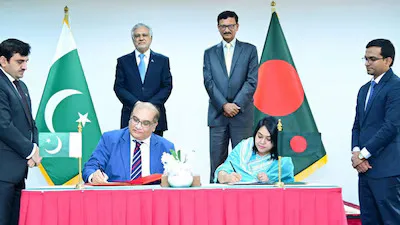
Bangladesh is hosting Pakistan’s Deputy Prime Minister and Foreign Minister Ishaq Dar, marking the most significant diplomatic exchange between the two countries in more than a decade. Dar met Bangladesh’s Chief Adviser Muhammad Yunus, trade envoys, and political leaders to discuss reviving old connections, boosting youth linkages, expanding trade, and enhancing connectivity.
The two nations signed six agreements, including a visa-free entry pact for diplomats, cultural exchange programs, and memoranda of understanding (MoUs) on trade, media, and strategic studies.
Bangladesh Army’s Quarter Master General, Lieutenant General Md Faizur Rahman, travelled to Pakistan this week in what is being seen as an attempt to recalibrate civil-military relations between the two countries, more than five decades after the 1971 Liberation War.
In Dhaka, Pakistan’s Deputy Prime Minister Ishaq Dar held a series of high-profile meetings. He met Jamaat-e-Islami’s deputy leader, Syed Abdullah Muhammad Taher, where discussions reportedly centred on strengthening ties with what was described as the “brotherly Muslim state” and exploring ways to build a more active regional alliance.
Dar also engaged with representatives of the newly formed National Citizen Party, which played a key role in last year’s uprising, and later held talks with the Bangladesh Nationalist Party (BNP) leadership, signalling Islamabad’s intent to widen its outreach across Dhaka’s political spectrum.
According to intelligence sources quoted in News 18, India views the growing Pakistan–Bangladesh proximity with serious concern on three strategic fronts:
India-Pakistan Border: Risk of escalated hostilities and proxy activities.
India-Bangladesh Border: Rising influence of Jamaat-e-Islami and BNP, seen as hostile to Indian interests.
India-China Border: Speculation that Bangladesh could tilt closer to the China-Pakistan axis.
The report highlights that Chinese and Pakistani influence in Dhaka adds pressure on Indian defence forces, already stretched across the Indian Ocean, Bay of Bengal, Arabian Sea, LoC and LAC.
For India, this evolving alignment between China, Pakistan, and Bangladesh raises questions of a two-front challenge in South Asia, with the possibility of anti-India groups gaining stronger ground across the eastern border.















Comments