





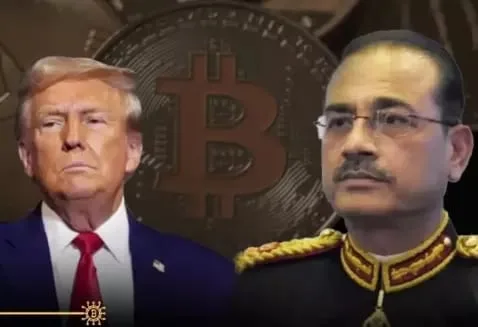
The United States has been unusually close to Pakistan over the past few months. Statements by President Donald Trump that run counter to India’s interests, along with his misleading claims regarding mediation in Operation Sindoor, have gone beyond standard diplomatic posturing. Notably, Pakistan’s army chief, Field Marshal Asif Munir, met Trump twice within two months, a frequency unprecedented even during Trump’s first term. Previously, Trump, a vocal critic of Pakistan, had cut off financial aid to Islamabad. Yet, after assuming office for a second term, Pakistan has emerged as one of Trump’s favoured countries.
The driving force behind this rapprochement appears to be a secret financial arrangement involving cryptocurrency between the Trump administration and Pakistan’s political and military leadership. A complex network, including members of the Trump family, terrorist organisations, and Pakistani military officials, is reportedly operating behind this deal. In line with this, the United States has frequently adopted an anti-India stance, ostensibly to appease this network.
Bilal bin Saqib has emerged as a central figure in Pakistan’s cryptocurrency project. He serves as the CEO of the newly established Pakistan Crypto Council (PCC) and as a special assistant to the Pakistani Prime Minister. A British-Pakistani entrepreneur, Bilal is also an advisor to the Trump family’s cryptocurrency venture, World Liberty Financial (WLF), in which Trump’s sons Eric and Donald Jr., along with son-in-law Jared Kushner, reportedly hold 40 per cent ownership.
The timeline of Bilal’s dual roles is revealing. On April 15, 2025, WLF appointed him as an advisor. Shortly thereafter, in May, Pakistan named him CEO of the PCC. In effect, Bilal became a trusted intermediary for both countries. While representing Pakistani interests in Washington, he is reportedly implementing American agendas from Islamabad. In June 2025, he met with dozens of US lawmakers, including Senator Cynthia Lummis, co-sponsor of the Bitcoin Act, Senator Bill Hagerty of the Banking Committee, White House advisers, and New York City Mayor Eric Adams. Bilal has been promoting Pakistan’s cryptocurrency vision while simultaneously advising Trump’s private crypto enterprise.
For India, the implications are significant. The new crypto deal between WLF and the Pakistani government is believed to facilitate money laundering and the financing of terrorism. The primary channel appears to be Binance, the world’s largest cryptocurrency exchange. Changpeng Zhao, Binance’s founder, is a pivotal figure in this arrangement. Despite claims of distancing Binance from China, multiple sources indicate Zhao retains strong Chinese connections. His partner, Yi He, is vice president of Yixia Technology, a company partly owned by the Chinese Communist Party, indicating potential Chinese involvement.
Zhao’s background raises further concerns. He previously served a four-month prison sentence in the United States for his role in facilitating money laundering tied to terrorism. Investigations revealed that he helped transfer funds to groups including Hamas, al-Qaeda, and ISIS. In November 2023, the US Department of Justice, Treasury, and Commodity Futures Trading Commission imposed a record $4.3 billion fine on Binance, following findings that the platform violated money laundering laws, including processing $1.1 million in transactions to Iran in breach of US sanctions. Zhao and Binance pleaded guilty. Binance has also faced indictments in multiple countries, including France, India, and Canada, for money laundering and terrorism financing.
Currently, Zhao serves as a strategic advisor to the PCC. After completing his prison sentence, he began working closely with Trump’s WLF and now collaborates with Bilal bin Saqib at the centre of Pakistan’s crypto initiative. Pakistan aims to leverage Zhao’s experience in terrorism financing and money laundering, with India as the likely target.
A network of shell companies reportedly operates under Bilal’s leadership. These entities, sharing a single address, lack websites or financial transparency. Bilal’s sister, Minahil, owns 75% of a company called Tayaba UK, a charitable organisation partnered with the Al Mustafa Trust (AMT), which manages the illicit finances of the Pakistani military. AMT is reportedly run by retired army, navy, and air force officers and is not linked to Pakistan’s official defence budget.
Since the signing of the crypto agreement in May 2025, US-Pakistan relations have deepened markedly. Multiple agreements have followed, alongside Field Marshal Munir’s two visits to Washington within a two-month period. In a symbolic gesture, Pakistan even nominated Donald Trump for the Nobel Peace Prize.
A further illustration of America’s anti-India posture is Trump’s appointment of Sergio Gore as the next US ambassador to India. Gore, a close confidant of Trump, was also named special envoy for South and Central Asia, granting him extensive powers, an unprecedented step. This move reflects a deliberate effort by Washington to influence and escalate regional geopolitics in South Asia.
Against this backdrop, the Modi government’s policy of resisting pressure from the Trump administration, whether on trade negotiations or India’s continued import of Russian oil, appears particularly prudent. By standing firm, New Delhi has avoided bowing to external pressures that could compromise national and regional interests.
The US-Pakistan rapprochement under Trump’s second term, fuelled by secret cryptocurrency deals and strategic appointments, presents a complex geopolitical challenge. With Pakistan seeking to exploit financial networks and cryptocurrency expertise to advance its interests, India faces heightened risks. The developments underscore the critical importance of vigilance in financial regulation, counter-terrorism financing, and regional diplomacy.














Comments