





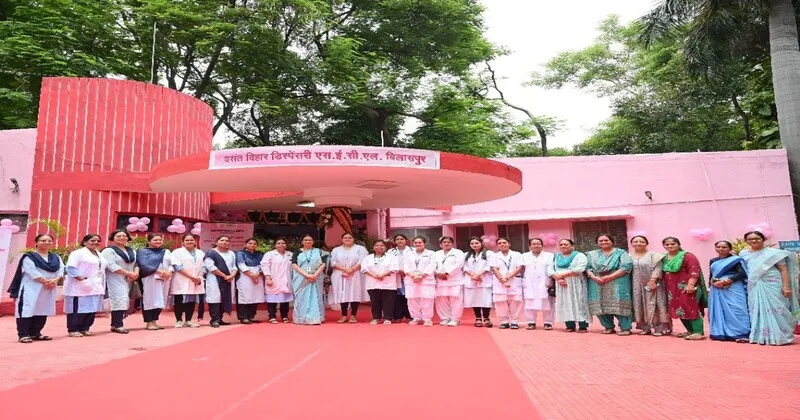
Coal India Limited (CIL) is one of the largest coal-producing companies in the world, it has opened its first women’s operated dispensary at Vasant Vihar, Bilaspur under South Eastern Coal fields Limited (SECL). This initiative was launched on July 14, 2025, represents a change in the country’s largest public sector undertaking, where women are no longer only participants, but are being prepared as leaders to define the future of the industry.
Breaking Stereotypes in a Male-Dominated Industry
Mining has long been a male-dominated job profile. Physical work, tough working conditions and deep-seated stereotypes have kept women from frontline activities for decades. CIL’s new all-female dispensary breaks through these boundaries. With exclusively female staff, it provides integrated healthcare services while demonstrating that gender does not determine ability.
This is not an isolated development. Across CIL’s subsidiaries, similar women-led initiatives are being introduced. From technical labs to healthcare units, women are entering in spaces previously considered unsuitable for them. Rajendra Nagar Dispensary at Ranchi (CCL), Koyla Nagar Hospital’s Day shift in Dhanbad (BCCL) and Sadbhavana Colony Dispensary in Nagpur (WCL) are the example of this silent and groundbreaking revolution.
Beyond dispensaries, women are managing highly specialised units across the coal belt. At SECL’s Central Excavation Workshop in Gevra, women oversee the Condition-Based Monitoring Laboratory. In Dhanbad, a Centralised Technical Centre for LED and Solar Equipment operated wholly by women technicians, representing a trailblazing induction of women into core technical work. NCL’s headquarters at Singrauli has an all-women employee team for the Cost & Budget Cell, which is redefining financial handling in the industry.
These units are not just symbolic gestures. They are indications of systemic shifts in institutional thought, evidence that women can perform critical tasks from patient care to high-tech technical maintenance.
Building Women Leaders: The Jyoti Initiative
Realising that the structural changes need to go beyond symbolic representation, CIL initiated “Jyoti programme Rising Together, Leading the Way,” a leadership program of excellence with the help of Indian Institute of Coal Management (IICM). The journey of five-month programmes has empowered women executives with communication, decision-making, negotiation and emotional quotient skills.
The goal of programme is very simple, establish a pipeline of female leaders who are prepared to assume senior roles. The participants benefited from mentoring, access to best practices and networking that prepares them for the top positions in an industry modernization age.
Outlook of opportunities apart from gender
CIL’s gender reforms is not only limited to the leadership programmes. Reforms in policies have included the female dependents as eligible candidate for work after the death of an employee, regardless of marital status. That’s a critical move towards gender parity in labour opportunities.
All committees in CIL are now required to have one woman representative for integrating inclusivity into decision-making forums. This makes way for women’s voices to be heard in areas that shape organisational direction and policy.
One of the important changes has been the inclusion of women in underground mining operations. Women were earlier excluded from these opportunities, but today women are being trained to gain Mining Sirdar Certificates of Competency. They are being incorporated in the rescue and recovery operations classes demanding very high courage and technical competence.
Till date 19 women of Western Coalfields Limited (WCL) and 9 women of Mahanadi Coalfields Limited (MCL) have undergone training for rescue work. This represents a cultural change, showing that skill and toughness is above gender, that determine competence in times of crisis.
CIL has also enhanced institutional protections for women workers. Internal Complaints Committees (ICCs) operate unit-wise under the Sexual Harassment of Women at Workplace (Prevention, Prohibition and Redressal) Act, 2013. They are charged with developing a safe workplace environment where women workers can work without fear of harassment or discrimination.
The push is not confined to Coal India alone. Neyveli Lignite Corporation India Limited (NLCIL) a public sector mining giant, it has incorporated 190 women into its mine workforce, 48 of them as executives. Women now hold statutory posts like surveyors, mining sirdars and overmen in nine statutory posts as a first for India’s mining history.
This combination not only makes the workforce more diverse but also assures women’s inclusion in core operations, reinforcing technical production as well as institutional tradition.
A Quiet Revolution in Coal Sector
These initiatives represent a quiet revolution in India’s coal belt. What started with the opening of a single dispensary has ignited a chain of women’s healthcare units, labs, financial cells and technical centres. It has paved the way for women to join mining operations, head teams and enter decision-making at the top.
Coal India’s initiative is not only about gender norm compliance, but transforming a public sector into a contemporary, responsive institution that can navigate the needs of the 21st century.
The transition in making women’s independent is continuous process, in the 21st century women’s are becoming entrepreneurs. A detailed report on government digital initiative Sakhi Udyam Portal is truly a supporting Mahila Sashaktikaran. For more information, detailed report is covered by Organiser.
There are still obstacles in changing the traditional attitudes and mindset, providing equal opportunity and building suitable infrastructure for women in distant mining regions. With well-scheduled leadership programmes, specially designed policies and integration in real-time supported the foundation of women’s growth.
As India pursues energy security and sustainable industrial development, women’s contribution in the coal and allied industries will be crucial. From dispensaries to mines, leadership training to rescue operations, women are no longer on the periphery they are the epicentre of action.










Comments