





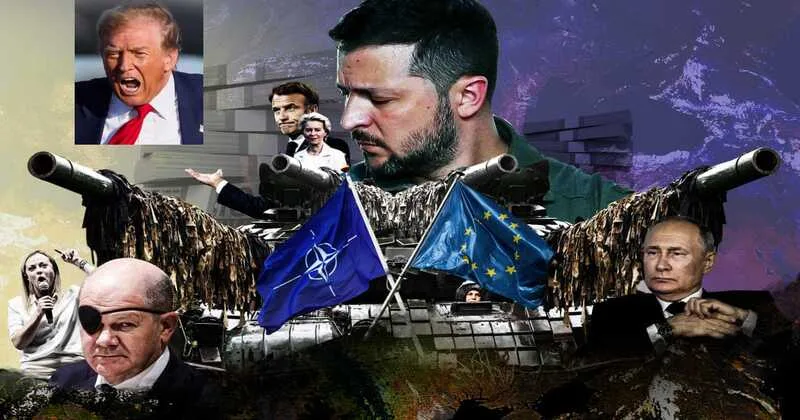
War clouds are thickening over Europe as diplomatic overtures to end the Russia-Ukraine conflict falter, and NATO members brace for the worst. US President Donald Trump himself has ruled out the possibility of an imminent ceasefire, declaring that peace in Europe is nowhere in sight. His stark words coincide with an alarming surge in military fortifications, troop deployments, and escalatory moves across the continent, signaling that the war may spill far beyond Ukraine’s borders.
Baltic States Brace for Invasion with Massive Fortifications
The clearest sign of this looming crisis is Lithuania’s unprecedented defensive measures along its Baltic frontier. The country has launched a massive project to build a 30-mile-deep defensive wall on its borders with Kaliningrad and Belarus to deter Russian incursions. This formidable barrier, projected to span over 940 miles when complete, includes minefields, anti-tank Dragoon systems, and engineering parks filled with counter-mobility equipment such as razor wire, concrete roadblocks, and pyramids. It is a three-layered system, starting with an anti-tank ditch, sandbanks, and strips of dragon’s teeth, followed by minefields and infantry fortifications. The plan even envisions explosive-laden bridges and tree clearing on access roads to slow Russian armored advances. Lithuania has increased its defense spending to an astonishing 5.5 percent of GDP, the highest rate among NATO members, while maintaining 23,000 professional soldiers and 104,000 reservists. These preparations underscore the fear that Moscow could strike through the vulnerable Suwalki Gap, NATO’s critical land link to the Baltic states.
This is not an isolated measure. Estonia, Latvia, Lithuania, and Poland are collectively reinforcing their borders, adding barriers to existing fences, and lobbying for EU funding for these vast projects. The Baltic fortifications are part of a larger NATO strategy to create an impregnable shield against Russia, reflecting a grim reality that European leaders no longer expect diplomacy to halt Moscow’s aggression. Instead, they are preparing for protracted confrontation.
Poland Accuses Russia After Drone Explosion Near Border
Poland, a frontline NATO state and one of Ukraine’s staunchest allies, has amplified these fears with fresh accusations against Moscow. A Russian drone crashed and exploded in a cornfield near the village of Osiny in eastern Poland, shattering windows in nearby homes. Polish Defence Minister Wladysław Kosiniak-Kamysz branded it “another provocation carried out by the Russian Federation,” noting that it came at a sensitive moment when hopes for peace talks were flickering. Investigators identified the drone as a Russian version of the Iranian-made Shahed, fitted with a Chinese engine. The Polish military confirmed no recent airspace violations from Ukraine or Belarus, further suggesting deliberate Russian intent. This incident adds to a series of airspace breaches since Russia’s full-scale invasion in 2022, starkly illustrating the proximity of the war to NATO soil.
Western Europe Ramps Up Military Posture as Peace Prospects Fade
Meanwhile, Western Europe is mobilizing at an unprecedented scale. The Netherlands has dispatched 300 troops and Patriot air defence systems to Poland to “defend NATO territory, protect supply to Ukraine, and deter Russian aggression.” Germany has sent five Eurofighter jets to Poland and deployed an additional five jets and 270 soldiers to Romania, where two fighters were mobilized to respond to Russian airstrikes near Ukraine’s border. These deployments mirror an intensifying military posture that includes joint exercises simulating Russian attacks through Belarus and bolstering electronic warfare and drone defense capabilities.
France and the United Kingdom are actively exploring plans to send force in Ukraine, contingent on a ceasefire that now appears illusory. British Prime Minister Keir Starmer has expressed willingness to lead security guarantees for Ukraine if a permanent truce materializes, including sending troops to enforce stability. Reports indicate that London had even sketched a plan to send 30,000 European soldiers to guard Ukrainian cities and infrastructure, relying on advanced surveillance, drones, and naval patrols. France has floated similar proposals for a “reassurance force” that would station thousands of troops in strategic locations such as Kyiv, Lviv, and Odessa. However, these scenarios remain hypothetical as Russia escalates rather than de-escalates, and Trump’s blunt assessment confirms that peace remains a distant dream.
Russian Strike Hits US Firm as Trump Warns, ‘No Chance of Winning Without Offense’
Indeed, Moscow’s recent actions drive home that point. Russia unleashed one of its largest airstrikes of the war, firing 574 drones and 40 missiles in an overnight barrage. This onslaught killed at least one person in Lviv and injured more than 15 others in Transcarpathia, where two Russian cruise missiles slammed into an American-owned electronics factory producing household items such as coffee machines. Ukrainian President Volodymyr Zelensky condemned the strike as a brazen attack on a civilian enterprise and a direct affront to global efforts for peace. Ukrainian Foreign Minister Andrii Sybiha echoed the urgency of ending the conflict, noting that hypersonic, ballistic, and cruise missiles were deployed in the attack, a grim reminder that Russia retains both the capability and intent to intensify the war.
Against this backdrop of spiraling violence, Trump has openly criticized past US policy for restricting Ukraine’s ability to strike Russian territory. In a pointed message on Truth Social, he argued that “it is very hard, if not impossible, to win a war without attacking an invader’s country,” likening the current strategy to “a great team in sports that has a fantastic defense, but is not allowed to play offense.” His comments signal a hardening US stance, even as Washington leads diplomatic initiatives that have yet to yield results. If anything, Trump’s statements underscore the diplomatic paralysis gripping the West. Efforts to broker peace through Switzerland, Austria, or Istanbul have stalled, leaving the continent teetering on the edge of a wider war.
US and Europe Deflect Failures by Targeting India with 50% Tariff Over Russian Oil
Adding to the geopolitical strain is Washington’s decision to impose a punitive 50 percent tariff on Indian imports starting August 27, a move that smacks of misplaced priorities and hypocrisy. US trade adviser Peter Navarro lashed out at India, branding it the “Maharaja” of tariffs and accusing New Delhi of running a “profiteering scheme” by importing Russian oil. Navarro claimed India’s purchases jumped from virtually zero before the 2022 invasion to 35 percent of its needs today, calling it a “laundromat for the Kremlin.” Such rhetoric ignores India’s legitimate energy security concerns and longstanding ties with Moscow. More importantly, it exposes Washington’s tendency to scapegoat partners instead of addressing its own diplomatic failures. The inability of the US and Europe to end the war between Russia and Ukraine while vilifying India for energy trade only highlights their policy incoherence.
No Path to Peace as Europe Braces for War and NATO Ramps Up Defenses
As Europe digs trenches and NATO states mobilize troops, the illusion of peace grows thinner by the day. Lithuania’s fortress-like border defenses, Poland’s confrontation with Russian drones, the Netherlands’ Patriot missile deployment, Germany’s fighter jets in Romania, and hypothetical plans for massive European troop deployments collectively paint a picture of a continent girding for conflict, not reconciliation. Moscow’s relentless missile barrages, targeting even western Ukraine, reinforce that reality. In this climate, Trump’s declaration that “there is no chance of winning without offense” sounds less like political bravado and more like grim realism.
The tragic truth is that Europe stands closer to war than to peace. Ceasefire dreams have evaporated under the weight of diplomatic inertia, Russia’s intransigence, and the West’s fragmented response. As armored barriers rise along Baltic borders and NATO doubles down on deterrence, the prospect of an expanding conflict looms large that a sobering testament to a world order in disarray.











Comments