





Rabies remains a persistent public health concern in India, resulting in approximately 18,000 to 20,000 fatalities annually. As per reports there was more than 37 lakhs dog bite cases in 2024. Although the disease is almost entirely preventable through timely vaccination yet, lack of awareness, uneven access to vaccines and poor coordination between health and veterinary sectors has kept this challenge alive. Dog bites account for nearly 97 per cent of rabies cases, making the management of India’s stray dog population a critical public health issue.
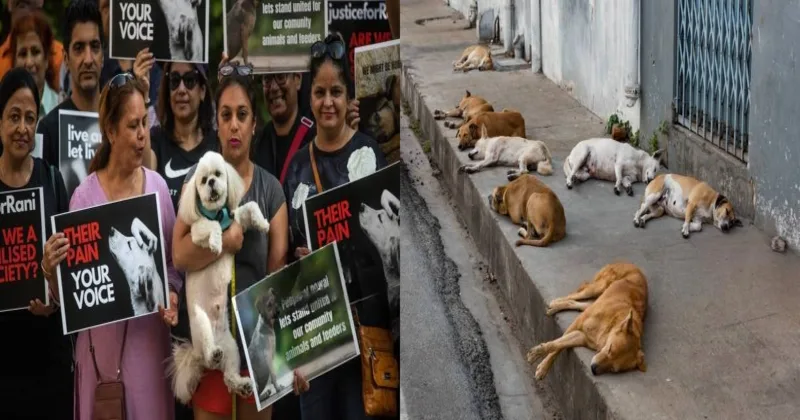
The judiciary has stepped into the debate, the court stated that the order came in the wake of an increase in dog bites and rabies cases across the capital city. Based on surveys conducted by government and private sector agencies, the stray dog population in alone Delhi is close to 1 million. The Supreme Court recently directed civic bodies in Delhi-NCR to relocate stray dogs from residential neighbourhoods to shelters on August 11, 2025, the ruling triggered intense reactions of animal rights groups calling it as inhumane, while majority of residents welcomed it by citing there are frequent attacks on children and elderly citizens.
Relocating of lakhs of stray dogs to shelters that barely exist and also poses enormous logistical and financial challenges. Most urban local bodies lack even the basic infrastructure to house or care for animals at such scale.
RSS Sarsanghchalak Dr Mohan Bhagwat on August 14, argued that the ongoing stray dog crisis in Delhi requires long-term solutions focused on population control rather than temporary measures like relocating them to shelters, during a congregation. He said “The problem can be solved only be regulating the population of stray dog. But it cannot be resolved by putting them in shelters”.
National Rabies Control Programme
The Ministry of Health & Family Welfare, through the National Rabies Control Programme (NRCP), has intensified surveillance across all States and Union Territories. Data on animal bites and rabies deaths are now being reported through the Integrated Health Information Platform (IHIP).
Under the National Health Mission states are provided funds to procure rabies vaccines, build capacity of healthcare staff and establish Anti-Rabies Clinics. Lifesaving drugs in rabies such as Anti-Rabies Vaccine (ARV) and Anti-Rabies Serum (ARS) are being provided free of cost under the National Free Drug Initiative. These drugs are listed as essential medicines at both national and state levels PHC and CHC, as a mandatory stocking in facilities.
The National Centre for Disease Control supports this effort by developing guidelines, awareness campaigns and training materials for veterinary doctors. Veterinary sector engagement is being strengthened under the “National One Health Programme for Prevention and Control of Zoonosis,” ensuring animal and human health systems work together to save life’s.
The health system strengthens its response, the judiciary has stepped into the debate. The ruling triggered intense reactions from animal rights activists called it inhumane, while many residents welcomed it by citing it as there were frequent attacks on children and elderly citizens in last few years. The implementation remains uncertain. Relocating lakhs of stray dogs to shelters that barely exist poses a huge logistical and financial challenges to government. Most urban local bodies lack even the basic infrastructure to house or care for animals at such scale.
Animal Birth Control (ABC) Rule, 2023
The Union Government has a far-sighted vision of this problem, so in 2023 they have already emphasised that stray dog management must be humane and scientific. To support the management, government framed the Animal Birth Control (ABC) Rules, 2023 under the Prevention of Cruelty to Animals Act, 1960. The Rules align with global standards set by the World Organisation for Animal Health, focusing on the Capture–Neuter–Vaccinate–Release (CNVR) method.
Local bodies have been tasked with carrying out sterilisation and vaccination programmes in collaboration with animal welfare organisations. In July 2025, the Ministries of Animal Husbandry, Housing and Urban Affairs and Panchayati Raj jointly urged the states to establish a dedicated ABC units and cover at least 70 per cent of stray dogs under sterilisation drives.
Union Government Pushing the Funds and Infrastructure
To accelerate sterilisation drive, government has revised its funding scheme. From this year 2025, the Animal Welfare Board of India (AWBI) provides up to Rs 800 per dog and Rs 600 per cat for sterilisation. State veterinary hospitals will receive one-time grants of ₹2 crore for facilities such as surgical theatres, kennels and recovery units.
Financial support has been provisioned for shelters, with ₹15 lakh for small shelters and ₹27 lakh for large ones. These funds are meant to strengthen the role of urban local bodies and recognised animal welfare organisations.
On August 11, 2025, a revised ABC module was launched aiming to tackle three interconnected goals i.e. street dog population management, rabies eradication and reduction of human-dog conflicts.
Apart from government subsidies and court orders, controlling rabies also calls for community involvement. The AWBI has sent out guidelines for Resident Welfare Associations and Apartment Owners Associations on how to manage community dogs responsibly. Adoption protocols, independent dog-bite data collection and rules for humane handling of strays have also been made in public.
Education campaigns are also important. The government has developed Information, Education and Communication (IEC) materials, to tackle dog-bite procedures and providing training videos for healthcare providers and the public. These materials emphasize the need for hand washing of the wound immediately, early vaccination and taking care of one’s pet.
Invisible challenges ahead for government
Despite increased funding, legal frameworks and public campaigns, challenges sometimes remain constant. India estimated stray dog population ranges between 60 and 80 million. Achieving 70 per cent sterilisation coverage requires a massive expansion of veterinary capacity and local governance efficiency.
Rabies vaccination also faces supply challenges. While ARV and ARS are found at public centres, rural access is patchy. Delayed treatment post-bite continues to claim lives, particularly among children. Coordination between health departments and municipal authorities is uneven across States, causing gaps in surveillance and intervention.
Countries such as Sri Lanka, Mexico, and Thailand have shown that rabies can be eliminated through consistent investment in dog vaccination, sterilisation, and public education. India’s scale is larger, but the principle remains the same—control of stray dog populations and universal access to vaccines.
India has pledged under WHO’s “Zero by 2030” initiative to end morbidity due to dog-bite related rabies. To accomplish this goal will take not only government finance and administration but also political willpower, community participation and sustained collaboration between the health and veterinary sectors.
The fight against rabies sits at the intersection of public health, animal welfare and civic governance. The Supreme Court ruling, government programmes and awareness campaigns together point toward a new momentum. The success will depend on how effectively states implement sterilisation drives, ensure vaccine access and build community trust. Rabies is preventable. The question is whether India can mobilise its institutions and citizens to ensure that a disease claiming thousands of lives each year is finally consigned to history.
















Comments