





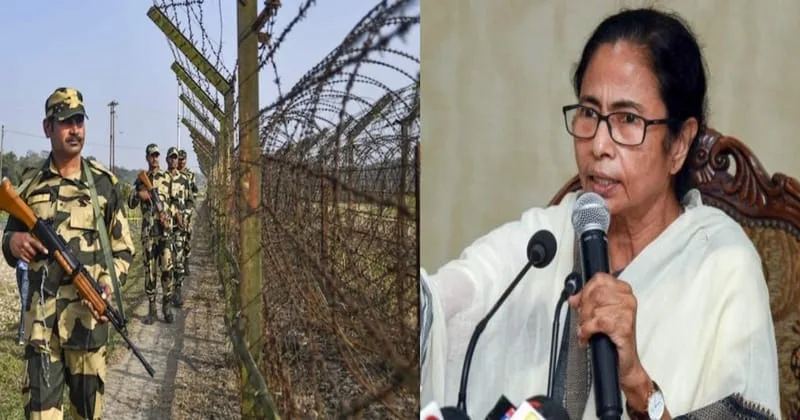
In a move raising significant national security concerns, the Mamata Banerjee-led West Bengal government has reportedly refused to hand over 181 kilometres of land to the union government for the construction of fencing along the Indo–Bangladesh border. This is despite the fact that the union government has already released full payment for the acquisition of this land. The delay and non-cooperation from the state government is being seen as a serious obstruction in securing India’s eastern frontier, especially amid rising incidents of cross-border smuggling, narcotics trade, and infiltration.
181 Kms of Land for Border Fencing Paid For – But Not Handed Over by Mamata Banerjee led West Bengal Government!
The Indo–Bangladesh border in West Bengal is 2,216.7 km long. Out of this, 569 km is still unfenced.
👉 The Central Government has already released payment for 181… pic.twitter.com/xxLay6K21x
— Amit Malviya (@amitmalviya) August 21, 2025
Indo–Bangladesh Border: A high-risk zone
West Bengal shares a 2,216.7 km-long border with Bangladesh, making it one of the most vulnerable regions for illegal cross-border activities. Of this vast stretch, 569 km remains unfenced. Fencing this area is not merely an infrastructural priority but a matter of national security. Border fencing acts as a crucial deterrent against illegal immigration, smuggling of contraband and livestock, human trafficking, and the movement of fake currency and arms.
According to data provided by security agencies, the extent of the threat is staggering. Narcotics seizures have hit record highs in recent years, 4,988 kg in 2023, 3,145 kg in 2024, and a massive 5,729 kg already seized in just the first seven months of 2025. These numbers underscore the rampant smuggling networks exploiting the porous border.
The union government’s efforts vs state’s roadblocks
The union government, recognising the urgency of the situation, has been proactive in its approach. Of the 456 km of feasible fencing stretch in West Bengal:
77 km of land has been handed over by the state government.
149 km remains where the land acquisition process hasn’t even been initiated.
31 km is pending approval from the West Bengal Cabinet.
7 km of land valuation is yet to be completed.
9.5 km of land is pending payment from the Ministry of Home Affairs.
Critically, 181 km of land has already been paid for, but not handed over by the state government.
This last category is the most controversial, highlighting a blatant disregard for cooperative federalism and a failure to prioritise national security over political considerations.
Implications of non-cooperation
The refusal to hand over land despite payment has a cascading effect. It delays the fencing process, leaving large swathes of the border vulnerable. This not only compromises the safety of Indian citizens but also benefits illegal elements like drug traffickers, cattle smugglers, and infiltrators.
The union government’s investment of funds and the armed forces’ efforts to maintain vigilance are rendered ineffective without the physical infrastructure of fencing. In such an environment, the state government’s inaction is not just administrative negligence but could be seen as an active impediment to national interests.
Moreover, the issue isn’t simply bureaucratic; it raises political and ethical questions. Why is the state government refusing to cooperate on a matter as serious as border security? What message does it send to the security agencies on the ground who are risking their lives daily?
A call for urgent action
There is an urgent need for the West Bengal government to rise above political differences and cooperate with the union government on issues that concern the safety and sovereignty of the nation. National security must never become a casualty of state-centre rivalry. The central government has fulfilled its part by releasing funds and planning fencing along feasible stretches. It is now the state’s responsibility to expedite land acquisition, hand over pending land parcels, and ensure timely cabinet clearances.
As smuggling and infiltration continue to threaten the stability of border regions, delaying fencing further will only embolden criminal networks. In the interest of both national integrity and the welfare of its own citizens, the Bengal government must act swiftly and decisively.
















Comments