





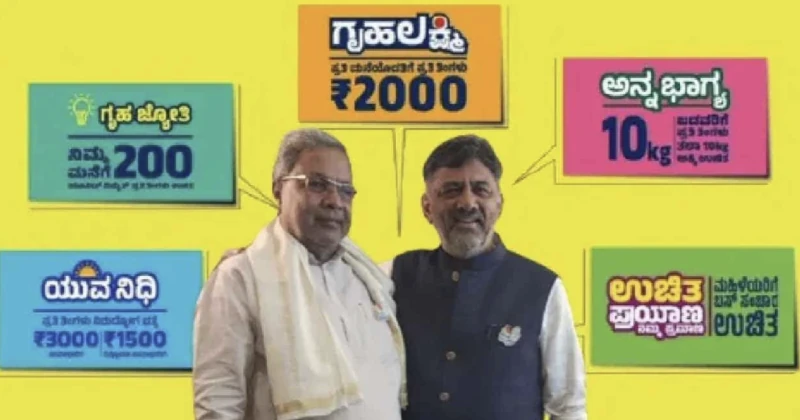
Chief Minister Siddaramaiah on August 18 presented the Comptroller and Auditor General’s (CAG) report for 2023-24 in the Karnataka Legislative Assembly, revealing the financial strain caused by the government’s five flagship guarantee schemes. According to the report, the state borrowed an additional Rs 63,000 crore during the year to fund the schemes, pushing the fiscal deficit to alarming levels.
The report notes that guarantees such as Anna Bhagya, Shakti, Gruha Lakshmi, Yuva Nidhi, and Gruha Jyothi together accounted for nearly 15 per cent of the total revenue expenditure in 2023-24. The fiscal deficit jumped from Rs 46,623 crore in the previous year to Rs 65,522 crore, a sharp increase attributed largely to these schemes.
Presenting the report, Chief Minister Siddaramaiah said, “The CAG findings underline the pressure these social welfare schemes have placed on state finances. Our government had to resort to heavy borrowings to meet commitments made under the guarantee programs.”
Breakdown of guarantee expenditure
According to the CAG report tabled in the House, the expenditure on guarantees in 2023-24 was as follows:
- Gruha Lakshmi (cash transfer to women): Rs 16,964 crore
- Gruha Jyothi (free electricity): Rs 8,900 crore
- Anna Bhagya (free rice scheme): Rs 7,384 crore
- Shakti (free bus travel for women): Rs 3,200 crore
- Yuva Nidhi (unemployment allowance): Rs 88 crore
Together, these amounted to over Rs 36,000 crore in direct expenditure. To manage the overall outgo, the state relied on net market borrowings of Rs 63,000 crore, which is Rs 37,000 crore higher than the previous year.
Reduced capital spending
The CAG report also flagged a worrying trend of declining capital investment in infrastructure. To make room for guarantee-related expenditure, the state cut capital spending by Rs 5,229 crore compared to the previous year. Economists warn that reduced allocations for infrastructure could slow down long-term growth.
“The schemes have certainly provided immediate relief to beneficiaries, but they have come at the cost of developmental expenditure. Infrastructure investment is critical for future economic expansion, and a cutback in this sector may have long-term implications,” the report observed.
Revenue performance
On the positive side, Karnataka’s tax revenues showed healthy growth in 2023-24. The state’s resources accounted for 76 per cent of total revenue receipts. Own tax revenue grew by 13.78 per cent compared to the previous year, while devolution from central taxes rose by 19.07 per cent.
However, non-tax revenue declined by Rs 797 crore—from Rs 13,914 crore in 2022-23 to Rs 13,117 crore in 2023-24. Overall, revenue receipts increased by just 1.86 per cent, whereas total expenditure jumped by 12.54 per cent.
Rising debt burden
The CAG report warned that sustained borrowings to finance welfare schemes could leave the state with a mounting debt burden. “The sharp rise in fiscal deficit and borrowings raises questions about fiscal sustainability. If corrective measures are not taken, the financial space for future development initiatives could be severely constrained,” the report cautioned.
Experts also pointed out that while guarantees are politically popular, the lack of corresponding revenue sources makes them fiscally risky. “Borrowing to fund consumption-oriented schemes creates a structural imbalance. Unless revenues are significantly boosted, the state will struggle to sustain these programs without compromising on capital expenditure,” an analyst said.
Siddaramaiah defends guarantees
Defending his government’s welfare commitments, Chief Minister Siddaramaiah maintained that the schemes were designed to support vulnerable sections of society. “These guarantees have improved the lives of lakhs of families by ensuring food security, financial assistance for women, free bus travel, and relief for unemployed youth. Economic justice is as important as fiscal prudence,” he told the Assembly.
















Comments