





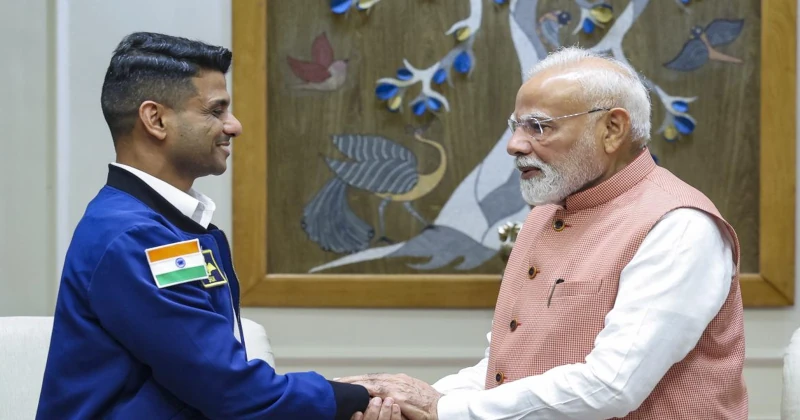
Group Captain Shubhanshu Shukla, India’s pioneering astronaut and Indian Air Force test pilot, met Prime Minister Narendra Modi at his official residence in Delhi after returning from his historic Axiom-4 (Ax-4) mission to the International Space Station (ISS).
The meeting was not merely ceremonial. It marked India’s transition from being a spacefaring nation to an active human spaceflight participant with Shukla standing as the face of that leap.
During the interaction, Shukla presented Prime Minister Modi with the Indian national flag he carried aboard the ISS during the Ax-4 mission. That single gesture encapsulated the journey of India’s space programme from the modest launch of Aryabhata in 1975 to the grandeur of Chandrayaan 3’s Moon landing, and now to the audacity of sending an Indian into space as part of an international crew.
The Prime Minister, deeply moved, described the moment as one that will “inspire generations to look beyond the Earth and dream of space as India’s next frontier.”
Challenges of spaceflight: “The brain needs rewiring”
Shukla shared candid insights about the physical and psychological demands of space travel, exposing the brutal reality behind the glamour. “The brain needs rewiring when you return to Earth,” he told the Prime Minister. “After weeks of floating in microgravity, the body slows down, and the mind must reorient to gravity’s pull.”
This was not abstract science but lived experience — an Indian astronaut explaining firsthand what it means to survive, work, and adapt in orbit.
Among the highlights of Shukla’s mission were pathbreaking experiments in space agriculture. He described how the simplicity of growing sprouts like moong and methi in microgravity has enormous potential to address food security back on Earth.
By proving that staple, nutrition-rich sprouts can thrive without soil or gravity, Shukla and his team opened possibilities for feeding astronauts on deep-space missions and simultaneously tackling malnutrition and resource scarcity in developing nations. In addition, Shukla’s Ax-4 experiments covered human physiology in microgravity, advanced materials research, and life-support technologies — all critical for India’s upcoming Gaganyaan mission.
Back in Delhi, Shukla’s achievement reverberated through Parliament, where Union Minister of State for Science and Technology, Dr. Jitendra Singh, led a special discussion to honour him.
“Shubhanshu Shukla’s mission is not just an individual achievement. It is a stepping stone for India’s Gaganyaan programme and our broader human spaceflight ambitions,” Singh declared, underscoring the significance of the Ax-4 mission as a practical rehearsal for India’s future astronauts.
During his meeting with the Prime Minister, Shukla also presented the Axiom-4 mission patch and a selection of photographs he personally captured from the ISS. These included sweeping images of Earth’s curvature, breathtaking sunrises from orbit, and photographs of India itself taken from the cupola of the ISS. Each image served as a reminder of what Shukla called “the humbling realisation that borders disappear when viewed from space.”
From Ax-4 to Gaganyaan: India’s Human spaceflight roadmap
The Ax-4 mission, conducted in collaboration with international partners, offered India invaluable experience in:
- Crew training under global standards
- Microgravity research directly linked to agriculture, medicine, and materials science
- Life-support and adaptation techniques for astronauts in space
These lessons are now being fed directly into ISRO’s Gaganyaan programme, scheduled to launch Indian astronauts aboard an indigenous spacecraft in the coming years.
For India, Ax-4 was more than symbolic participation. It was hands-on preparation for independent human spaceflight, closing the gap with established space powers like the US, Russia, and China. Group Captain Shubhanshu Shukla’s journey from an Indian Air Force test pilot to astronaut aboard the ISS is not just a tale of personal courage but a story of national resurgence.
He represents the new India ambitious, resilient, and unafraid to take its place among the great powers of the world. His act of carrying the tricolour into orbit symbolises the merging of individual achievement with national aspiration.
India’s journey in space began humbly, with rockets once transported on bicycles and bullock carts. Today, with Chandrayaan, Mangalyaan, and now human participation aboard the ISS, the nation stands at the cusp of an era where the next logical step is Mars and beyond. Prime Minister Modi summed it up best when he told Shukla, “You have not only carried the flag into space but have carried the hopes and dreams of 1.4 billion Indians.”













Comments