





On 15th August, while Bharat was celebrating its 79th Independence Day under the bold and visionary leadership of Prime Minister Narendra Modi, Pakistan was reeling under a humiliating military reality it tried hard to conceal. The so-called guardians of Pakistan’s sovereignty — the Army, which has for decades projected itself as the ultimate custodian of the nation — quietly admitted to a staggering loss in Operation Sindoor. The irony? The acknowledgement came not from transparency or courage, but from a hurriedly deleted news item on their own media.
Pakistan’s leading channel, Sama TV, published a list of 155 Pakistani soldiers killed in Operation Sindoor, whom the Army chose to “honour” on their Independence Day. The moment the list caught attention, it mysteriously vanished from their website. But as always in the digital age, screenshots, downloads, and videos emerged, preserving this inconvenient truth for history. The evidence lives on at:
https://archive.ph/EaiIH#selection-2315.0-2377.33.
For a country that survives on manufacturing narratives of “victory” every time it faces Bharat, this revelation is devastating. Those in Bharat’s political circles — particularly the Congress and their ecosystem of apologists who constantly whimper, “What has been achieved from Operation Sindoor?” — should take a hard look at the numbers.
The Price Pakistan Paid
Among the 155 dead, reports confirm that over 50 were commissioned officers. The casualty list is not just about foot soldiers from Punjab or Baloch regiments being used as cannon fodder. This time, it cut deep into the Pakistan Army’s so-called elite. The list includes:
- Eight senior Air Force officers, including Squadron Leaders and Wing Commanders.
- Ten high-ranking officers, including Brigadiers and those above.
This means that in a matter of hours, Bharat’s armed forces dealt a blow that shook the very command structure of Pakistan’s military establishment. For a nation obsessed with uniformed authority, where generals often outweigh civilian governments, such an outcome is nothing short of humiliation.
But the Pakistani state, ever the master of deception, thought that simply scrubbing a webpage could erase history. The same old tactic of denial, obfuscation, and spin. Unfortunately for Rawalpindi, Bharat has entered a new era — an era where strong political leadership ensures that military actions are backed by decisive political will, where information warfare is handled with as much precision as ground operations.
Pakistan’s “Honours” for Terrorists
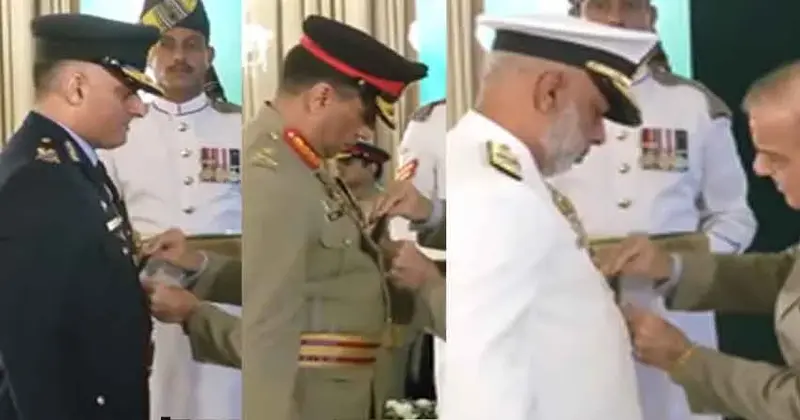
Adding another layer of irony to the saga are the military awards conferred by Pakistan. For their “supreme sacrifice,” the Pakistan Army announced gallantry medals — including the Tamgha-e-Jurat, their equivalent of Bharat’s Vir Chakra. Out of the five recipients, four are posthumous:
- L/Hav Amir Sheraz (posthumous), Baloch Regiment
- Nk Abdul Rehman (posthumous), SSG
- L/Nk Ikram Ullah (posthumous), AK Regiment
- Sep Adeel Akbar (posthumous), Punjab Regiment
One must pause to reflect here. When the very generals of Pakistan are often spotted at the last rites of terrorists masquerading as “freedom fighters,” one wonders whether the next logical step for Rawalpindi is to confer these dead jihadis with their highest civilian award — Nishan-e-Imtiaz. After all, if hosting funerals with full military protocol for men like Mudassar Khadian Khas alias Abu Jundal, Hafiz Muhammed Jameel, who was the eldest brother-in-law of Maulana Masood Azhar, Mohammad Yusuf Azhar, Khalid alias Abu Akasha and Mohammad Hassan Khan, has become a norm, then perhaps the only “promotion” left in Pakistan’s award hierarchy is to equate terrorists with state heroes. The sarcasm, sadly, is not far from reality.
Why the Silence in Pakistan?
The deletion of Sama TV’s report is not just a matter of embarrassment. It speaks volumes about the crisis of legitimacy the Pakistan Army is facing domestically. For decades, it has thrived on a carefully manufactured myth — that it is undefeatable, that Bharat is perpetually on the back foot, and that every skirmish is a “victory” for Pakistan. Operation Sindoor shattered all that myth.
At the domestic level, questions would naturally arise: how could such senior officers fall in such large numbers in such a short span of combat? For a country already in the throes of economic collapse, political chaos, and rising terror within its own borders, acknowledging the full scale of the losses would have risked sparking unrest.
Contrast with Bharat’s Leadership
While Pakistan hides its dead and spins tales of “resistance,” Bharat under Prime Minister Narendra Modi has shown a remarkable shift in strategic posture. From the surgical strikes to Balakot, and now to Operation Sindoor, Bharat has made it clear: gone are the days when provocations across the border would be tolerated in silence.
The political will emanating from Delhi ensures that the armed forces are unshackled, empowered, and celebrated. The RSS vision of a strong, assertive Bharat — unapologetically defending its sovereignty and civilisational identity — is now visible in every military and diplomatic step. The message is loud and clear: terrorism and proxy war will not go unanswered.
Lessons for Congress and its Sycophants
It is amusing — and at times, tragic — to hear opposition parties in Bharat downplay such achievements. Leaders and commentators aligned with the Congress ecosystem constantly parrot the enemy’s line: “What did we gain?”
Well, here is the answer in cold numbers — 155 Pakistani soldiers dead, including over 50 commissioned officers, with eight from the Air Force and ten Brigadiers or above. That is the scale of damage inflicted by Bharat’s military might. It is not just about territory gained or lost; it is about the psychological, structural, and symbolic blow to Pakistan’s war machinery.
And make no mistake — the fact that Pakistan rushed to delete its own admissions only reinforces Bharat’s success. The embarrassment in Rawalpindi is our victory.
The Larger Strategic Context
Operation Sindoor is not just about one military operation. It is part of a broader narrative where Bharat asserts its rightful place as a strong, sovereign, and civilizational state. For too long, Pakistan thrived on exporting terror, manipulating Western powers with the “nuclear threat” card, and bleeding Bharat through proxy wars.
Today, that paradigm is collapsing. The international community increasingly sees Pakistan not as a “strategic ally” but as a hub of instability and terrorism. Bharat, in contrast, is emerging as a reliable, democratic, and strong power — respected in the West, trusted in the East, and admired in the Global South.
The symbolism of Operation Sindoor, therefore, extends far beyond the battlefield. It shows a confident Bharat that does not just defend, but strikes when necessary. A Bharat that will not allow its soldiers’ sacrifices to be mocked by denialist neighbours. A Bharat that ensures even in the information domain, the truth is preserved — whether Pakistan likes it or not.
The Pakistan Army’s Self-Inflicted Wound
In the end, the story of Operation Sindoor will be remembered not just for the casualties inflicted, but for the way Pakistan tried to erase them — and failed. The screenshots, the archive links, and the videos will remain etched in digital history, mocking Pakistan’s attempt at cover-up.
As Bharat continues to rise under visionary leadership, rooted in the cultural nationalism of the RSS and the decisive governance of the BJP, Pakistan is left grappling with its self-inflicted wounds. It can continue to award Tamgha-e-Jurat to its fallen, and perhaps even daydream about conferring Nishan-e-Imtiaz to the terrorists it celebrates. But none of that will alter the truth — that Bharat has decisively changed the rules of engagement.
Operation Sindoor is proof: Bharat is no longer reactive. It is proactive, assertive, and unapologetic. Pakistan may hide behind deleted reports, but history will remember who struck and who bled.











Comments