





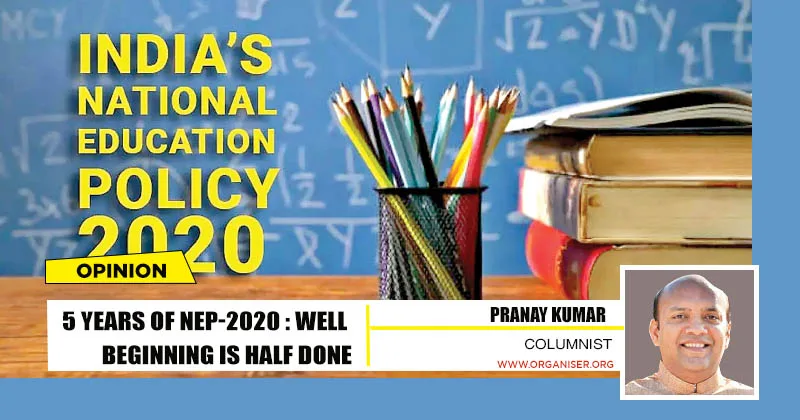
It has now been five years since the National Education Policy 2020, announced on July 29, 2020, came into force. This is the third education policy of Independent Bharat and the first of the 21st century.
The draft of National Education Policy 2020 was prepared under the chairmanship of space scientist Dr K Kasturirangan and was finalised after extensive deliberations and public participation across the country. Between 2014 and June 2020, suggestions were received from nearly two lakh gram panchayats, six thousand blocks and urban bodies, and more than 676 districts, culminating in a comprehensive, balanced, and forward-looking education policy. While earlier education policies primarily aimed to ensure equality of opportunity in education, the approach of the 2020 policy is broader and more multidimensional. Its vision is to move beyond an education system limited to awarding certificates, towards one that fulfills the dreams of millions of people of a developed Bharat through research, innovation, skills, association, inclusion and self-reliance. This policy redefines the very meaning of education and places lifelong learning at its core.
Problems Confronting School Education
For decades in Bharat, increasing enrolment and attendance in schools have been a major challenge. Many children, due to poverty or other reasons, have been compelled to drop out of school midway. This policy has addressed that challenge head-on, aligning with the Sustainable Development Goals and setting the target of providing compulsory education from pre-primary to Class 10 for all children by 2030 and achieving a Gross Enrolment Ratio of 100 per cent. In higher education, the target has been set at 50 per cent by 2035. Concrete steps have been taken towards these goals: new schools are being opened in remote areas. So far, 14,500 PM SHRI schools have been inaugurated across the country in seven phases. Under the NIPUN Bharat Mission, a commitment has been made to ensure that all children up to Class 3 acquire foundational literacy and numeracy skills – such as reading, writing, and basic arithmetic – by 2027.
According to the 2024 report of the ASER (Annual Status of Education Report) survey conducted by the non-governmental organisation ASER and NCERT’s National Achievement Survey, the past five years have seen a 60–64 per cent improvement in enrolment, attendance, letters and words recognition, reading and writing ability, numerical and mathematical skills, and overall learning outcomes in the early years of schooling.
Making Education An Engaging Exercise
To make education at the primary level engaging and practical, a “Magic Pitara” has been developed for the foundational stage (pre-primary classes), emphasising learning through play. This kit contains cards, stories, and audio-visual material to make learning enjoyable and interactive. Notably, it has not been confined to printed books alone—it has been made available in all 22 languages recognised by the Constitution on e-platforms.
The need for skill-based education has been felt in Bharat for a long time. This is the first policy to formally integrate practical, technical and vocational skills into the curriculum from Class 6 onwards. To promote research and innovation among school students, the Atal Innovation Mission has been launched. Over the past few years, more than 10,000 Atal Tinkering Labs have been set up across the country, with the aim of increasing this number to 50,000 in the current budget. Another key feature of this policy is the extensive use of digital resources. CBSE, NCERT, and UGC have ensured the delivery of high-quality online content to teachers and students through platforms such as PM eVidya, DIKSHA, Vidya Samiksha Kendra, ePathshala, SWAYAM, SWAYAM Prabha, Samarth, NISHTHA, the National Digital Library, and the National Academic Depository. These resources are now accessible even to children and teachers in remote villages. The policy also places special emphasis on teacher training, professional development, and assessment.
Commendable Achievements
One of the most remarkable achievements of NEP 2020 is the comprehensive reform in the structure of school education. The decades-old 10+2 system has been replaced with a new 5+3+3+4 structure, comprising the Foundational Stage (pre-primary to Class 2), Preparatory Stage (Classes 3 to 5), Middle Stage (Classes 6 to 8), and Secondary Stage (Classes 9 to 12). Based on the National Curriculum Framework 2023, textbooks for Classes 1 to 8 have already been published in line with the demands and needs of the new era, while textbooks for Classes 9 to 12 will be completed this year and the next. This curriculum incorporates reflections and concerns from Bharat’s past, present, and future. To ensure flexibility and promote multidisciplinarity from school to higher education, the Academic Bank of Credits (ABC) and the National Credit Framework (NCrF) have been implemented. Under this system, students are awarded credit points for academics, games & sports, co-curricular activities, and skills. If a student’s education is interrupted for any reason, his or her earned credits remain stored in the account, and study can be resumed later to add more credits. There is even a provision for earning credits on an hourly basis for learning or skill acquisition. To reduce examination pressure, CBSE has announced that from the 2025–26 session onwards, Class 10 students will have the option to appear for board examinations twice a year. NCERT will also introduce a comprehensive report card called PARAKH (Performance Assessment, Review, and Analysis of Knowledge for Holistic development), which will go beyond marks to assess life values, ethics, creativity, cooperation, sensitivity, and other such attributes in students. Similarly, in the four-year undergraduate degree programme, students will have the facility of multiple entry and exit points/options, ensuring that their time, money, and effort are not wasted. A certificate will be awarded after one year of study, a diploma after two years, an honours degree after three years, and an honours degree with research after four years. Students with a research inclination will be able to enter this field directly after completing a four-year undergraduate programme. To promote research and innovation in science, technology, engineering, health, medicine, and STEM education, the Prime Minister’s Research Fellowship (PMRF) scheme has been launched. Under the leadership of the Prime Minister, the Anusandhan National Research Foundation (ANRF) has been established with the aim of fostering a culture of research and innovation in colleges, universities, research institutes, and laboratories. The Central Government has allocated Rs 50,000 crore to support this initiative. The policy also encourages dual degrees and multidisciplinary studies, allowing students from any stream to choose subjects of interest, eligibility, and need for higher education.
In recent years, reforms in higher education have moved beyond mere plans on paper to producing tangible results. In 2014–15, only 11 Bharatiya universities and academic institutions could secure a place in the QS World University Rankings. By 2025–26, this number has risen to 54. Bharat has surpassed Japan and Germany to join the United States, the United Kingdom, and China among the top four countries in this league. On several of the ten global benchmarks used to determine these rankings, Bharatiya universities are now counted among the top 100. This transformation is not only a shift in numbers, but also a surge in confidence. In the spheres of innovation and entrepreneurship, too, Bharat has taken a historic leap forward. The country is now home to approximately 176,000 registered startups, including more than 118 unicorns, making it the world’s third-largest startup ecosystem. Bharat has also reached new heights in patent filings — with 92,168 patent applications in 2023–24, the nation ranks among the top six countries globally. Moving from the 81st position in the Global Innovation Index in 2024 to the 39th in 2025, and securing first place worldwide in global fintech adoption, stand as clear evidence that Bharat is not merely chasing past dreams, but setting new global standards.
Invigorating New Vision
In just five years, the National Education Policy 2020 has infused the country’s education system with fresh vision, renewed energy, and new confidence. Structural reforms have been implemented, new textbooks and digital platforms are ready, and there is measurable progress not only in enrolment but also in learning outcomes. Higher education enrolment has risen from 34 million in 2014–15 to 44.6 million in 2022–23 — a growth that represents not just numbers, but expanded opportunities.
Still, the road ahead will not be easy. Achieving the ambitious targets for the Gross Enrolment Ratio will require expansion of resources, development of trained human capital, and a concrete action plan. Bridging the digital divide, strengthening infrastructure in rural areas, and improving the teacher–student ratio must be high priorities in the coming years. The National Education Policy 2020 also provides for the study of two Bharatiya languages and one foreign language in Classes 9–10, and one Bharatiya and one foreign language in Classes 11–12. Unfortunately, this provision has not yet been implemented in practice. Both society and Government must remember that language is not merely a medium for communication and the expression of knowledge — it is a living repository of values, culture, and civilisation. Each language carries within it the cultural roots, principles, and worldview that shape the soul of a society. Therefore, the preservation and promotion of Bharatiya languages is not simply a linguistic task, but an essential responsibility for the nourishment, safeguarding, and strengthening of Bharat and Bharatiyata. Rising above language disputes and political obstacles, concrete steps must be taken to implement this without delay. Taken in its entirety, it would not be an exaggeration to conclude that the National Education Policy 2020 is not merely a government plan or vision document. Rather, it is a comprehensive roadmap to guide Bharat towards becoming a knowledge-driven, self-reliant global leader. Its achievements inspire confidence, but the decade ahead will be decisive for reaching its ultimate goals. If the provisions of this policy are implemented with full sincerity, determination, foresight, and continuity, it could well prove to be the historic revolution that propels Bharat to new pinnacles in the 21st century through the power of education.













Comments