





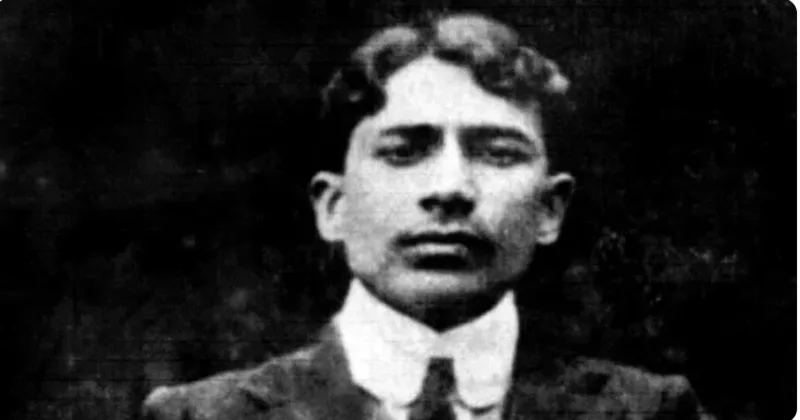
On August 17, 1909, at exactly 9:00 AM, a 25-year-old engineering student from Amritsar walked to the gallows at London’s Pentonville Prison with unshakeable resolve. Madan Lal Dhingra, who had assassinated a senior British official six weeks earlier, became the first Indian freedom fighter to be executed on British soil. Yet today, over a century later, his name remains conspicuously absent from the pantheon of heroes celebrated. a deliberate erasure that reveals historical antipathy toward revolutionary nationalism and its systematic privileging of a sanitized narrative that diminishes Hindu nationalist contributions to India’s independence struggle. This calculated neglect is not accidental but represents a fundamental ideological schism that has plagued Indian historiography for decades. While Congress lionizes figures who fit its preferred narrative of non-violent resistance, it has consistently marginalized revolutionaries whose methods—and more importantly, whose Hindu nationalist ideology—challenged both British imperialism and the Congress’s monopolistic claims over the freedom movement.
Madan Lal Dhingra was born on September 18, 1883, into one of Amritsar’s most affluent families. His father, Dr. Ditta Mal Dhingra, was a prominent civil surgeon who held the British-conferred title of Rai Saheb and owned 21 houses in Katra Sher Singh along with six bungalows on the Grand Trunk Road. The family’s wealth was considerable—they were among the first car owners in Amritsar, and Dr. Ditta Mal was firmly embedded within the colonial administrative structure as a loyal British subject. This privileged background makes Dhingra’s revolutionary transformation all the more remarkable. Unlike many freedom fighters who were radicalized by personal grievances or economic hardship, Dhingra’s nationalism emerged from an intellectual awakening about India’s systematic exploitation under British rule. During his college years in Lahore, he conducted extensive research into the causes of Indian poverty and famines, concluding that Swaraj (self-governance) and Swadeshi (indigenous production) were the only viable solutions.
As noted by historian V.N. Datta in his authoritative biography, Dhingra’s political consciousness was profoundly shaped by his exposure to the Swadeshi movement in Lahore, where he came under the influence of nationalist leaders like Lala Lajpat Rai and Ajit Singh. The crystallizing moment came in 1904 when Dhingra led a student protest against the mandatory use of British-manufactured cloth for college blazers—a seemingly minor issue that symbolized the broader colonial domination over Indian economic life.
When Dhingra was expelled from Government College Lahore for his protest activities, his family’s response was characteristic of the colonial elite: they sought to channel his energies into “respectable” pursuits by sending him to London for engineering studies. In June 1906,
Dhingra enrolled at University College London, but rather than dampening his nationalist fervor, the metropole became the crucible for his revolutionary transformation. London in the early 1900s was a hotbed of anti-colonial activity, with India House serving as the nerve center for revolutionary Indian nationalism. Founded by Shyamji Krishna Varma—himself a victim of British administrative treachery during his service in the princely states—India House provided both accommodation and ideological guidance to Indian students. It was here that Dhingra encountered the towering figure of Vinayak Damodar Savarkar, whose influence would prove decisive in shaping the young Punjabi’s revolutionary trajectory.
Savarkar’s impact on Dhingra cannot be overstated. The future ideologue of Hindutva had already established himself as a formidable revolutionary theorist, advocating armed resistance against British rule and developing a sophisticated critique of colonial exploitation. Under Savarkar’s mentorship, Dhingra joined the secretive Abhinav Bharat Mandal, where he received both ideological indoctrination and practical training in revolutionary methods, including weapons handling and strategic planning. Vikram Sampath notes in his research that Savarkar’s influence extended beyond mere tactical guidance to encompass a comprehensive worldview that linked anti-colonial resistance to Hindu cultural revival. This synthesis of nationalism and Hindu identity would become a defining characteristic of the revolutionary movement.
Sir William Hutt Curzon Wyllie was not a random victim but a carefully chosen target whose assassination would send a powerful message to both the British establishment and Indian nationalists. As political aide-de-camp to the Secretary of State for India, Wyllie occupied a crucial position within the colonial intelligence apparatus. More significantly, he served as head of the Secret Police and was actively engaged in surveillance operations against Indian revolutionaries in Britain. The selection of Wyllie reveals the sophisticated strategic thinking behind Dhingra’s action. As established by academic research from Oxford’s academic journals, Wyllie had spent considerable effort attempting to gather intelligence on Dhingra and his fellow revolutionaries, making him a legitimate military target in what the revolutionaries perceived as an ongoing war of liberation. The personal dimension—Wyllie’s friendship with Dhingra’s father—added psychological complexity to the act, representing a symbolic rejection of the collaborative relationship between the Indian elite and the colonial administration.
Several weeks before the assassination, Dhingra had attempted to target even more prominent figures, including Lord Curzon and Lieutenant-Governor Bampfylde Fuller. The fact that he eventually settled on Wyllie was not a compromise but a calculated decision based on accessibility and symbolic value. By killing a relatively obscure official rather than a household name, Dhingra demonstrated that the revolutionary movement’s reach extended throughout the colonial hierarchy, creating an atmosphere of pervasive insecurity among British officials.
On the evening of July 1, 1909, the annual “At Home” function of the National Indian Association at the Imperial Institute in South Kensington presented the perfect opportunity.
Dhingra had spent the afternoon at a shooting gallery on Tottenham Court Road, perfecting
his marksmanship—a detail that underscores the premeditated nature of his action. He arrived at the function as a legitimate member of the Association, mingling freely with British
officials and Indian collaborators. When Curzon Wyllie and his wife began leaving the hall around 10:30 PM, Dhingra approached his target and engaged in pleasantries—a final irony
given their respective positions in the colonial drama. Then, at point-blank range, he fired five shots directly into Wyllie’s face, four of which found their mark, killing him instantly. When Dr. Cawas Lalcaca, a Parsee physician, attempted to intervene, Dhingra fired two additional shots, fatally wounding the would-be rescuer. The clinical precision of the execution reflects not only Dhingra’s technical preparation but also his psychological readiness for martyrdom. His subsequent attempt at suicide—thwarted only by an empty chamber—demonstrates his complete commitment to the revolutionary cause and his understanding that his action would inevitably result in his own death.
Dhingra’s trial at the Old Bailey on July 23, 1909, became a dramatic confrontation between revolutionary nationalism and colonial justice. In a move that scandalized the British legal establishment, Dhingra refused legal representation and explicitly rejected the legitimacy of the court. This was not mere theatrics but a principled political stance that challenged the very foundations of colonial rule. As documented in contemporary court records, Dhingra’s self-representation allowed him to transform his trial into a platform for anti-colonial propaganda. His statement to the court represents one of the most powerful articulations of revolutionary nationalist ideology ever delivered in a British courtroom: “I admit the other day I attempted to shed English blood as a humble revenge for the inhuman hangings and deportations of patriotic Indian youths.”
The brevity of the trial—lasting just ninety minutes—reflects the British determination to minimize Dhingra’s platform while ensuring swift justice. Yet even within these constraints, Dhingra managed to deliver a devastating critique of colonial rule that resonated far beyond the courtroom. His declaration that “a nation held down in bondage with the help of foreign bayonets is in a perpetual state of war” articulated a theory of legitimate resistance that challenged British claims to civilizational superiority.
Dhingra’s final statement, known as the “Challenge,” stands as one of the most powerful documents of revolutionary nationalism. Written while awaiting execution, it combines personal testimony with political theory, creating a template for future revolutionary martyrdom. The statement’s key passages reveal the depth of Dhingra’s ideological commitment and his sophisticated understanding of the revolutionary process: “The only lesson required in India at present is to learn how to die and the only way to teach it is by dying ourselves. Therefore I die and glory in my martyrdom! This war of Independence will continue between India and England.”
Contemporary observers recognized the power of Dhingra’s testament. Even Winston Churchill, then a young politician, reportedly described it as “the finest ever made in the name of patriotism,” while the Irish nationalist press celebrated Dhingra as a kindred spirit in the struggle against British imperialism.
The Indian National Congress’s treatment of Madan Lal Dhingra reveals the party’s fundamental antipathy toward revolutionary nationalism and its systematic preference for a sanitized version of the independence struggle. This bias is epitomized by Mahatma Gandhi’s vitriolic condemnation of Dhingra in his foundational text, Hind Swaraj (1909). Writing immediately after Dhingra’s execution, Gandhi launched a scathing attack on the young revolutionary and his methods: “Do you not tremble to think of freeing India by assassination? What we need to do is to sacrifice ourselves. It is a cowardly thought, that of killing others.”
Gandhi’s characterization of Dhingra’s action as “cowardly” represents a profound misreading of revolutionary sacrifice and reveals his fundamental misunderstanding of the nature of anti-colonial resistance. Gandhi’s critique extended beyond tactical disagreement to encompass a wholesale rejection of revolutionary nationalism’s ideological foundations. He dismissed Dhingra as someone “intoxicated by the wretched modern civilization,” thereby positioning the Congress’s traditional approach as authentically Indian while characterizing revolutionary methods as foreign contamination. This rhetorical strategy allowed Gandhi to claim exclusive legitimacy for his own movement while delegitimizing alternative forms of resistance.
The intellectual dishonesty of Gandhi’s position becomes apparent when examined in context. As historian Dr. Koenraad Elst has noted, Gandhi’s condemnation of Dhingra occurred while he was simultaneously organizing armed resistance against discriminatory laws in South Africa. The same man who called Dhingra a coward was actively promoting civil disobedience—itself a form of illegal resistance—while building alliances with violent revolutionary groups when it served his tactical purposes.
The Congress’s hostility toward Dhingra is inseparable from its broader campaign against Vinayak Damodar Savarkar and the Hindu nationalist ideology he represented. Savarkar’s mentorship of Dhingra and his role in shaping revolutionary strategy made him a natural target for Congress ideologues seeking to discredit the revolutionary movement.
Contemporary scholarship by historians like Vikram Sampath and Uday Mahurkar has documented the extensive intellectual relationship between Savarkar and Dhingra. Savarkar not only provided ideological guidance but also practical support, allegedly supplying the weapon used in the assassination and helping draft Dhingra’s final statement. This connection transformed Dhingra from an isolated individual actor into a representative of a broader movement that threatened Congress hegemony.
This cultural grounding gave the revolutionary movement a different relationship to violence than that found in Western revolutionary traditions. As Savarkar explained in his theoretical writings, the use of force against colonial oppressors was not merely justified but represented a sacred duty derived from Hindu concepts of dharma and righteous war. This theological framework transformed individual revolutionaries like Dhingra into karma yogis—spiritual warriors fulfilling their dharmic obligations regardless of personal consequences.The sophistication of this ideological synthesis challenges conventional narratives that portray the revolutionary movement as reactive or purely destructive. Instead, scholars like Professor Arvind Sharma have argued that revolutionaries like Dhingra represented a mature political philosophy that combined spiritual discipline with strategic thinking, creating a distinctively Hindu form of nationalist resistance.
The restoration of Madan Lal Dhingra’s rightful place in India’s national memory represents more than historical correction—it constitutes a fundamental challenge to the ideological
frameworks that have dominated Indian political discourse since independence. Recognizing Dhingra’s contribution requires acknowledging the legitimacy of Hindu nationalist claims about the independence struggle and the validity of revolutionary methods in anti-colonial resistance. Madan Lal Dhingra’s sacrifice on that August morning in 1909 represented more than the death of a single revolutionary—it marked the emergence of a distinctively Hindu form of nationalist resistance that challenged both British imperialism and the accommodationist politics of the Indian National Congress. His execution at Pentonville Prison transformed him into the first martyr of revolutionary nationalism, establishing a template for sacrifice that would inspire generations of freedom fighters.
The century that has passed since Dhingra’s martyrdom has witnessed a systematic campaign to minimize his contribution and distort his legacy. The Congress party, committed to its own mythological narrative of the independence struggle, has consistently relegated revolutionary nationalism to the margins of historical memory. This deliberate amnesia serves contemporary political purposes but represents a betrayal of historical truth and national memory. In remembering Madan Lal Dhingra, we honor not just an individual martyr but an entire tradition of resistance that linked the struggle for political freedom to the deeper project of civilizational revival. His revolution remains unfinished, awaiting those with the courage to complete what he began on that summer evening in London more than a century ago.










Comments