





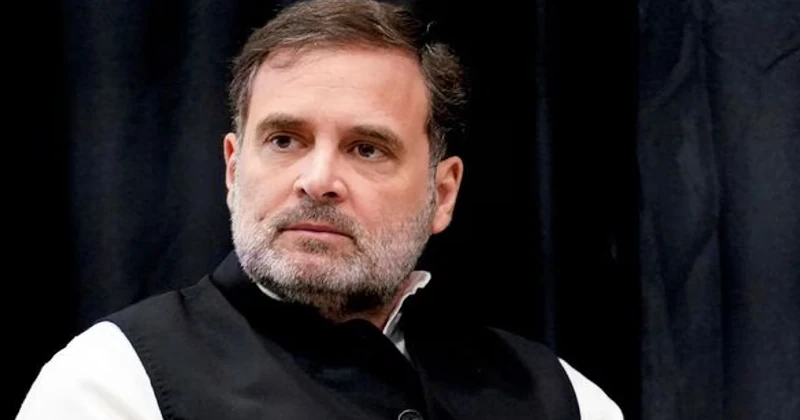
Leader of Opposition Rahul Gandhi remained absent from the Independence Day Celebration.
India’s Independence Day belongs to no party; it belongs to the people. In failing to stand at the ramparts as the tricolour rose, Rahul Gandhi did not wound the government—he wounded the dignity of his own office.
Independence Day at the Red Fort is not an optional pageant; it is a constitutional communion. To absent oneself from it is not an act of protest—it is an abdication of duty. Independence Day is not a government function—it is the nation’s function, an event of grandeur. It belongs neither to the ruling party nor to the Opposition, but to every single citizen whose heart beats for the tricolour. By failing to attend, Rahul Gandhi, as Leader of the Opposition, has displayed a petulant disdain for the very Republic he aspires to lead. That is why his absence from the ceremonial celebration at the Red Fort is both puzzling and perturbing.
Rahul Gandhi chose to absent himself from the nation’s Independence Day celebration at the Red Fort is not merely a dereliction of protocol—it is a dereliction of symbolism. In the theatre of democracy, moments such as these transcend partisanship; they are occasions when we set aside our ideological cudgels to affirm a shared national identity.
His absence was not a statement of principle but a spectacle of petulance. In shirking this moment of shared national affirmation, he has reduced the Opposition’s voice to a sulking whisper when it should have resonated as a confident counterpoint. Leadership demands the maturity to rise above partisan rancour, not the juvenility to boycott the nation’s own celebration.
The annual address from the ramparts is steeped in symbolism: it is the moment when the nation sees itself reflected in the unity of its institutions. The Prime Minister’s words are meant for the people, not merely for the party faithful. In such a setting, the visible presence of the Opposition’s leader is not an act of endorsement—it is an act of allegiance to the Republic itself.
By abstaining, Rahul Gandhi has inadvertently allowed political antipathy to overshadow constitutional responsibility. A democracy thrives on debate, but it withers when its symbolic occasions are abandoned to the monopoly of one side. The Opposition is not merely an antagonist in Parliament; it is an essential co-steward of the Republic’s spirit.
History has shown that great leaders have stood shoulder-to-shoulder on such days, despite their fierce disagreements. In the vocabulary of statecraft, Independence Day is not the moment for partisan grammar—it is the punctuation of unity.
The Red Fort, draped in the tricolour, is meant to be the nation’s balcony to the world. When one of the two principal voices of our democracy is missing from that tableau, the silence speaks louder than any slogan.
The absence sends an unfortunate semaphore: that political schism can supersede patriotic solidarity. One need not be in concord with the government to stand in concert with the Republic. By forfeiting presence, the Leader did not diminish the government—he diminished the gravitas of the Opposition’s own constitutional role.
History will not remember the cleverness of his absence, only the smallness of it. Independence Day is the one day when the tricolour should eclipse the party flag.










Comments