





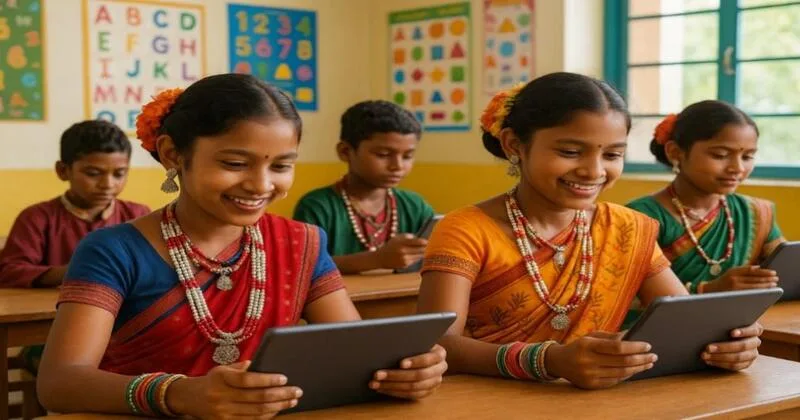
India has always been a vanvasi opportunity land. Deeply rooted in ecological and cultural knowledge, these communities have survived in symbiotic relationships with the natural world and have had practices associated to their surroundings. But for decades, they were nowhere close to being part of the dominant development discourse. The current government, today, fuels much transformation in this narrative. A new era is meant to be dawning wherein vanvasi youth are emerging as visible changemakers, brazenly navigating between the contemporary and the indigenous.
Indeed, this passage is not one of leaving customs behind. Instead, it’s defined by the quite enjoyable and nourishing friction of old-world values with online and business ambitions. With deep roots to culture, tribal youth are stepping into the digital world. They leverage local-language-supporting mobile apps and speak in their local dialects every day. They go to village fairs and perform religious ceremonies, seek higher education and education online, and connect with the outside world through smartphones and laptops powered by solar panels in remote homesteads. It’s not just a declarative statement, but the definition of a tremendous transformation taking place in India’s vanvasi belts, spearheaded by an inclusive-development model.
Some targeted government schemes have aided this trend to construct a robust next generation of tribal youths, from Eklavya Model Residential Schools (EMRS) to Van Dhan Yojana and Digital India expansion in vanvasi areas. Above and beyond infrastructure, these efforts have the compassion to embrace equal opportunity, dignity and confidence. While preserving vanvasi children’s language, culture, and customs, Eklavya schools aim to be among the best academically and bring them the best possible education. Similarly, the Van Dhan Yojana saw vanvasi entrepreneurs increase the value of forest produce and create sustainable community income streams.
Development projects have reached even vanvasi hinterlands due to significant improvements in infrastructure. PMGSY and Bharat Net and its allied digital connectivity initiatives have woven vanvasi hamlets with markets, institutions, and digital networks. These changes were more than just physical modifications since they act as socio-economic spark plugs that allow vanvasi youth to seek dreams once out of reach. By putting solar power next to clean water and digital services, we let people taste what national development feels like in their own bodies.
Education still remains the basis for this transformation. Even the number of vanvasi students appearing for competitive tests like NEET, JEE and UPSC is increasing. The government offers scholarships along with hostels and residential schools to safeguard students from dropping out due to monetary issues. Vanvasi community girls are leading social progress by breaking age-old barriers to become educators and caregivers while spearheading community movements.
Digital empowerment is necessary to accelerate development. Digital transformation has integrated vanvasi youth into full engagement with the knowledge economy due to increasing smartphone access and internet connectivity. Through cyberspace, students gain new skills as they access government subsidies and market folk art and organic produce. Through digital technologies, youthful ethnical entrepreneurs have begun to explore eco-tourism as well as herbal drugs and original agrarian inventions, an important shift from bare survival to independent enterprise.
Besides infrastructure, these programs support opportunity, dignity, and confidence building. The Eklavya schools not only give quality education to tribal children but also keep alive and respect their language, culture, and traditions. The essence of the vanvasi community’s identity and dignity gets a strong reaffirmation through such efforts as the digitalisation of oral traditions, GI tagging tribal products, and vanvasi India exhibitions.
One of the best things happening is that tribal youth are slowly transforming from passive beneficiaries of government schemes into active leaders. Many are returning home to use their technical knowledge and education to improve their villages. They are addressing social issues regarding women’s discrimination, substance abuse problems, as well as children dropping out of school, while highlighting health, education, and human rights. In the establishment of youth groups working together and support circles, they help build strong, self-reliant neighbourhoods. Though problems of inadequate infrastructure, unemployment, and inaccessibility to medical facilities persist, the will for change is very high. The transformation of vanvasi India is not an accident but the result of focused policies, sustained outreach, and growing confidence among the vanvasi population. Schemes that take care of identity on one hand while fostering empowerment have enhanced the cooperation between state and society, particularly in tribal regions. Vanvasi youth have not been cast in an epilogue role post the launch of the Viksit Bharat @2047 vision. They are coming back on board highlights precisely what New India stands for. They are representatives of a nation aspiring to progress yet holding onto their traditional culture, with science at one end and old wisdom at the other. It is their stories of courage, grit and silent, easy strength that made their way of life and statehood.
Vanvasi youth are not just scraping by in contemporary India; they are authoring a story of progress, innovation, and renewal. They are well equipped with the basics and knowledge of technology to finally take charge and contribute to building up India. Their progress is a healthy country’s sound and liberal manifestation, making a pride, hope and unbroken spirit.















Comments