





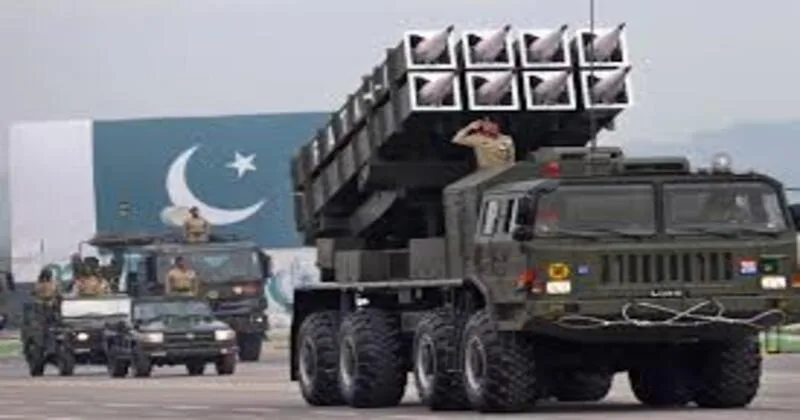
On the eve of Independence Day celebrations on August 13th, Pakistan Prime Minister Shehbaz Sharif announced that the nation is aiming to construct a novel Army Rocket Force Command(ARFC) with the intention of targeting and defeating the enemy side. The affirmation to build ARFC comes from Islamabad in the aftermath of facing freezing backlash and strategic defeat against India during the four-day military conflict in May.
As per the reports, Army Rocket Force will be developed in Pakistan which will be modeled in lines with the China’s People Liberation Army Rocket Force(PLARF) and thereby aims to boost the conventional military capabilities of Pakistan. “The new military force will prove to be a milestone in strengthening the combat capability of Pakistan’s army and will be equipped with modern technology”, said Shehbaz Sharif while unveiling the new military goal of his nation.
Pakistan’s latest goal to strengthen its conventional warfare capabilities seems to be a strategic realization in Islamabad in the aftermath of suffering massive wounds from the missiles and other military technologies of India. During Operation Sindoor, India’s indigenous missiles and air defence systems such as BrahMos, S-400, Akash NG, other drones and loitering munitions evidently outperformed the Pakistani missiles during the critical combat situation, while Islamabad was extremely dependent on China-made PL-15 and other imported missiles.
What is Army Rocket Force Command Centre(ARFC)?
Army Rocket Force Command is a unified, integrated, dedicated and an umbrella command & control centre fostered to maintain and nurture every aspect related to a conventional warfare. In China, People’s Liberation Army Rocket Force(PLARF) is considered as the fourth branch of the People’s Liberation Army(PLA) that plays a crucial role in integrating and managing the vast arsenal of land-based ballistic, hypersonic and cruise missiles meant for both conventional and nuclear warfare domain. PLARF is infact, deemed as a bulwark of Beijing’s strategic deterrence strategy.
The Army Rocket Force of Pakistan will be designed and developed in a very similar fashion to that of China. According to military experts, Pakistan’s ARFC will be leveraged with Chinese assistance and technology as a key missile deployment, maintenance and training unit. The upcoming ARFC in Pakistan might house the apex missiles of the country such as Babur cruise missiles, Shaheen ballistic missile series, Fatah series guided rockets, Chinese supplied systems like the A-100 multiple launch rocket systems etc. The Rocket Force Centre aims at swift and coordinated execution of missiles during combats.
ARFC will basically act as a new corps-level command under the direct control and vigilance of the Army Chief.
Pakistan’s military move: What does it mean for India?
Islamabad’s latest announcement to craft a novel Army Rocket Force Command(ARFC) indeed intends a strong strategic messaging for India. During Operation Sindoor, Pakistani missiles and drones were wrecked and debilitated by the Indian missiles and air defence systems. With its state-of-the-art military technology, India was capable of hitting the nerve centres of Pakistan terror bases and other critical infrastructures in Punjab, Muridke and other places deep inside Pakistani mainland, beyond the vicinity of POJK.
India’s offensive-defensive capabilities might have led to a strategic messaging in Rawalpindi thus stimulating Pakistan to build a new Army Rocket Force and fill the structural deficits in their military system. Moreover, Pakistan with its new ARFC intends to send a strong signal to India regarding its military capabilities.
As per the reports, senior Pakistani security officials said, “ARFC is obviously meant for India”. Any military movement in Pakistan thus evokes strategic alertness in India. India should as well seek to consistently upgrade its military capabilities to thwart any enemy atrocities. In this direction, Prime Minister Narendra Modi during his Independence Day speech sent a strong message to Pakistan and unveiled ‘Mission Sudarshana Chakra’ that aims to expand the Rashtriya Raksha Kavacch, strengthen the national security architecture and shield the strategic public places across the country with multiple layers of defence systems during crucial circumstances.
Moreover, the spiking Islamabad-Beijing military relationship is an alarm for New Delhi. Approximately, 85% of Pakistan’s defence imports are from China, most of which were witnessed during Operation Sindoor. In this backdrop it is imperative for India to be on alert and continuously accelerate its offensive-defensive capabilities.















Comments