





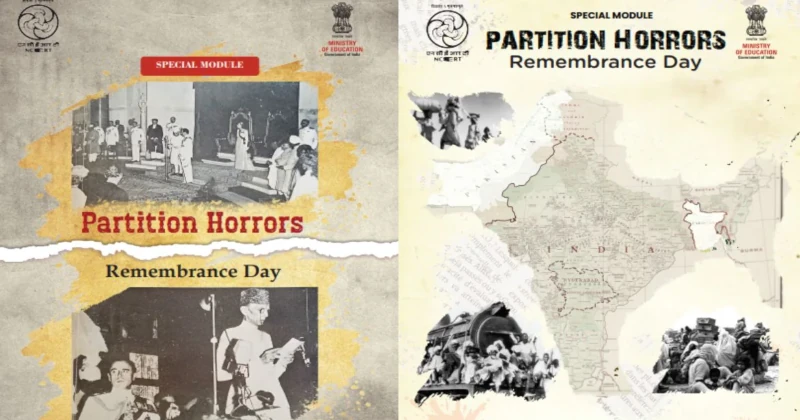
The National Council of Educational Research and Training (NCERT) has released a special module for schools to mark Partition Horrors Remembrance Day. Unlike routine textbook content, this new module — designed separately for Classes 6–8 and 9–12, does not shy away from placing responsibility for India’s bloody Partition in 1947, directly naming Muhammad Ali Jinnah, the Congress leadership, and Lord Mountbatten as the three central actors who brought about the division.
“The Partition of India and the creation of Pakistan were by no means inevitable,” the secondary-stage module states in blunt terms. Instead, it identifies “Jinnah, who demanded it; the Congress, which accepted it; and Mountbatten, who implemented it” as the forces that shaped the tragedy. The middle-stage version for younger students reiterates the same point in simpler language.
Calling Partition an “unprecedented human tragedy, with no parallel in world history,” the modules document the staggering scale of human suffering: nearly 1.5 crore people uprooted, mass killings across Punjab and Bengal, large-scale sexual violence against women, and trains arriving “filled only with corpses, having been slaughtered en route.”
The content does not whitewash pre-Partition communal violence either. It recalls Noakhali and Calcutta (1946), and the Rawalpindi–Thoha–Beval massacres of March 1947, as chilling harbingers of the carnage to come. Jinnah’s infamous “Direct Action Day” of August 1946, which unleashed unprecedented communal bloodshed, is highlighted as the turning point that pushed Nehru and Patel into conceding to Partition. Jinnah’s threat “Either a divided India or a destroyed India” — is cited as coercion that Congress underestimated until it was too late.
The module places the positions of India’s foremost leaders under sharp scrutiny. Gandhi, it notes, remained opposed to Partition but refused to resist the Congress decision through violence. Patel is quoted as saying, “India had become a battlefield and it was better to partition the country than to have a civil war.” Eventually, both Patel and Nehru accepted Partition, with Gandhi himself persuading the Congress Working Committee on June 14, 1947, to formally agree.
While Jinnah and the Congress bear responsibility for demand and acceptance, the NCERT material strongly criticises Lord Mountbatten, Britain’s last Viceroy, for preponing the transfer of power. “Mountbatten had announced June 1948 as the date of transfer of power but later preponed it to August 1947,” the text says. The result, it argues, was chaos on the ground: “In many places, people did not even know by August 15, whether they were in India or Pakistan.”
The module calls this haste “a great act of carelessness” that worsened the tragedy and left millions unprepared for the upheaval.
NCERT’s new modules also connect Partition directly with India’s longest-running national security challenge: Kashmir. “Partition turned Kashmir into a new security problem for the country,” the text says, pointing out how Pakistan has since waged three wars to annexe Kashmir and, after losing, resorted to “exporting jihadist terrorism.” It frames this as a continuing legacy of 1947.
The closing sections of both modules carry a sharp warning: “Shortsightedness in rulers can become a national catastrophe. Giving concessions to violence to gain peace results in whetting the appetite of violence-prone groups.”
The NCERT insists that the purpose of recalling Partition is not merely to relive pain but to learn lessons. The content urges students to recognise the dangers of communal politics and the consequences of weak or hasty leadership, underlining that national welfare must always come before party or personal ambition.












Comments