





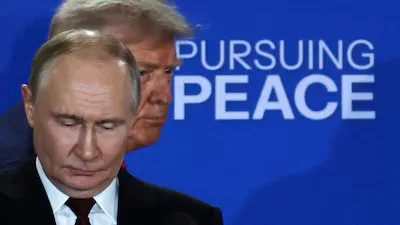
Russian President Vladimir Putin used the backdrop of the Alaska Summit to send a clear diplomatic signal to Ukraine and European nations: Moscow is ready to work toward ending the war, but only if the underlying causes of the conflict are addressed.
Speaking after his over three-hour-long meeting with Trump at a military base in Alaska, Putin described Ukraine as a “brotherly nation” and the war as a “tragedy” for Russia. However, he framed the conflict as stemming from “fundamental threats” to Russia’s security, an apparent reference to NATO’s eastward expansion and calls for Ukraine’s inclusion in the alliance.
“We are sincerely interested in putting an end to it,” Putin said, “but to make the settlement lasting and long-term, we need to eliminate all the primary roots and causes of that conflict.”
He added that peace would require addressing “all legitimate concerns of Russia” and restoring a “just balance of security” in Europe and globally. At the same time, Putin acknowledged that Ukraine’s security must also be guaranteed, echoing Trump’s position during the summit.
Putin confirmed that the agreement reached in Alaska could serve as a step toward ending the conflict. “President Trump said that the security of Ukraine should be ensured as well. We are prepared to welcome that. I hope the agreement will pave the path towards peace in Ukraine,” he stated.
The Russian leader stressed that both sides must take each other’s security concerns seriously to achieve a sustainable settlement.
In a pointed message, Putin told Kyiv and European capitals to act “constructively” and avoid sabotaging any progress.
“We expect that Kyiv and European capitals will perceive that constructively, and they won’t throw a wrench in the works. They will not make any attempts to use some back-room dealings to conduct provocations to torpedo the progress,” Putin cautioned.
The Alaska meeting, which was held in a three-on-three format and ended with a joint press conference without questions, produced no formal treaty but signalled a rare moment of convergence between Washington and Moscow. Both leaders appeared determined to keep communication channels open and to explore a settlement that safeguards Ukraine’s sovereignty while addressing Russia’s long-standing security demands.
Whether European allies and Ukraine will view the Alaska “understanding” as a genuine opportunity for peace or as a political manoeuvre, remains uncertain.














Comments