





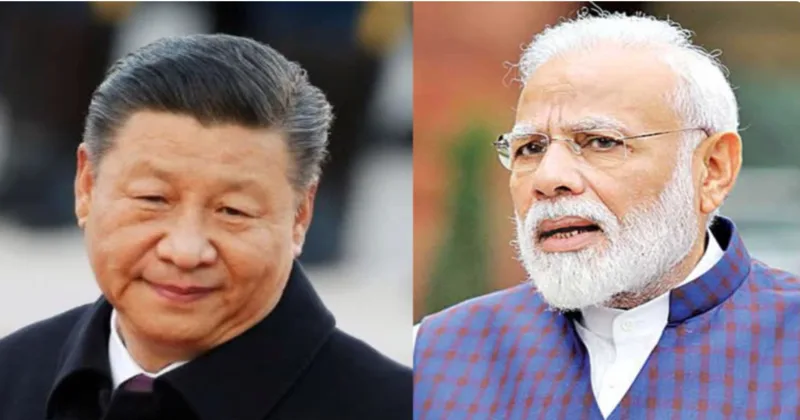
Days after US President Donald Trump doubled tariffs on Indian products, India and China are preparing to work together, sending a fresh message to the global community. If both nations cooperate, they could exert significant influence over the world market. Prime Minister Narendra Modi’s upcoming visit to China is expected to mark a new milestone in bilateral relations, with the Chinese President also likely to visit India soon.
As part of the efforts to strengthen ties, both countries plan to resume trade through the mountain passes connecting them. The move comes against the backdrop of Trump’s policies targeting India and China over their stance on Russian crude oil, creating unease in both countries.
Held detailed talks with Politburo Member and FM Wang Yi in Beijing this evening.
Spoke about the need for a far-seeing approach to bilateral ties and building a stable & constructive relationship.
Incumbent on us to address aspects related to the border, normalizing… pic.twitter.com/8zBRBoaKQE
— Dr. S. Jaishankar (@DrSJaishankar) July 14, 2025
External Affairs Ministry spokesperson Randhir Jaiswal confirmed that India will continue to work with China to resume border trade through the Lipulekh Pass in Uttarakhand, the Shipki La Pass in Himachal Pradesh, and the Nathu La Pass in Sikkim. A high-level meeting will be held next week to address pending border disputes. Chinese Foreign Minister Wang Yi is scheduled to visit India for talks with National Security Advisor Ajit Doval. This will be the first such meeting since the Galwan Valley clash in 2020. Chinese Foreign Ministry spokesperson Lin Jian stated that Beijing remains committed to handling differences appropriately and to strengthening cooperation in multilateral forums such as the Shanghai Cooperation Organization (SCO).
Direct Flights Set to Resume, Reviving Travel, Trade, and Diplomatic Ties
Preparations are also underway for another significant step, resuming direct flights between India and China after a gap of five years. China announced on Thursday that it is in talks with India to restore air traffic at the earliest opportunity. Lin Jian said that both countries are in regular contact to restart direct flights and are working seriously on the matter. He noted that the resumption of flights would facilitate travel, boost trade, and deepen mutual cooperation. He also emphasised that both sides are working to implement agreements reached between their leaders.
The move to restore air connectivity follows the recent meeting between Prime Minister Modi and President Xi Jinping in Kazan, Russia, where both leaders agreed to revive several dialogues and mechanisms. Reports indicate that an official announcement could be made during the SCO summit in Tianjin, scheduled for August 31 to September 1. In related developments, Indian Consul General in Shanghai Prateek Mathur met senior executives of China Eastern Airlines to discuss cooperation in air services and hospitality. Before their suspension in 2020, due to the COVID-19 pandemic and the border clashes in eastern Ladakh, airlines such as China Eastern and Air China operated daily flights to multiple Indian cities, including Delhi. The resumption of flights is expected to encourage greater travel, trade, and people-to-people exchanges, while also reinforcing diplomatic engagement. The long-term aim is to nurture a strong partnership within Asia.
Easing Trade Barriers and High-Level Visits Signal Renewed Strategic Engagement
Trade relations have also been affected in recent years. India imported 5.7 million tonnes of urea during the 2024–2025 financial year, a 20% drop from the previous year. The decline is mainly due to reduced imports from China. In 2023–24, India purchased 1. 87 million tonnes of urea from China, but this fell sharply to 100,000 tonnes in 2024–25. It is in this context that China has begun easing its export restrictions.
Prime Minister Modi will travel to China on August 31 to participate in the SCO summit, where he will also hold bilateral talks with President Xi Jinping. This visit will be Modi’s first to China since 2019. Defence Minister Rajnath Singh, External Affairs Minister S. Jaishankar, and National Security Advisor Ajit Doval have also recently visited China, signalling a coordinated effort to improve ties.
The planned reopening of mountain trade routes, high-level diplomatic engagements, and the restoration of air services indicate a broad-based approach to rebuilding relations between Asia’s two largest economies. The coming weeks, particularly the SCO summit in Tianjin, will be a key moment in determining the pace and scope of this renewed cooperation.










Comments