





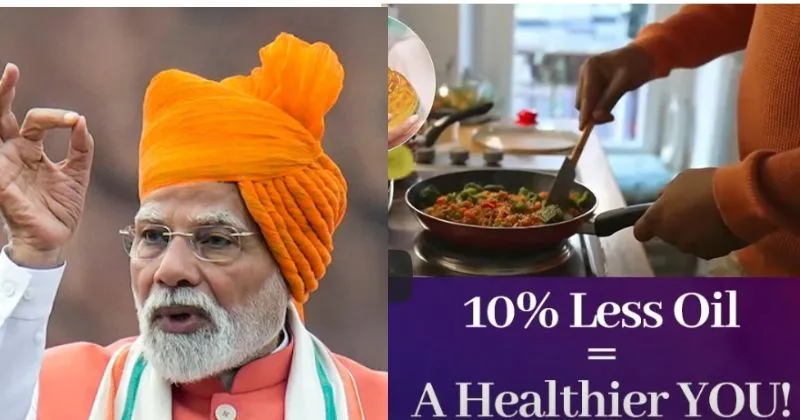
Bharat, celebrating its 79th Independence Day in 2025, the tricolour unfurled over the Red Fort as Prime Minister Narendra Modi took the podium. His speech comprises of vision, resolve and motivation in a 103-minute address, which carried a message that reached beyond politics and policy. During his visionary speech, he spoke about a growing obesity, if it’s left unchecked it could burden Bharat’s future.
“Every family in the country should be concerned,” he said, quoting experts who warn that one in every three persons in the coming years could be obese. The simplified option he offered was a practical solution of buying and using 10% less cooking oil. Thus, he reminded by cutting calories one can reclaim a healthier lifestyle. He also shared “True freedom means freedom from lifestyle diseases.”
A Year-Long National Mission for a Healthier Bharat
Since the beginning of 2025, Prime Minister has been consistently warning the nation about obesity’s dangers, tying it to heart disease, strokes, diabetes and even few forms of cancer. His campaign began in January at the opening of the National Games in Dehradun, where he first appealed to families to trim edible oil usage by 10 per cent. It was not a headline but a sustained message he has repeated and reinforces across multiple platforms.
In March, addressing a large gathering he cited a report that by 2050, nearly 44 crore Bharatiyas could be obese, a number he called “huge and scary.” Again, he linked the solution to personal and collective responsibility. “Buy 10% less oil, cycle more, walk more, exercise regularly,” he urged. It was a cultural shift, a national discipline that could save millions from disease and healthcare costs.
His Mann Ki Baat broadcasts also carried this theme. In one episode, he nominated well-known citizens to spearhead a nationwide awareness drive. The focus remained on simple, doable lifestyle changes with cooking with less oil, eating more traditional foods and making fitness a daily habit.
A Growing Public Health Crisis
According to the World Health Organization (WHO), obesity is defined as abnormal or excessive fat accumulation that presents a risk to health. Globally, between 1990 and 2022, the number of obese children and adolescents (aged 5–19) rose fourfold from 2 per cent to 8 per cent. Adult obesity more than doubled within the same period from 7% to 16%.
The WHO estimates that obesity now causes at least 2.8 million deaths each year worldwide. Many of these are due to cardiovascular diseases, type-2 diabetes, certain cancers (such as breast, colorectal and kidney) and respiratory issues like sleep apnea. Research shows that obesity can reduce life expectancy by up to 8–10 years, depending on the severity.
In Bharat, the National Family Health Survey (NFHS-5, 2019–21) reports that 24 per ecnt of women and 23 per cent of men are overweight or obese. Among age group of 15–49 years, 6.4 per cent of women and 4.0 per cent of men are obese. Among children’s, overweight cases (under 5 years) increased from 2.1 per cent in 2015–16 to 3.4 per cent in 2019–21.
The WHO sets the overweight BMI threshold at 25 and obesity at 30. But in Bharat, recognising its population’s higher vulnerability to metabolic risks sets lower thresholds i.e. overweight at 23 and obesity at 25. With a BMI of 35 or more, is a dangerous category that brings severe health risks.
Obesity Leads to Death
Obesity increases mortality risk by setting off a cascade of related diseases:
Type-2 Diabetes – Overweight is one of the risk factors for insulin resistance, which can lead to organ damage and conditions such as kidney failure.
Some Cancers – The International Agency for Research on Cancer (IARC) has confirmed obesity can cause at least 13 cancers.
Respiratory Complications – A condition like obstructive sleep apnea which decreases oxygen flow while sleeping, pressurizing the brain and heart.
Liver and Digestive Disorders – Non-alcoholic fatty liver disease (NAFLD) has become a major cause of liver failure, it also have direct association with obesity.
The Lancet Public Health study of 2023 concluded that obesity-related conditions account for 5–8% of all deaths in adults globally. In urban Bharat, obesity-related non-communicable diseases are now among the top 10 causes of death.
Policies and Programmes launch by Government
The government strategy against obesity merges the contemporary public health policy with Bharat’s indigenous knowledge of wellness. The Fit India Movement initiated in 2019, has motivated millions of people to incorporate exercise as a part of their daily routine through school certifications, corporate fitness activities and initiatives such as Fit India Sunday on Cycle.
The Ayush Ministry has utilized Ayurveda for the management of obesity through specialist Panchakarma treatments, yoga, diet counselling and herbal remedies. The All-India Institute of Ayurveda (AIIA) in New Delhi has seen approximately 45,000 diabetes and metabolic disorder patients, whereas the Central Council for Research in Ayurvedic Sciences (CCRAS) has established clinical trials proving practices such as Dincharya (daily regimen) and Ritucharya (seasonal regimen) help prevent lifestyle ailments. Prevention is better than cure.
The 10 per cent Oil Rule a Simple but Powerful Start
What makes PM Modi’s message resonate is its simplicity. Asking households to cut oil consumption by 10 per cent is measurable and actionable. It forces a conversation at the kitchen table, not just in policy halls. Reducing oil intake lowers calorie density, improves cardiovascular health and shifts taste preferences towards less oily foods.
The rule suggested by Modiji requires no gym membership, no expensive diet plans and no complex technology.
From the Red Fort to Every Home
By linking the fight against obesity to national pride and collective responsibility, Modiji has elevated the conversation beyond personal fitness. His speeches connect the dots from January’s sports event to March’s report warning to August’s Independence Day appeal by creating a consistent narrative: Bharat’s strength lies in the health of its people.
In the spirit of Atmanirbhar Bharat, reducing obesity is framed as reducing dependence on excessive foreign-processed food, costly healthcare and imported edible oils. It’s about reclaiming Bharat’s own dietary wisdom, from millets to seasonal vegetables and reviving active community life.
The Prime Minister’s call is so timely, that when Bharat is set to lead the world in population size and economic growth, its workforce health will directly shape its productivity, innovation and global influence. Lifestyle diseases like obesity are economic threats as much as medical ones.















Comments