





US President Donald Trump’s use of punitive tariffs and sanctions to compel the comity of nations to play second fiddle to US supremacy is a timely lesson in the historical roots of colonialism and its post-World War II avatar, neo-colonialism. Economy is the substratum of the polity, and it has no intrinsic relationship with capitalism or democracy or free trade or any other liberal dogma. The economy determines a nation’s best interests, but its polity could take myriad forms.
BRICS, according to this writer, is a logical but superior heir to the post-World War II Non-Alignment Movement (NAM), that sought to achieve economic development while avoiding the constraints of dominant power blocs. BRICS is consciously focused on the economic empowerment of member and partner countries; it facilitates trade in local currencies to dodge the rising protectionism in Washington. The New Development Bank and the non-Western cross-border payment system are keys to the rise of a truly multipolar world free from Western diktat. In the face of rising American hostility, it is considering the possibility of a digital currency.
Ostensibly Oil
President Trump expressed anger at India’s purchase of Russian oil and military equipment (the F-35 fighter jet is a universal embarrassment). On July 31, 2025, he imposed 25 per cent tariff on all major Indian exports to the US with effect from August 1, 2025, to correct India’s “unfair” trade practices (high tariffs). But on August 4, he suddenly hiked this to 50 per cent.
The real beef appears to be India’s refusal to compromise the interests of its agriculture sector. Thus, China imports more oil than India and pays only 30 per cent tariffs. Turkey, a NATO member, pays only 15 per cent, as does the European Union, whose trade with Russia ($77.9 bn) was larger than India’s ($68.7bn) in 2024. In Asia, Japan and South Korea pay 15 per cent, while Indonesia pays 19 per cent. Brazil, like India, has been pegged at 50 per cent, because, Trump explained, it has put former president Jair Bolsonaro on trial
India has much to be unhappy about vis-à-vis America. In the past five years, Washington supported the protests against the new farm laws, funded regime-change in Bangladesh, and made overtures to Pakistan. After the gruesome attack on innocent tourists at Pahalgam, Kashmir, Pakistan Army Chief Asim Munir made two trips to Washington. Moreover, President Trump kept claiming credit for the cessation of hostilities, despite clarifications from New Delhi. Finally, Air Chief Marshall Amar Preet Singh revealed that during Operation Sindoor, India shot down five fighter jets and an AWACS aircraft of Pakistan, using the famed Russian S-400 surface-to-air missiles.
Trump justified his actions, stating that India buys huge amounts of Russian Oil, and sells it on the Open Market for handsome profits. He raged that people in Ukraine were being killed by the Russian War Machine. The Ministry of External Affairs responded that India began importing from Russia because traditional supplies were diverted to Europe after the Ukraine conflict began. The US then encouraged imports to stabilize global energy markets.
Washington itself does substantial business with Russia, importing uranium hexafluoride for its nuclear industry, palladium for its EV industry, besides fertilisers and chemicals. Calling the tariffs “unjustified and unreasonable,” the MEA said that India, like any major economy, “will take all necessary measures to safeguard its national interests and economic security.”
Domestically, the Government got wholehearted support from opposition leaders such as Sharad Pawar, Manish Tewari and Karti P Chidambaram (Congress). Former Prime Minister and JD(S) chief, HD Deve Gowda appreciated the government for standing up for farmers. He said, “The firm stand that the Modi government has taken will lead to a national resurgence of an unprecedented scale… A word of caution to some Opposition leaders who have rejoiced the statements of Mr. Trump and have jumped to be his deluded spokespersons in India. I can understand their frustration but they should not harm themselves, and their parties, and end up very soon in the dustbin of history alongside Mr. Trump.” (Aug 01, 2025)
On the positive side, major American brands such as Apple, Google, Dell, and Tesla continue to invest in India. India supplies over 70 per cent of U.S.-bound iPhones, and manufacturing giants like Foxconn are fast expanding under PLI schemes due to India’s skilled manpower and long term alternative to China.
BRICS response
The leading BRICS nations have decided to face Washington’s aggressiveness with the seriousness it deserves. Brazil, Russia, India and China are expected to meet soon. The group will firm up steps to build alternatives in global finance, including a SWIFT alternative; there will be more trade in local currencies; the New Development Bank will be strengthened along with its lending power, and US tariffs will be challenged at the World Trade Organisation (WTO).
India sent National Security Advisor Ajit Doval to Moscow, where he met President Vladimir Putin, accompanied by Sergei Shoigu, Secretary of the Russian Security Council, and Yuri Ushakov, foreign policy aide to the President. The high level delegation reflects the importance Moscow attached to the meeting, which would have discussed the latest developments in Russia-US relations and US-India ties in the context of Trump’s attack on India-Russia trade and military deals.
Doval reputedly finalised the dates for President Putin’s visit to India later this year. The Brazil President and Japan Prime Minister are also coming to New Delhi, and Chinese Foreign Minister Wang Yi is expected around August 20, 2025. Senior Israel government officials have said that Prime Minister Binyamin Netanyahu would like to visit India.
On August 8, 2025, Prime Minister Modi tweeted, “Had a very good and detailed conversation with my friend President Putin. I thanked him for sharing the latest developments on Ukraine. We also reviewed the progress in our bilateral agenda, and reaffirmed our commitment to further deepen the India-Russia Special and Privileged Strategic Partnership. I look forward to hosting President Putin in India later this year.” As the time of this writing, President Putin is due meet President Trump in Alaska on August 15, 2025 to finalise a peace deal with territorial exchanges in Ukraine (vehemently opposed by President Zelensky).
Besides Modi, President Putin also called South African President and Chinese President Xi Jinping. Brazil President Luiz Inacio Lula da Silva telephoned Modi on Aug 07, 2025 and discussed the international economic scenario as US’s unilateral tariffs could potentially hit Brazil and India the most. In the hour-long conversation, Lula mooted greater integration between the two countries and confirmed an official visit to India in 2026. Meanwhile, a delegation led by Vice-President Geraldo Alckmin will visit India to discuss cooperation in trade, defence, energy, critical minerals, health, and digital inclusion. The two countries aim to increase bilateral trade to over US$ 20 billion by 2030 by expanding the scope of the Mercosur agreement with India. The discussion covered virtual payment platforms, namely PIX (Brazil) and UPI (India).
Chinese Foreign Minister Wang Yi expressed his country’s support to Brazil in resisting the bullying imposition of tariffs (Aug 06, 2025). Beijing assured Rio that it would buy any coffee surplus due to US tariffs (Aug 7, 2025) and offered a five-year permit to 183 new Brazilian coffee companies to export to the Chinese market.
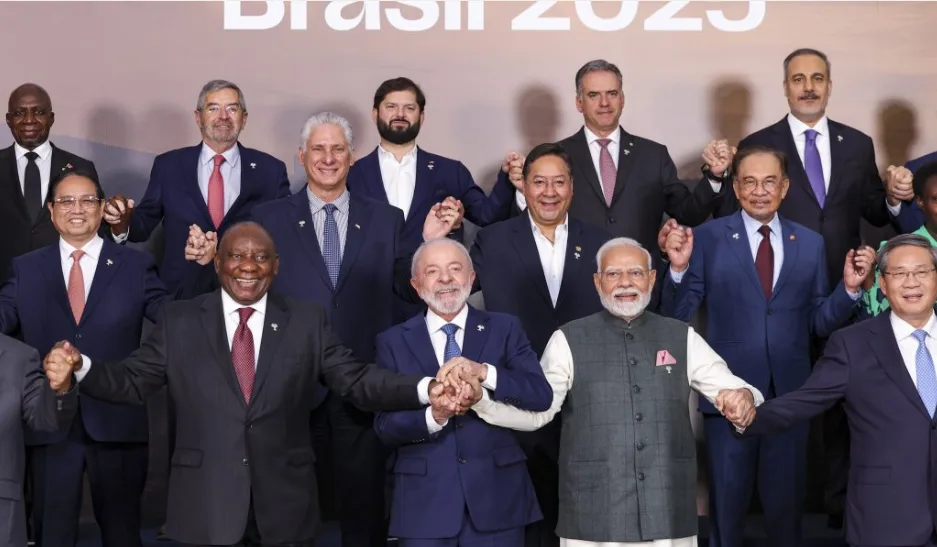
The US tariffs have increased the importance of the BRICS and the SCO in safeguarding and advancing diverse national interests. At the BRICS Summit in Rio de Janeiro in July 2025, the leaders of the 11 largest emerging economies signed a joint declaration expressing concern over the rise of unilateral tariffs and non-tariff measures that distort trade and are inconsistent with WTO rules. Wang Yi warned that higher tariff prices will lower the real wages of workers, and make the economy less productive.
Prime Minister Modi will visit Tianjin, China, for the Shanghai Cooperation Organisation summit (August 31 to September 1, 2025), his first visit after the border clash at Galwan in 2020. Bilaterals are being planned with Chinese President Xi Jinping and Russian President Vladimir Putin. He may visit Japan on August 30, 2025.
At the 16th BRICS Summit in Kazan, Russia, in October 2024, Beijing had agreed to reopen the Kailash Mansarovar pilgrimage which began in June 2025; both countries restored direct flights. Beijing welcomed Moscow’s call for an RIC (Russia-India-China) bloc as a political alternative to the US binary of ‘with us’ or ‘against us’.
Kazan marked a fresh page in bilateral relations. Beginning in June 2025, National Security Advisor Ajit Doval, Defence Minister Rajnath Singh and External Affairs Minister S. Jaishankar have visited China. Both sides have undertaken to not let the border issue hinder bilateral relations. India has restored issuing tourist visa for Chinese citizens travelling to India. The 75th anniversary of the establishment of diplomatic ties is expected to further boost China-India relations.
For the first time since Shah Mohammad Reza Pehlavi visited India in October 1974 and invoked a common Aryan heritage, the Islamic Republic of Iran has commemorated World Sanskrit Day to honour “one of the world’s oldest languages and a pillar of India’s cultural heritage.” In a post on X, Tehran observed, “Sanskrit shares roots with Iranian languages – a reminder of the deep cultural and historical bonds between #India and #Iran. Let’s celebrate and preserve this shared legacy.” (Aug 09, 2025)
Alluding to US President Trump’s peace deal between Azerbaijan and Armenia, Ayatollah Khamenei’s advisor Ali Akbar Velayati asserted on X, “Iran will BLOCK Trump’s Caucasus corridor.” This will not become a Trump-owned corridor, but a graveyard for his mercenaries, he said, warning that the “plan will divide Armenia. No nation agrees to division of its land, even if government unfortunately takes unstable positions.”
Seeking stronger ties with New Delhi amidst Washington’s coercive tariffs, Iranian ambassador to India, Dr. Iraj Elahi urged India to resume purchasing oil from Iran and expand cooperation across strategic sectors. Elahi said Iran is a leading car manufacturer in West Asia and has good potential for joint manufacturing, technology transfer, and distribution.
Dissenting voices
Political scientist John Mearsheimer warned that the US and the West have a heavy dependency on China and Russia for strategic raw materials, military components, and high-production inputs, especially rare earths, titanium, pharmaceuticals, and electronics. Retaliation by BRICS nations could paralyse U.S. production, with cascading effects on the economy and military, and trigger a deep crisis.
Trump’s former National Security Adviser John Bolton said Trump has miscalculated as the tariffs intended to hurt Russia by discouraging India from buying Russian oil could instead “push India closer to Russia and even China.”
Atul Keshap, president of the US-India Business Council, said “I represent 200 of the largest companies in America and India. Let me tell you that they are all nervous… Business doesn’t like uncertainty; it likes predictability. If the US and India can’t agree on a deal that frames the economic relationship and sends a positive psychological message to investors, it is going to very hard to see growth. Both the President and the PM advocated for getting a 500 billion dollar target in annual trade… I think, speaking for the business community – everybody wants to see this drama come to an agreed deal.”
US foreign policy expert Michael Kugelman observed that India appears low in the Trump administration priorities as an ambassador has not been appointed in New Delhi and there is no confirmed assistant secretary of state for South Asia in DC. (Aug 01, 2025)
John Sitilides, diplomacy consultant to the US Department of State, observed that “India is literally one of the most important countries in the world to the United States, certainly from a security perspective.” He warned that the tariff issue could jeopardise Trump’s revitalisation of the Quad network that brought the US, India, Japan and Australia together to limit China’s belligerence in the South China Sea, the Pacific, and the Indian Ocean.
In reality, the Quad lost much of its raison d’être as a wall against China when, in September 2021, Washington forced Australia to cancel its multi-billion-dollar contract with France for a fleet of diesel-electric submarines. Australia was made to accept nuclear-powered submarines (of questionable safety) from the US and the UK as part of the AUKUS security pact. As the submarines would arrive only in 2032, this negates the immediacy of a military threat from China.
More recently, Japan’s Taiyo Oil refinery purchased 600,000 barrels of Sakhalin Blend crude from Russia, to ensure the stability of a plant also supplying Japan with liquefied natural gas (LNG). Amidst reports that Australia is seeking Chinese investments in its economy, the logic of multi-alignment seems to be compelling.










Comments